
All Evaluable Patients Achieved Improvements in Multiple Hallmarks of
MYBPC3-Associated HCM
Benefits Among Cohort 1 Patients Sustained as Far Out as Two Years; Cohort 2 Patients Showed Greater Symptom Relief and Improved Cardiac Function at Earlier Timepoint
TN-201 Granted PRIME Designation by EMA; and Pediatric Indication Accepted into FDA’s Rare Disease Evidence Principles Process
Tenaya Management to Host a Webcast Conference Call to Review Results at 8:00 a.m. ET / 5:00 a.m. PT
SOUTH SAN FRANCISCO, Calif., June 03, 2026 (GLOBE NEWSWIRE) -- Tenaya Therapeutics, Inc. (NASDAQ: TNYA) reported promising new interim safety and efficacy data from the company’s MyPEAK™-1 Phase 1b/2 clinical trial of TN-201. TN-201 is being developed for the potential treatment of MYBPC3-associated hypertrophic cardiomyopathy (HCM), a condition caused by insufficient levels of myosin-binding protein C (MyBP-C).
Data shared today build on previously presented interim results, now with 78-104 weeks of follow-up for the three patients dosed with TN-201 gene therapy at 3E13 vg/kg (Cohort 1), and 26-52 weeks of follow-up for four patients dosed with TN-201 at 6E13 vg/kg (Cohort 2). Among the new findings as of the May 2026 data cut off, the six patients evaluable for efficacy endpoints demonstrated improvements in multiple clinical parameters of disease including echocardiographic measures of hypertrophy, and one or more measures of symptom burden. In addition, three patients, including two from the high-dose cohort, had improvements in exercise capacity by at least one measure.
“It is encouraging to see patients’ symptoms, functional capacity and measures of cardiac hypertrophy - the key feature of their disease - consistently improving in MyPEAK-1. HCM is defined by enlargement of the left ventricle as the heart muscle thickens, so the decreases in mass among all patients following treatment with TN-201 indicate that cardiac remodeling is occurring over time,” said Whit Tingley, M.D., Ph.D., Tenaya’s Chief Medical Officer. “Also noteworthy in this updated dataset is the durability of responses seen in Cohort 1 and early signals that at the higher dose patients are achieving more substantial changes sooner. Taken together, TN-201 is showing increasing evidence of benefit in a patient group with severe disease.
Interim results from the MyPEAK-1 Phase 1b/2 Clinical Trial
The MyPEAK-1 Phase 1b/2 clinical trial is intended to assess the safety and tolerability of a single infusion of TN-201 gene therapy at two dose levels. All patients enrolled in MyPEAK-1 had objectively severe nonobstructive HCM, with pronounced hypertrophy and symptoms of heart failure despite standard of care treatment. Data reported today includes safety results for all seven patients dosed to date, as well as biopsy and efficacy endpoints for six patients (three from each cohort). All patients, other than Patient 5 from Cohort 2, have completed every visit and remain in the trial.
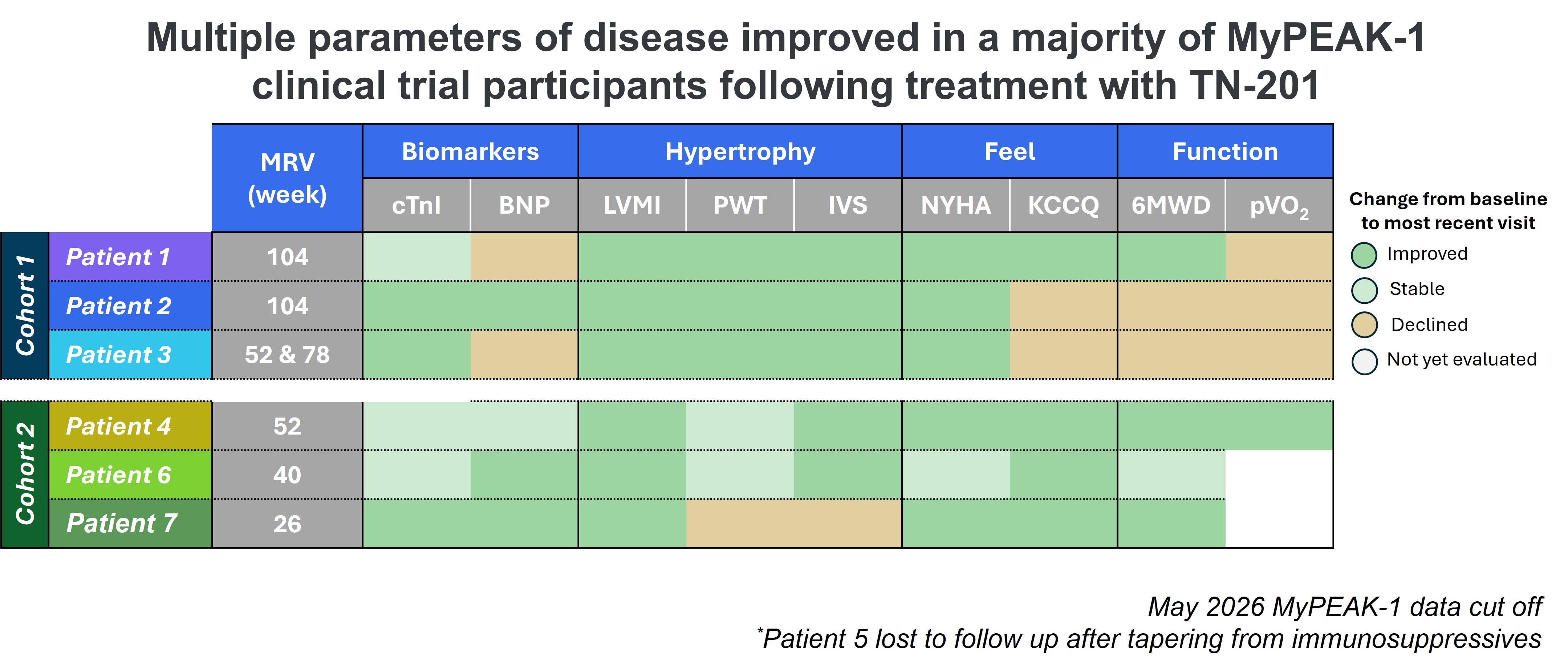
- Treatment with TN-201 has improved multiple clinical parameters of disease in all evaluable patients. While additional follow-up is needed, results suggest that the higher dose of 6E13 vg/kg may result in equivalent or greater clinical benefit at an earlier timepoint post-dose.
- Cardiac troponin, a known risk factor for cardiac-related morbidities or mortality, improved or remained stable in five of six patients and NT-pro BNP, a measure of heart muscle strain, improved in three patients.
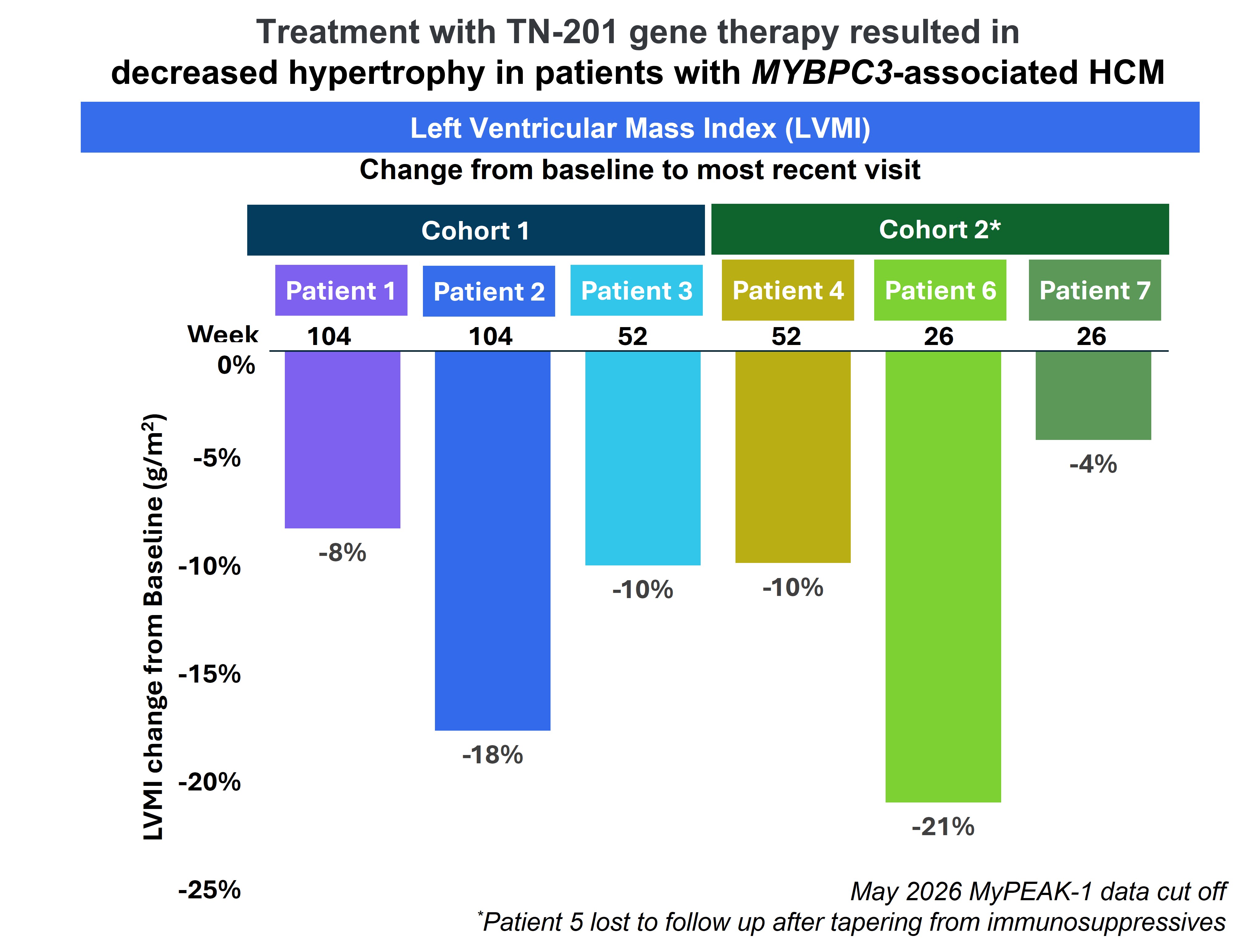
- Echocardiogram measures of left ventricular structure showed decreases in multiple measures of left ventricular hypertrophy, a defining characteristic of HCM.
- All six evaluable patients achieved reductions in left ventricular mass index (LVMI) and five of six demonstrated reductions in one or more measures of wall thickness.
- Decreases in LVMI were durable through two years for the first two Cohort 1 patients.
- Decreases among Cohort 2 patients were observed at an earlier timepoint post-dose compared to Cohort 1 patients.
- Among all six patients, treatment with TN-201 resulted in a lessening of symptom burden as assessed by either New York Heart Association (NYHA) classification, a physician assessment of the impact of heart failure symptoms on activities of daily living, and/or the Kansas City Cardiomyopathy Questionnaire (KCCQ), a validated tool for measuring health status, symptom burden and quality of life among HCM patients.
- NYHA classification improved by at least one class in five of six patients treated with TN-201. All five are now Class I and no longer have heart failure symptoms that interfere with activities of daily living. The sixth patient remained stable as of their most recent visit.
- Four of six patients demonstrated meaningful benefit in symptoms and quality of life, with KCCQ Clinical Summary Scores (KCCQ-CSS) improving by between 12 to 56 points from baseline. A change of ≥5 points in a KCCQ-CSS is considered a clinically important difference
- The three evaluable Cohort 2 patients who received TN-201 at a dose of 6E13 vg/kg. all had improved KCCQ-CSS with a mean increase of 36 points.
- Functional capacity was assessed by six-minute walk test (6MWT) and cardiopulmonary exercise testing (CPET) and improved by at least one of the two measures in three patients.
- Three patients achieved meaningful improvements as measured using 6MWT with changes from baseline ranging from 50-255 meters greater distance at the time of most recent visit. Two of three patients were from Cohort 2.
- An increase of 30 meters is considered clinically meaningful.
- Patient 4 from Cohort 2 also demonstrated clinically meaningful improvement in peak oxygen consumption (pVO2). CPET at one year was not available as of the May 2026 data cut off for the remaining Cohort 2 patients.
- Taken together, these functional improvements in Cohort 2 may be an indicator of dose response.
- Results from serial cardiac biopsies taken at baseline or Week 8 and again post-dose or Week 52 showed that TN-201 DNA transduction and mRNA expression were robust, and MyBP-C protein levels increased by an average of 4% over time.
- Protein level changes were measured using liquid chromatography mass spectrometry (LCMS) normalized to myosin heavy chain (MYH). As of the most recent assessment, MyBP-C levels were shown to increase in four of six patients. Normal variation in expression between individual biopsies is believed to have contributed to smaller differences in the remaining two patients.
- TN-201 was generally well tolerated at both the 3E13 vg/kg and 6E13 vg/kg doses, with no new safety events associated with TN-201 reported since the prior data readout. No dose-limiting toxicities were observed and all patients have tapered off immunosuppressive medicines.
- Adjustments to monitoring and immunosuppression during Cohort 1 resulted in faster tapers and lower cumulative corticosteroid doses in Cohort 2, despite the higher TN-201 dose.
Tenaya continues to enroll adults at the 6E13 vg/kg dose to characterize safety and efficacy observations obtained to date for dose selection. Next steps for the TN-201 development program include sharing additional long-term follow-up data for both dose levels in the second half of 2026. Tenaya is also engaging with regulators to gain alignment on TN-201 pivotal studies.
The company announced today that TN-201 has been granted PRIority MEdicine (PRIME) designation by the European Medicines Agency (EMA) and that TN-201 for the treatment of biallelic pediatric patients with MYBPC3-associated HCM has been accepted to the Rare Disease Evidence Principles (RDEP) process by the US Food and Drug Administration (FDA).
- PRIME designation recognizes the potential of TN-201 to address significant unmet medical needs in patients with MYBPC3-associated HCM and enables the EMA to offer early and proactive support to sponsors in an effort to optimize data generation to accelerate assessment of medicines applications.
- RDEP is a new FDA initiative intended to support the development of therapies for ultra-rare genetic diseases typically affecting fewer than 1,000 patients in the U.S. The process enables early and ongoing collaboration between the FDA and sponsors to align on regulatory strategy, clinical trial design, and innovative approaches to generating evidence needed to support potential approval.
Tenaya plans to provide an update on its efforts with regulators by year end.
Conference Call and Webcast
Tenaya management will host a conference call on Wednesday, June 3, 2026, at 8:00 a.m. ET/5:00 a.m. PT to discuss these interim MyPEAK-1 data. The webcast conference call, including an accompanying slide presentation, can be accessed from the Investor section on the “Events and Presentations” page of the Tenaya website at www.tenayatherapeutics.com.
About the MyPEAK-1 Phase 1b Clinical Trial
The MyPEAK-1 Phase 1b/2 clinical trial (Clinicaltrials.gov ID: NCT05836259) is a multi-center, open-label, dose-escalating (3E13 vg/kg and 6E13 vg/kg) study of symptomatic adults) who have been diagnosed with MYBPC3-associated HCM. MyPEAK-1 is designed to assess the safety, tolerability and clinical efficacy of a one-time intravenous infusion of TN-201 gene replacement therapy. MyPEAK-1 has tested doses of 3E13 vg/kg and 6E13 vg/kg in two cohorts of three patients each and is now enrolling additional patients to receive 6E13 vg/kg in an expansion cohort.
To learn more about gene therapy for HCM and participation in the MyPEAK-1 study, please visit HCMStudies.com.
About MYBPC3-Associated Hypertrophic Cardiomyopathy (HCM)
Variants in the Myosin Binding Protein C3 (MYBPC3) gene are the most common genetic cause of hypertrophic cardiomyopathy (HCM), accounting for approximately 20% of the overall HCM population, or 120,000 patients, in the United States alone. MYBPC3-associated HCM is a severe and progressive condition affecting adults, teens, children and infants. Mutations of the MYBPC3 gene result in insufficient expression of a protein, called MyBP-C, needed to regulate heart contraction. The heart becomes hypercontractile and the left ventricle thickens, resulting in symptoms such as chest pain, shortness of breath, palpitations and fainting. Patients whose disease is caused by MYBPC3 mutations are more likely than those with non-genetic forms of HCM to experience earlier disease onset and have high rates of serious outcomes, including heart failure symptoms, arrhythmias, stroke and sudden cardiac arrest or death. There are currently no approved therapeutics that address the underlying genetic cause of HCM.
About TN-201
TN-201 is an adeno-associated virus serotype 9 (AAV9)-based gene therapy designed to address the underlying cause of MYBPC3-associated hypertrophic cardiomyopathy (HCM) by delivering a working MYBPC3 gene to heart muscle cells via a single intravenous infusion and thereby increasing insufficient MyBP-C protein levels with the aim of halting or even reversing disease after a single dose. The U.S. Food and Drug Administration has granted TN-201 Fast Track, Orphan Drug and Rare Pediatric Drug Designations, and has accepted TN-201 for biallelic pediatric patients into the Rare Disease Evidence Principles (RDEP) process. TN-201 has also received orphan medicinal product and PRIME designation from the European Commission.
About Tenaya Therapeutics
Tenaya Therapeutics is a clinical-stage biotechnology company committed to a bold mission: to discover, develop and deliver potentially curative therapies that address the underlying drivers of heart disease. Tenaya’s pipeline includes clinical-stage candidates TN-201, a gene therapy for MYBPC3-associated hypertrophic cardiomyopathy (HCM); TN-401, a gene therapy for PKP2-associated arrhythmogenic right ventricular cardiomyopathy (ARVC); and TN-301, a highly specific small molecule HDAC6 inhibitor with broad potential clinical utility in cardiac, metabolic and muscular conditions, including heart failure with preserved ejection fraction (HFpEF) and Duchenne muscular dystrophy (DMD). Tenaya has employed a suite of integrated internal capabilities including modality agnostic target discovery and validation, to generate a portfolio of novel medicines based on genetic insights, aimed at the treatment of both rare genetic disorders and more prevalent heart conditions. For more information, visit www.tenayatherapeutics.com.
Forward-Looking Statements
This press release contains forward-looking statements as that term is defined in Section 27A of the Securities Act of 1933 and Section 21E of the Securities Exchange Act of 1934. Statements in this press release that are not purely historical are forward-looking statements. Words such as “planned,” “potential,” “will,” and similar expressions are intended to identify forward-looking statements. Such forward-looking statements include, among other things, the potential advantages of TN-201; clinical outcomes, which may materially change as patient enrollment continues or more patient data become available; the potential for higher doses to result in equivalent or greater clinical benefit at an earlier timepoint post-dose; the timing and content of the MyPEAK-1 data presentation and related conference call; timing and content of additional data from the MyPEAK-1 trial; plans to pursue regulatory alignment on pivotal trial plans and the timing of updates on the Company’s regulatory efforts; and statements by Tenaya’s Chief Medical Officer. The forward-looking statements contained herein are based upon Tenaya’s current expectations and involve assumptions that may never materialize or may prove to be incorrect. These forward-looking statements are neither promises nor guarantees and are subject to a variety of risks and uncertainties, including but not limited to: availability of data at the referenced times; the timing and progress of MyPEAK-1 and Tenaya’s other ongoing clinical trials; the potential failure of Tenaya’s product candidates to demonstrate safety and/or efficacy in clinical testing; changes in Tenaya’s plans to develop and commercialize its product candidates; the potential for any clinical trial results to differ from preclinical, interim, preliminary, topline or expected results; risks associated with the process of discovering, developing and commercializing therapies that are safe and effective for use as human therapeutics; Tenaya’s ability to develop, initiate or complete preclinical studies and clinical trials, and obtain approvals, for any of its product candidates; Tenaya’s continuing compliance with applicable legal and regulatory requirements; Tenaya’s ability to raise any additional funding it will need to continue to pursue its business and product development plans; Tenaya’s reliance on third parties; Tenaya’s manufacturing, commercialization and marketing capabilities and strategy; the loss of key scientific or management personnel; competition in the industry in which Tenaya operates; Tenaya’s ability to obtain and maintain intellectual property protection for its product candidates; general economic and market conditions; and other risks. Information regarding the foregoing and additional risks may be found in the section entitled “Risk Factors” in Tenaya’s Quarterly Report on Form 10-Q for the quarter ended March 31, 2026, and future documents that Tenaya files from time to time with the Securities and Exchange Commission. These forward-looking statements are made as of the date of this press release, and Tenaya assumes no obligation to update or revise any forward-looking statements, whether as a result of new information, future events or otherwise, except as required by law.
Tenaya Contacts
Michelle Corral
VP, Corporate Communications and Investor Relations
IR@tenayathera.com
Investors
Anne-Marie Fields
Precision AQ
annemarie.fields@precisionaq.com
Media
Wendy Ryan
Ten Bridge Communications
wendy@tenbridgecommunications.com
Photos accompanying this announcement are available at:
https://www.globenewswire.com/NewsRoom/AttachmentNg/1b8d2461-429c-4e3e-821f-13ad463ef24c
https://www.globenewswire.com/NewsRoom/AttachmentNg/0e4abc48-f1a1-4cad-9273-137ff74bfb1a


