
WASHINGTON, Jan. 20, 2026 /PRNewswire/ -- The U.S. Food and Drug Administration (FDA) has issued new draft guidance modernizing statistical methodologies used in clinical trials, formally recognizing Bayesian approaches that align with the long-standing scientific framework developed and advanced by Professor Sarfaraz K. Niazi, PhD, for evaluating drug and biosimilar efficacy without redundant clinical studies.
The FDA's guidance, "Use of Bayesian Methodology in Clinical Trials of Drug and Biological Products," marks a pivotal regulatory shift toward probabilistic, evidence-integrated decision-making and away from rigid reliance on comparative clinical efficacy trials that have repeatedly proven to be statistically insensitive and ethically unnecessary.
This regulatory action follows years of peer-reviewed scientific contributions, formal advisory submissions, and a petition submitted by Professor Niazi on August 15, 2024, urging the FDA to adopt Bayesian statistical frameworks to judge the necessity of clinical efficacy studies—particularly in biosimilar development. The petition documented why traditional equivalence trials cannot meaningfully discriminate between biologically similar products and often add cost without improving safety or efficacy assessment.
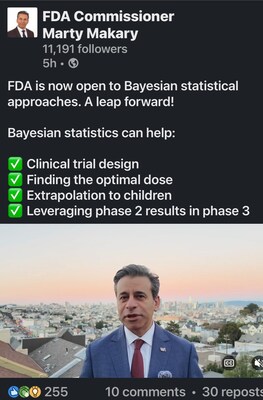
On January 14, 2026, the FDA issued draft guidance reflecting these principles, acknowledging Bayesian methodologies as appropriate tools for clinical trial design, dose optimization, population extrapolation, and leveraging prior evidence across development phases. ((Source: FDA press announcement, January 2026)
The FDA's decision provides regulatory confirmation of Professor Niazi's earlier scientific conclusions that comparative clinical efficacy studies of biosimilars are fundamentally flawed. These conclusions were previously published in leading peer-reviewed journals and supported by extensive analyses of historical biosimilar approvals, none of which have failed clinical efficacy testing despite thousands of enrolled subjects.
Notably, the FDA had earlier removed routine requirements for clinical efficacy testing of biosimilars, granting approvals under this revised paradigm—an approach first applied following scientific justification provided by Professor Niazi. The new Bayesian guidance now supplies the formal statistical foundation for that policy, offering final regulatory validation of the scientific rationale underlying those decisions.
Professor Niazi's peer-reviewed publications central to this policy evolution include:
- Niazi SK. Scientific Justification and Policy Recommendations to the US Food and Drug Administration for Waiving Comparative Efficacy Studies. Pharmaceuticals. 2025;18(6):779. https://doi.org/10.3390/ph18060779
- Niazi S. Scientific Rationale for Waiving Clinical Efficacy Testing of Biosimilars. Drug Design, Development and Therapy. 2022;16:2803–2815. doi:10.2147/DDDT.S378813
These publications demonstrated, using Bayesian probability modeling and regulatory trial data, that equivalence-based efficacy trials have a high probability of success regardless of true clinical difference, rendering them unsuitable as decision tools and inconsistent with ethical standards against unnecessary human experimentation.
The FDA's adoption of Bayesian methodologies is expected to substantially reduce drug development costs, accelerate patient access to affordable therapies, and reinforce ethical compliance by eliminating redundant clinical testing. Industry estimates suggest that eliminating unnecessary late-stage efficacy trials could reduce biosimilar development costs by more than 70%.
"The FDA's guidance confirms what the science has shown for years," said Professor Niazi. "Bayesian inference allows regulators to ask the correct question—not whether two products appear equivalent in an underpowered trial, but what the totality of evidence tells us about safety, efficacy, and uncertainty."
The draft guidance is now open for public comment and is expected to influence global regulatory harmonization, as international agencies typically align with FDA scientific policy.
References
- FDA. FDA Issues Guidance Modernizing Statistical Methods for Clinical Trials. January 2026. https://www.fda.gov/news-events/press-announcements/fda-issues-guidance-modernizing-statistical-methods-clinical-trials
- Niazi SK. Scientific Justification and Policy Recommendations to the US Food and Drug Administration for Waiving Comparative Efficacy Studies. Pharmaceuticals. 2025;18(6):779.
- Niazi S. Scientific Rationale for Waiving Clinical Efficacy Testing of Biosimilars. Drug Des Devel Ther. 2022;16:2803–2815.
Media Contact:
Sarfaraz K. Niazi
University of Illinois
312-297-0000
 View original content to download multimedia:https://www.prnewswire.com/news-releases/professor-sarfaraz-niazis-scientific-framework-adopted-as-fda-modernizes-clinical-trial-evaluation-through-bayesian-methods-302663658.html
SOURCE Professor Sarfaraz K. Niazi


