
- Phase 1b study in atopic dermatitis demonstrated a statistically significant mean reduction of 2.1 years in measured skin epigenetic age after four weeks of treatment with RLS-1496 (p=0.032), with reductions of up to 11.7 years observed in a best responder one month after treatment ended
- Clinical and translational findings demonstrated improvements in collagen production, inflammatory signaling and molecular markers associated with cellular aging in both skin tissue and plasma
- Additional Phase 1b/2a actinic keratosis data support dual SenoAdaptive mechanism; Phase 2a androgenetic alopecia study planned to initiate in October
MOUNTAIN VIEW, Calif.--(BUSINESS WIRE)--#biotech--Rubedo Life Sciences, a clinical-stage biotechnology company developing therapeutics that rejuvenate cellular functions disrupted by aging, today announced new Phase 1b clinical findings for RLS-1496, its lead investigational GPX4 modulator.
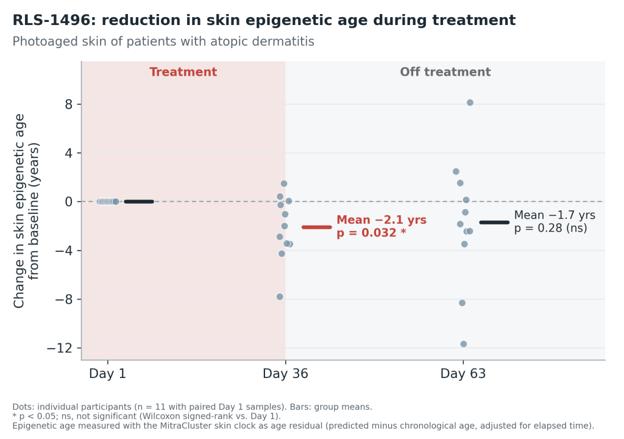

In patients with atopic dermatitis, four weeks of topical treatment with RLS-1496 resulted in a statistically significant mean 2.1-year reduction in measured skin epigenetic age (p-0.032) across 11 paired photoaged skin samples, accompanied by changes in DNA methylation associated with aging. In a best responder, a reduction of 11.7 years was observed at Day 63, approximately one month after treatment ended.
Clinical and translational analyses also demonstrated improvements in markers of collagen production, inflammatory signaling and cellular aging. Blood proteomics showed reductions in circulating inflammatory biomarkers despite undetectable systemic exposure of RLS-1496 in the majority of subjects, providing preliminary evidence that local GPX4 modulation may influence systemic inflammatory pathways.
Separately, additional Phase 1b/2a clinical data in patients with actinic keratosis (AK) provided evidence supporting RLS-1496's dual SenoAdaptive mechanism of action, designed to selectively eliminate pathological senescent cells while restoring cellular function through redox modulation.
The atopic dermatitis results were presented at the Aging Research and Drug Discovery (ARDD) conference in Boston on October 2. Clinical findings from the AK program were presented in a late-breaking presentation at the European Academy of Dermatology and Venereology (EADV) Congress in Vienna, Austria on the same day.
"These findings represent an important milestone in translating the biology of cellular aging into potential therapies for age-related diseases," said Frederick Beddingfield, M.D., Ph.D., Chief Executive Officer of Rubedo Life Sciences. "In addition to meeting primary clinical endpoints, we demonstrated changes in epigenetic aging markers in a human clinical study alongside evidence of selective senescent cell clearance, restoration of cellular function and reductions in circulating biomarkers of systemic inflammation following topical treatment, despite undetectable systemic exposure in most subjects. These findings reinforce the potential of our SenoAdaptive approach to target underlying disease biology and support its potential application beyond dermatology into immunology and inflammation.”
Rubedo also plans to initiate a Phase 2a study of RLS-1496 in androgenetic alopecia in October.
Phase 1b Clinical Data Demonstrate Reduction in Skin Epigenetic Age and Circulating Inflammatory Biomarkers in Atopic Dermatitis
In Rubedo's Phase 1b clinical study of RLS-1496 in photoaged skin of patients with atopic dermatitis, epigenetic clock analyses performed by an independent laboratory demonstrated a statistically significant reduction in measured skin epigenetic age following four weeks of treatment with RLS-1496.
Across 11 paired samples, the mean difference between Day 36 and baseline was -2.1 years (p=0.032), as measured using the MitraBio aging clock. Individual reductions of up to eight years were observed at Day 36, with a reduction of 11.7 years observed in a best responder at Day 63, approximately one month after treatment ended.
These findings were accompanied by DNA methylation changes that moved in the opposite direction of patterns associated with skin aging. Additional molecular analyses identified enrichment of pathways in hypermethylated regions at Day 63 compared with baseline, including pathways associated with cellular senescence, cellular stress responses and redox regulation. This provides preliminary evidence that pharmacological modulation of GPX4 may influence molecular signatures associated with biological aging.
Analyses of skin biopsies from the same patients also demonstrated molecular evidence of reduced senescence-associated signatures and inflammatory signaling, together with improvements in extracellular matrix biology. Histological analysis showed a 10% increase in type III collagen fibers.
Blood proteomics analysis demonstrated reductions in circulating inflammatory biomarkers following topical treatment. CCL22, a chemokine associated with atopic dermatitis disease severity, was among the most reduced biomarkers. These data suggest potential for GPX4 modulation to serve as a novel mechanism in the treatment of systemic inflammation beyond dermatology.
"These clinical findings provide important evidence that pharmacological targeting of cellular aging and senescence may influence molecular processes associated with biological aging," said Marco Quarta, Ph.D., Co-Founder and Chief Scientific Officer of Rubedo Life Sciences. "The observed changes in epigenetic age, together with age-associated DNA demethylation and improvements in cellular and tissue-level biomarkers, support our hypothesis that selectively removing pathological senescent cells while restoring the function of stressed cells may offer a new approach to treating age-related diseases and inflammaging."
Phase 1b/2a Actinic Keratosis Data Support Dual SenoAdaptive Mechanism of Action
At EADV 2026, Rubedo presented additional findings from its Phase 1b/2a clinical study of RLS-1496 in patients with actinic keratosis, providing evidence supporting the compound's dual mechanism of action. RLS-1496 is designed to selectively eliminate pathological senescent cells through ferroptosis, a form of regulated cell death, while promoting restoration of redox balance and cellular function in stressed, non-senescent cells.
Clinical and translational analyses demonstrated GPX4 target engagement in patient skin biopsies. Additional spatial transcriptomic and proteomic analyses showed upregulation of NRF2 and oxidative stress response pathways in non-senescent cells, alongside reductions in inflammatory and immune signaling consistent with cellular senescence across multiple skin cell populations.
Together, these findings provide evidence supporting RLS-1496's ability to target pathological senescent cells while promoting restoration of cellular function in surrounding tissue.
Final clinical results also showed a mean 49% reduction in AK lesions across all 22 patients following 28 days of treatment, improving upon the previously reported interim mean reduction of 46%. RLS-1496 was reported to be well tolerated, with minimal to no irritation observed in treated patients.
About RLS-1496
RLS-1496 is Rubedo's lead investigational SenoAdaptive medicine and a first-in-class topical GPX4 modulator designed to selectively target pathological senescent cells while restoring cellular function in stressed, non-senescent cells. The compound was discovered using Rubedo's proprietary ALEMBIC platform, which integrates artificial intelligence and single-cell multiomics to identify disease-driving senescent cell populations and novel therapeutic targets. RLS-1496 was previously evaluated in Phase 1b and Phase 1b/2a clinical studies across multiple dermatologic indications, including atopic dermatitis, psoriasis, actinic keratosis and photoaged skin.
About Rubedo Life Sciences
Rubedo Life Sciences is a clinical-stage biotechnology company developing a new generation of medicines designed to selectively target pathological senescent cells that contribute to chronic and age-related diseases. Through its proprietary ALEMBIC AI-enabled drug discovery platform, Rubedo identifies disease-driving senescent cell populations and develops targeted SenoAdaptive therapeutics designed to eliminate pathological cells while preserving and restoring healthy cellular function. Its lead program, RLS-1496, is a first-in-class GPX4 modulator in clinical development for dermatologic indications. For more information, visit www.rubedolife.com.
Contacts
Investor Contact
Ami Bavishi or Nick Colangelo
Gilmartin Group
rubedo@gilmartinir.com
Media Contact
Kimberly Ha
KKH Advisors
917-291-5744
kimberly.ha@kkhadvisors.com


