
- Approval is based on unprecedented Phase 3 data showing statistically significant improvements in progression-free and overall survival versus standard of care regimens1
- This immunotherapy doublet regimen demonstrated durable disease control as early as second line, with more than 90% of patients who were progression-free at six months remaining progression-free at three years1
BEERSE, BELGIUM, Aug. 21, 2026 (GLOBE NEWSWIRE) -- Johnson & Johnson today announced that the European Commission (EC) has approved an indication extension for TECVAYLI® (teclistamab) in combination with daratumumab for the treatment of adults with relapsed or refractory multiple myeloma (RRMM) who have received at least one prior therapy. The approval introduces a new treatment option as early as second line for patients living with RRMM.
Complementary mechanisms of action underpin this immunotherapy doublet
Teclistamab and daratumumab work in a complementary manner, with daratumumab modulating the immune system to enhance T-cell fitness and activation, thereby amplifying teclistamab-mediated killing of myeloma cells.1,2
Expert and company perspectives on advancing the standard of care in RRMM
“Patients with relapsed or refractory multiple myeloma often experience shorter remissions and diminishing responses with each subsequent line of therapy, making earlier access to the most effective treatments increasingly important,” said María-Victoria Mateos, M.D., Director of the Myeloma Unit at the University Hospital of Salamanca, Spain. “Today’s approval of teclistamab in combination with daratumumab marks an important advance by providing physicians with an off-the-shelf, steroid-sparing, immunotherapy option that has demonstrated meaningful improvements in progression-free and overall survival, with the potential to redefine treatment expectations as early as second line.”
"This new indication for teclistamab plus daratumumab brings forward a new standard of care for patients in Europe living with relapsed or refractory multiple myeloma," said Ester in 't Groen, EMEA Therapeutic Area Head, Haematology, Johnson & Johnson. "By combining the complementary mechanisms of teclistamab, a BCMAxCD3 bispecific antibody, with daratumumab, a well-established standard of care that helps modulate the immune system, we can deliver meaningful long-term outcomes earlier in the treatment journey, where they have the greatest opportunity to influence the disease trajectory and redefine expectations for patients.”
“Today’s approval reflects our ongoing commitment to addressing the diverse needs of patients with multiple myeloma, giving them more options at every stage of their disease,” said Yusri Elsayed, M.D., M.H.Sc., Ph.D., Global Therapeutic Area Head, Oncology, Johnson & Johnson. “By continuing to invest in scientific innovation and practice-changing research, we aim to redefine what is possible for patients today, while moving closer to a future where long-term disease control, and ultimately cure, becomes an achievable goal."
Unprecedented Phase 3 study data demonstrate significant survival benefits versus standard of care, representing a potential new benchmark in RRMM
The EC approval is supported by data from the Phase 3 MajesTEC-3 study (NCT05083169), which evaluated the efficacy and safety of teclistamab plus daratumumab subcutaneous (SC) formulation versus investigator’s choice of daratumumab SC and dexamethasone with either pomalidomide or bortezomib (DPd/DVd) in patients with RRMM who have received 1–3 prior lines of therapy.3
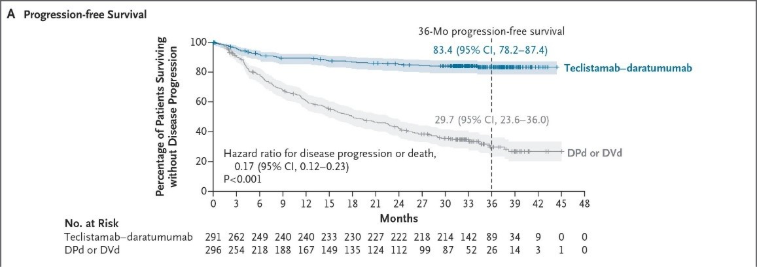
Source: Costa L, et al. Teclistamab plus Daratumumab in Relapsed or Refractory Multiple Myeloma. The New England Journal of Medicine 2025; Full article and supplementary material. Available at: https://www.nejm.org/doi/full/10.1056/NEJMoa2514663. Last accessed: August 2026.
The study demonstrated clinically meaningful and statistically significant improvements in both progression-free survival (PFS) and overall survival (OS).1 At nearly three years of follow-up, teclistamab plus daratumumab SC reduced the risk of disease progression or death by 83.4% compared to standard of care (hazard ratio [HR], 0.17; 95% confidence interval [CI], 0.12-0.23; p<0.001).1 More than 90% of patients who remained progression-free at six months (n=249) remained progression-free at three years, highlighting the durability of response observed with this regimen.1 OS favoured teclistamab plus daratumumab SC (HR, 0.46; 95% CI, 0.32-0.65; p<0.0001), with treatment benefit observed across all prespecified subgroups.1,2 At three years, OS rates were 83.3% for the combination compared with 65.0% for standard of care.1
Teclistamab combination demonstrated manageable safety profile
The safety profile of teclistamab plus daratumumab SC was consistent with the well-known profiles of the individual therapies and no new safety signals were identified.1,4,5 All cases of cytokine release syndrome were Grade 1/2 and did not lead to treatment discontinuation.1 Cytopenia and infection were the most commonly observed Grade 3/4 treatment-emergent adverse events (TEAEs).1 Treatment discontinuations due to TEAEs were low and occurred at similar rates between study arms (4.6% [teclistamab] vs. 5.5% [DPd/DVd]).1
About the MajesTEC-3 Study
MajesTEC-3 (NCT05083169) is an ongoing, Phase 3 randomised study evaluating the safety and efficacy of teclistamab plus daratumumab subcutaneous (SC) (n=291) versus investigator’s choice of daratumumab SC and dexamethasone with either pomalidomide or bortezomib (n=296) (DPd/DVd) in patients with relapsed/refractory multiple myeloma (RRMM) who have received 1–3 prior lines of therapy.1,3 The primary endpoint is progression-free survival (PFS) and secondary endpoints include complete response or better (≥CR), overall response rate (ORR), minimal residual disease (MRD) negativity (10⁻⁵ by next-generation sequencing), overall survival (OS), time to worsening of symptoms (MySIm-Q), and safety.3 The MajesTEC-3 study is a part of the MajesTEC clinical programme, which includes exploring the potential of teclistamab as a combination regimen.3
About Teclistamab
Teclistamab received European Commission (EC) approval in August 2022 for the treatment of patients with RRMM who have received at least three prior therapies, including an immunomodulatory agent, a proteasome inhibitor, and an anti-CD38 antibody, and have demonstrated disease progression on the last therapy.6 In August 2023, the EC approved a Type II variation application for teclistamab, providing the option for a reduced dosing frequency of 1.5mg/kg every two weeks in patients who have achieved a complete response (CR) or better for a minimum of six months.7
Teclistamab is an off-the-shelf (or ready-to-use) bispecific antibody.4,8 Teclistamab, a subcutaneous injection, redirects T-cells through two cellular targets (BCMA and CD3) to activate the body’s immune system to fight cancer.1,5 Teclistamab is currently being evaluated in several combination studies.4,9,10,11
To date, more than 30,700 patients have been treated worldwide with teclistamab.12
For a full list of adverse events and information on dosage and administration, contraindications and other precautions when using teclistamab, please refer to the Summary of Product Characteristics at: https://www.ema.europa.eu/en/documents/product-information/tecvayli-epar-product-information_en.pdf.
▼ In line with EMA regulations for new medicines and those given conditional approval, teclistamab is subject to additional monitoring.4
About Daratumumab and Daratumumab SC
Johnson & Johnson is committed to exploring the potential of daratumumab for patients with multiple myeloma across the spectrum of the disease.
In August 2012, Janssen Biotech, Inc., a Johnson & Johnson company, and Genmab A/S entered a worldwide agreement, which granted Johnson & Johnson an exclusive licence to develop, manufacture and commercialise daratumumab. Since launch, daratumumab has become a foundational therapy in the treatment of multiple myeloma, having been used in the treatment of more than 830,000 patients worldwide.13 Daratumumab was the first CD38-directed antibody approved to be given subcutaneously to treat patients with multiple myeloma.5,14 Daratumumab SC was also the first oncology injectable approved for administration by patients living with multiple myeloma or their caregivers from the fifth dose, if determined to be appropriate by their healthcare professional and following proper training.5,15 Daratumumab SC is co-formulated with recombinant human hyaluronidase PH20 (rHuPH20), Halozyme's ENHANZE® drug delivery technology.5
CD38 is a surface protein that is present in high numbers on multiple myeloma cells, regardless of the stage of disease.5,16 Daratumumab binds to CD38 and inhibits tumour cell growth causing myeloma cell death.5 Daratumumab may also have an effect on normal cells.5 Data across ten Phase 3 clinical trials, in both the frontline and relapsed settings across all newly diagnosed multiple myeloma patients, have shown that daratumumab-based regimens resulted in significant improvement in progression-free survival and/or overall survival.17,18,19,20,21,22,23,24,25,26
For further information on daratumumab, please see the Summary of Product Characteristics at: https://www.ema.europa.eu/en/documents/product-information/darzalex-epar-product-information_en.pdf.
About Multiple Myeloma
Multiple myeloma is a complex blood cancer that affects a type of white blood cell called plasma cells, which are found in the bone marrow.27,28 In multiple myeloma, these malignant plasma cells continue to proliferate, accumulating in the body and crowding out normal blood cells, as well as often causing bone destruction and other serious complications.29,30 In the European Union, it is estimated that more than 35,000 people were diagnosed with multiple myeloma in 2024, and more than 21,900 patients died.31 Patients living with multiple myeloma experience relapses which become more frequent with each line of therapy, while remissions become progressively shorter.32,33,34 Whilst some patients with multiple myeloma initially have no symptoms, others can have common signs and symptoms of the disease, which can include bone fracture or pain, low red blood cell counts, fatigue, high calcium levels, infections, or kidney damage.35
About Johnson & Johnson
At Johnson & Johnson, we believe health is everything. Our strength in healthcare innovation empowers us to build a world where complex diseases are prevented, treated, and cured, where treatments are smarter and less invasive, and solutions are personal. Through our expertise in Innovative Medicine and MedTech, we are uniquely positioned to innovate across the full spectrum of healthcare solutions today to deliver the breakthroughs of tomorrow, and profoundly impact health for humanity.
Learn more at https://www.jnj.com/innovativemedicine/emea/. Follow us at www.linkedin.com/company/jnj-innovative-medicine-emea.
Cautions Concerning Forward-Looking Statements
This press release contains “forward-looking statements” as defined in the Private Securities Litigation Reform Act of 1995 regarding product development and the potential benefits and treatment impact of teclistamab and daratumumab. The reader is cautioned not to rely on these forward-looking statements. These statements are based on current expectations of future events. If underlying assumptions prove inaccurate or known or unknown risks or uncertainties materialise, actual results could vary materially from the expectations and projections of Johnson & Johnson. Risks and uncertainties include, but are not limited to: challenges and uncertainties inherent in product research and development, including the uncertainty of clinical success and of obtaining regulatory approvals; uncertainty of commercial success; competition, including technological advances, new products and patents attained by competitors; challenges to patents; changes in behaviour and spending patterns of purchasers of health care products and services; changes to applicable laws and regulations, including global health care reforms; and trends toward health care cost containment. A further list and descriptions of these risks, uncertainties and other factors can be found in Johnson & Johnson’s most recent Annual Report on Form 10-K, including in the sections captioned “Cautionary Note Regarding Forward-Looking Statements” and “Item 1A. Risk Factors,” and in Johnson & Johnson’s subsequent Quarterly Reports on Form 10-Q and other filings with the Securities and Exchange Commission. Copies of these filings are available online at http://www.sec.gov/, http://www.jnj.com/, www.investor.jnj.com or on request from Johnson & Johnson. Johnson & Johnson does not undertake to update any forward-looking statement as a result of new information or future events or developments.
Key Search Terms
- MajesTEC-3 Phase 3 clinical trial
- TECVAYLI
- Teclistamab
- DARZALEX
- Daratumumab
- Teclistamab and daratumumab combination
- TECVAYLI and DARZALEX combination
- Relapsed and or refractory multiple myeloma (RRMM)
- Early relapse multiple myeloma
- Second line multiple myeloma treatment
- First relapse therapy for multiple myeloma
- Treatment resistance in multiple myeloma
- Progression-free survival (PFS) in multiple myeloma
- Overall survival (OS) in multiple myeloma
- Multiple myeloma
- Bispecific antibody therapy
- CD38-targeted therapy
- BCMA-targeted bispecific therapy
- Combination immunotherapy
- EMEA haematology pipeline
- Multiple myeloma innovation
- Multiple myeloma treatment
*Maria-Victoria Mateos, M.D., Ph.D., Consultant Physician in Hematology, University Hospital of Salamanca, has provided consulting, advisory, and speaking services to Johnson & Johnson; she has not been paid for any media work.
END
References:
1 Costa L, et al. Teclistamab plus Daratumumab in Relapsed or Refractory Multiple Myeloma. The New England Journal of Medicine. 2025; Full article and supplementary material. Available at: https://www.nejm.org/doi/full/10.1056/NEJMoa2514663. Last accessed: August 2026.
2 Mateos M-V, et al. Phase 3 Randomized Study of Teclistamab plus Daratumumab Versus Investigator’s Choice of Daratumumab and Dexamethasone with either Pomalidomide or Bortezomib (DPd/DVd) in patients (pts) with Relapsed Refractory Multiple Myeloma (RRMM): Results of the MajesTEC-3 Study. Oral Presentation #06. American Society of Hematology (ASH) Annual Meeting; 06-09 December, 2025.
3ClinicalTrials.gov. A Study of Teclistamab in Combination With Daratumumab Subcutaneously (SC) (Tec-Dara) Versus Daratumumab SC, Pomalidomide, and Dexamethasone (DPd) or Daratumumab SC, Bortezomib, and Dexamethasone (DVd) in Participants With Relapsed or Refractory Multiple Myeloma (MajesTEC-3). Available at: https://clinicaltrials.gov/study/NCT05083169. Last accessed: August 2026.
4 European Medicines Agency. TECVAYLI Summary of Product Characteristics. Available at: https://www.ema.europa.eu/en/documents/product-information/tecvayli-epar-product-information_en.pdf. Last accessed: August 2026.
5 European Medicines Agency. DARZALEX Summary of Product Characteristics. Available at: https://www.ema.europa.eu/en/documents/product-information/darzalex-epar-product-information_en.pdf. Last accessed: August 2026.
6 Johnson & Johnson.com. Janssen Marks First Approval Worldwide for TECVAYLI®▼(teclistamab) with EC Authorisation of First-in-Class Bispecific Antibody for the Treatment of Patients with Multiple Myeloma. Available at: https://www.jnj.com/media-center/press-releases/janssen-marks-first-approval-worldwide-for-tecvayli-teclistamab-with-ec-authorisation-of-first-in-class-bispecific-antibody-for-the-treatment-of-patients-with-multiple-myeloma. Last accessed: August 2026.
7 Johnson & Johnson.com. European Commission Approves Reduced Dosing Frequency for Janssen’s Bispecific Antibody TECVAYLI®▼ (teclistamab). Available at: https://www.jnj.com/media-center/press-releases/european-commission-approves-reduced-dosing-frequency-for-janssens-bispecific-antibody-tecvayli-teclistamab. Last accessed: August 2026.
8 Moreau P, et al. Teclistamab in Relapsed or Refractory Multiple Myeloma. New England Journal of Medicine. 2022;287(6):494-505.
9 ClinicalTrials.gov. A Study of Teclistamab With Other Anticancer Therapies in Participants With Multiple Myeloma (MajesTEC-2). Available at: https://clinicaltrials.gov/ct2/show/NCT04722146. Last accessed: August 2026.
10 ClinicalTrials.gov. A Study of the Combination of Talquetamab and Teclistamab in Participants With Relapsed or Refractory Multiple Myeloma. Available at: https://clinicaltrials.gov/ct2/show/NCT04586426. Last accessed: August 2026.
11 ClinicalTrials.gov. A Study of Subcutaneous Daratumumab Regimens in Combination With Bispecific T Cell Redirection Antibodies for the Treatment of Participants With Multiple Myeloma. Available at: https://clinicaltrials.gov/ct2/show/NCT04108195. Last accessed: August 2026.
12 J&J Data on File. Number of Patients Treated with TECVAYLI Worldwide as of June 2026.
13 J&J Data on File. Number of Patients Treated with DARZALEX® Worldwide as of August 2026.
14 Janssen EMEA. European Commission Grants Marketing Authorisation for DARZALEX® (Daratumumab) Subcutaneous Formulation for All Currently Approved Daratumumab Intravenous Formulation Indications. Available at: http://www.businesswire.com/news/home/20200604005487/en/European-Commission-GrantsMarketingAuthorisation-for-DARZALEX%C2%AE%E2%96%BC-daratumumab-SubcutaneousFormulation-for-all-CurrentlyApproved-Daratumumab-Intravenous-Formulation-Indications. Last accessed: August 2026.
15 J&J Data on File. DARZALEX® is the first oncology injectable approved for self-administration by patients or caregivers as of March 2026.
16 Fedele G, et al. CD38 ligation in peripheral blood mononuclear cells of myeloma patients induces release of protumorigenic IL-6 and impaired secretion of IFNy cytokines and proliferation. Mediators Inflamm. 2013;564687.
17 Moreau P, et al. Bortezomib, Thalidomide, and Dexamethasone With or Without Daratumumab Before and After Autologous Stem-Cell Transplantation for Newly Diagnosed Multiple Myeloma (CASSIOPEIA): A Randomised, Open-label, Phase 3 Study. Lancet. 2019;394(10192):29-38.
18 Facon T, et al. MAIA Trial Investigators. Daratumumab Plus Lenalidomide and Dexamethasone for Untreated Myeloma. New England Journal of Medicine. 2019;380(22):2104-2115.
19 Mateos MV, et al. Overall Survival with Daratumumab, Bortezomib, Melphalan, and Prednisone in Newly Diagnosed Multiple Myeloma (ALCYONE): A Randomised, Open-label, Phase 3 Trial. The Lancet. 2020;395(10218):132-141.
20 Dimopoulos MA, et al. APOLLO Trial Investigators. Daratumumab Plus Pomalidomide and Dexamethasone Versus Pomalidomide and Dexamethasone Alone in Previously Treated Multiple Myeloma (APOLLO): An Open-label, Randomised, Phase 3 Trial. Lancet Oncol. 2021;22(6):801-812.
21 Palladini G, et al. Daratumumab Plus CyBorD for Patients with Newly Diagnosed AL Amyloidosis: Safety Run-in Results of ANDROMEDA. Blood. 2020;2;136(1):71-80.
22 Chari A, et al. Daratumumab Plus Pomalidomide and Dexamethasone in Relapsed and/or Refractory Multiple Myeloma. Blood. 2017;130(8):974-981.
23 Bahlis NJ, et al. Daratumumab Plus Lenalidomide and Dexamethasone in Relapsed/Refractory Multiple Myeloma: Extended Follow-up of POLLUX, A Randomized, Open-label, Phase 3 study. Leukemia. 2020;34(7):1875-1884.
24 Mateos MV, et al. Daratumumab, Bortezomib, and Dexamethasone Versus Bortezomib and Dexamethasone in Patients with Previously Treated Multiple Myeloma: Three-Year Follow-up of CASTOR. Clin Lymphoma Myeloma Leuk. 2020;20(8):509-518.
25 Usmani S Z, et al. Daratumumab + Bortezomib/Lenalidomide/Dexamethasone in Patients with Transplant-Ineligible or Transplant-Deferred Newly Diagnosed Multiple Myeloma: Results of the Phase 3 CEPHEUS Study. Oral Presentation. 21st International Myeloma Society (IMS) Annual Meeting. September 25 – 28, 2024.
26 Sonneveld P, et al. Daratumumab, Bortezomib, Lenalidomide, and Dexamethasone for Multiple Myeloma. New England Journal of Medicine. 2024; 390(4):301-313.
27 Abdi J, et al. Drug Resistance in Multiple Myeloma: Latest Findings on Molecular Mechanisms. Oncotarget. 2013;4(12):2186-2207.
28 Myeloma UK. What is myeloma? Available at: https://www.myeloma.org.uk/understanding-myeloma/what-is-myeloma/. Last accessed: August 2026.
29 Lungu O, et al. Mechanistic insights into bone destruction in multiple myeloma: cellular and molecular perspectives. Journal of Bone
Oncology. 2025;51:100668.
30 Mayo Clinic. Multiple Myeloma. Available at: https://www.mayoclinic.org/diseases-conditions/multiple-myeloma/symptoms-causes/syc- 20353378. Last accessed: August 2026.
31 ECIS - European Cancer Information System. Estimates of Cancer Incidence and Mortality in 2024, by Country. Multiple Myeloma. Available at: https://ecis.jrc.ec.europa.eu/data-explorer#/estimates/estimated-incidence-mortality-by-cancer-summary?indicator=IN&sex=0&ageFrom=0&ageTo=85%2B&cancerEntity=-1&yearFrom=2024&yearTo=2024&country=EU27X. Last accessed: August 2026.
32 Bhatt P, et al. Relapsed/Refractory Multiple Myeloma: A Review of Available Therapies and Clinical Scenarios Encountered in Myeloma Relapse. Curr Oncol. 2023;30(2):2322-2347.
33 Hernández-Rivas JÁ, et al. The Changing Landscape of Relapsed and/or Refractory Multiple Myeloma (MM): Fundamentals and Controversies. Biomark Res. 2022;10(1):1-23.
34 Gavriatopoulou M, et al. Metabolic Disorders in Multiple Myeloma. Int J Mol Sci. 2021;22(21):11430.
35 American Cancer Society. Multiple Myeloma: Early Detection, Diagnosis and Staging. Available at: https://www.cancer.org/content/dam/CRC/PDF/Public/8740.00.pdf. Last accessed: August 2026.
CP-595345
August 2026
CONTACT: Media contact:
Jenni Mildon
jmildon@its.jnj.com
+44 7920 418 552

Investor contact:
Jess Margevich
investor-relations@its.jnj.com


