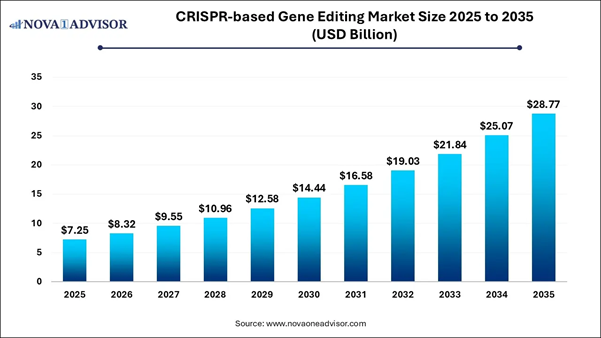
According to Nova One Advisor, the global CRISPR-based gene editing market size was valued at USD 7.25 Billion in 2025 and is poised to grow from USD 8.32 Billion in 2026 to USD 28.77 Billion by 2035, at a CAGR of 14.78% during the forecast period (2026-2035).
From shifting from basic research in academic laboratories to clinical-scale, the CRISPR-based gene editing market is experiencing a significant transformation, in vivo therapeutic applications. This evolution is moving away from standard plasmid reagents toward integrated RNP-based workflows and specialized services. The driving force behind this change is the demand for higher on-target efficiency and reduced off-target risks. Landmark approvals have transitioned CRISPR from an investigative tool into a mainstream therapeutic platform capable of correcting genetic mutations related to blood disorders, oncology, and rare diseases.
Key Takeaways
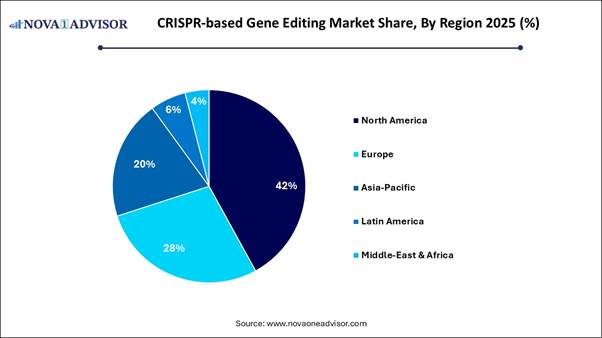
· North America dominated with the largest market share in 2025.
· Asia Pacific is anticipated to have the fastest growth with a notable CAGR during the forecast period.
· By product and service, the products segment contributed the highest market share in 2025.
· By product and service, the service segment is growing at a strong CAGR between 2026 and 2035.
· By application, the biomedical segment held a major market share in 2025.
· By application, the agricultural segment is expected to expand at a notable CAGR from 2026 to 2035.
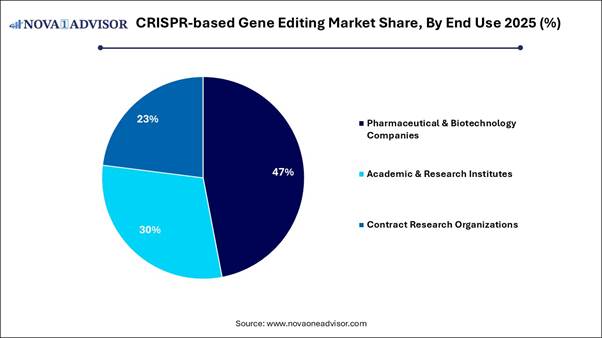
· By end use, the pharmaceutical and biotech companies segment captured the highest market share in 2025.
· By end use, the academic and government research institutes segment is poised to grow at a healthy CAGR between 2026 and 2035.
The Complete Study is Now Available for Immediate Access | Download the Sample Pages of this Report@ https://www.novaoneadvisor.com/report/sample/8915
Market Overview: Rewriting the Future of Biology
The CRISPR-based gene editing market is growing rapidly, evolving from a scientific breakthrough into a powerhouse of innovation. Driven by the high demand for personalized medicine and precision agriculture, this sector is leveraging advanced Cas9/Cas12 tools to revolutionize therapeutic development, drug discovery, and crop improvement. With a notable shift towards in vivo editing and AI-driven platforms, the industry is moving beyond conventional research kits to provide comprehensive, high-efficiency solutions that are actively shaping the future of genetic medicine and sustainable biotechnology.
The Shift toward Scalable Gene Editing Cures: Major Potential
In vivo gene editing is transforming medicine by directly delivering CRISPR to patients to correct genetic errors at the source. This approach bypasses the intensive and costly ex vivo process of cell extraction, offering a less invasive, more accessible, and faster treatment for diseases affecting the liver, brain, and muscle. Accelerated by successful clinical trials, particularly in amyloidosis, the shift towards non-viral lipid nanoparticles enhances safety and scalability, bringing one-time gene editing to fruition as a commercially viable, groundbreaking cure.
Off-Target Toxicity and Immunogenicity: Major Limitations
Despite its revolutionary potential, gene editing is impeded by a high incidence of off-target effects, unintended DNA modifications, and significant pre-existing immunity to the Cas9 enzyme in humans, which can cause severe adverse reactions. Additionally, the technology faces a perfect storm of challenges, including rigorous regulatory scrutiny, intense intellectual property disputes, and legal ambiguities surrounding germline editing, all of which are stalling commercialization.
CRISPR-based gene editing is a powerful and precise technology inspired by natural bacterial defense systems. It enables scientists to modify, remove, or repair specific DNA sequences with high efficiency and relatively low cost. The system works by using a guide RNA (sgRNA) to direct the Cas9 enzyme to a targeted DNA region, where it creates a double-stranded break, allowing genetic changes to be introduced.
Key Components and Mechanism ·
Cas9 Enzyme:
Functions as molecular “scissors” that cut DNA at a specific location. ·
Guide RNA (gRNA):
A customizable RNA sequence that directs Cas9 to the exact DNA target. ·
DNA Repair Mechanisms: After the DNA is cut, the cell’s natural repair processes—such as
Non-Homologous End Joining (NHEJ) or Homology-Directed Repair (HDR)—repair the
break, enabling gene insertion, deletion, or correction. Applications of CRISPR Technology ·
Medical Therapeutics: CRISPR is being used to treat genetic disorders and develop
advanced therapies, including cancer treatments like CAR-T cell therapy. It is
also under investigation for targeting viruses such as HIV and SARS-CoV-2. ·
Agricultural Improvement: Helps enhance crop traits, improve disease resistance, and increase
yields, offering a faster alternative to traditional breeding methods. ·
Research and Disease Modeling: Allows scientists to create accurate cell and animal models to
study diseases such as cancer and neurological disorders. ·
Diagnostics:
Plays a role in developing rapid, sensitive, and highly accurate diagnostic
tools. Technological Advancements ·
Base Editing and Prime Editing: Advanced CRISPR techniques that allow precise DNA changes without
creating double-strand breaks. ·
Gene Regulation:
Methods like CRISPR interference (CRISPRi) and CRISPR activation (CRISPRa)
enable control over gene expression levels rather than altering the DNA
sequence itself. You can place an order or ask any
questions, please feel free to contact at sales@novaoneadvisor.com
| +1 804 441 9344 CRISPR-based Gene Editing Market Report
Scope Report Attribute Details Market Size in 2026 USD 8.32 Billion Market Size by 2035 USD 28.77 Billion Growth Rate From 2026
to 2035 CAGR of 14.78% Base Year 2025 Forecast Period 2026 to 2035 Segments Covered Product &
Service, Application, End use, Region Market Analysis
(Terms Used) Value (US$
Million/Billion) or (Volume/Units) Report Coverage Revenue forecast,
company ranking, competitive landscape, growth factors, and trends Key Companies
Profiled Revvity, Inc.;
Danaher Corporation; GenScript; Merck KGaA; Thermo Fisher Scientific, Inc.;
Tocris Bioscience; OriGene Technologies, Inc.; Bio-Rad Laboratories;
Bio-Techne; New England Biolabs, Inc.
Immediate Delivery is Available | Get
Full Report Access@ https://www.novaoneadvisor.com/report/checkout/8915
CRISPR-based Gene Editing Market:
Segmental Analysis By Product and Service Analysis The products segment dominated the market in
2025, primarily due to the widespread adoption of CRISPR
technology in research settings. There was high demand for ready-to-use
CRISPR kits and Cas9 enzymes, which are essential for ensuring efficiency in
laboratories. These kits and enzymes form the backbone of CRISPR experiments,
making them vital for both academic and pharmaceutical
research and development, which is expected to grow at a rapid pace. The
high-throughput capabilities of CRISPR libraries facilitate functional genomics
studies, allowing researchers to expand beyond simpler gene knockouts. The service segment is projected to
experience the fastest growth during the forecast period. This increase is
mainly due to a rising demand for outsourced research, custom cell line
engineering, and tailored therapeutic development. The gene editing services
market is forecasted to see accelerated growth, driven by both commercial and
academic demand. Pharmaceutical and biotechnology firms are increasingly
outsourcing complex, custom cell line engineering and specialized, target-specific
CRISPR design services for in vivo and ex vivo editing, which are essential for
treating inherited disorders. By Application Analysis The biomedical segment led the market in
2025, driven largely by high-value applications in therapeutic development, oncology,
and cures for genetic disorders. The urgent need for cures for genetic
disorders and cancers is fuelling significant investments in therapeutics, with
a strong focus on ex vivo and in vivo editing. The use of CRISPR for target
validation, functional genomics, and high-throughput screening is accelerating
drug development and contributing to substantial market revenue. As clinical
trials yield positive results, the approval of these therapies further
validates the market and accelerates adoption. The agricultural segment is expected to
experience the fastest growth during the forecast period. This growth is
primarily driven by its ability to rapidly, cost-effectively, and precisely
improve crop yield, disease resistance, and environmental stress tolerance.
CRISPR technology enables the development of crops that can withstand various
environmental stressors, allowing for the quicker development of
drought-tolerant and stress-resilient varieties. This technology is utilized to
enhance nutritional value, increase crop yield, create disease-resistant and
pathogen-resistant crops, and improve post-harvest quality. By End Use Analysis The segment of pharmaceutical and biotech
companies held market dominance in 2025. This dominance is largely attributable
to large-scale research and development and clinical trial applications aimed
at therapeutic advancements, along with significant investments in personalized
medicine. These companies focus on developing targeted gene therapies for
diseases such as sickle cell anemia and cancer. They utilize CRISPR technology
on a massive scale, transitioning from research to therapeutic manufacturing. Their
high investment capacity enables them to dominate the pipeline of preclinical
and clinical trials. The academic and government research
institutes segment is anticipated to grow the fastest during the forecast
period. This rapid growth is mainly fueled by increasing government funding for
fundamental research, ramped-up genomic studies, and the critical role that
these institutions play. Substantial investments from government bodies in
developed countries are driving widespread adoption of CRISPR technology. As
they explore novel CRISPR variants, Cas enzymes, and editing techniques,
academic labs provide the foundational knowledge required for commercial
applications, accelerating the clinical application. CRISPR-Based Gene Editing Market:
Regional Analysis North America dominated the market in 2025.
This dominance mainly stems from its advanced biotechnology infrastructure,
high research and development spending, and early regulatory approvals. The
region hosts a high concentration of biotech and pharmaceutical companies,
along with significant public funding for genomic research. Clear guidelines
from the U.S. FDA for gene editing therapies have sped up the approval process
for CRISPR-based treatments. The U.S. remains the leading innovator in
the market, focusing heavily on curing rare diseases and cancer, with
pioneering firms like CRISPR Therapeutics, Intellia, and Vertex at the
forefront. This is supported by the world’s highest levels of research and
development funding, paving the way for a new era of molecular medicine. 🔹 In June 2025, Lilly made waves in cardiovascular care by acquiring
Verve Therapeutics for up to $1.3 billion, aiming to pioneer one-time gene
editing solutions. By leveraging Verve’s groundbreaking CRISPR technology,
including its lead candidate VERVE-102, Lilly seeks to permanently lower
cholesterol and transform heart disease treatment. Canada is rapidly emerging as a key player
in the market, effectively bridging the gap between cutting-edge academic
research and biotechnology commercialization, particularly in genomics and
precision medicine. With major infrastructure investments and strategic
high-value acquisitions, Canada is cementing its role as an essential hub for
innovation in global gene editing advancements. Asia Pacific is recognized as the
fastest-growing region, driven by aggressive national strategies and rising
investments. Countries such as China, Japan, and India are prioritizing
biotechnology through substantial state funding to reduce reliance on foreign technologies.
The high incidence of genetic disorders and cancers in these countries drives
demand for precision medicine and curative gene therapies. CRISPR is
increasingly being used in this region to enhance food security, targeting crop
resilience, higher yields, and improved pest resistance, especially in China
and India, as they become hubs for clinical trials focused on somatic cell
therapy. India is revolutionizing its market by
pivoting toward indigenous technology to escape costly, foreign-patented
systems. Driven by the Department of Biotechnology (DBT), India is pioneering
in-house, native gene-editing tools and streamlining regulations, exempting
SDN1/SDN2 edited plants from strict GMO approvals, to fast-track
disease-resilient rice, wheat, and improved livestock. 🔹 In November 2025, India launched BIRSA 101, a groundbreaking,
low-cost, and indigenous CRISPR-based gene therapy for sickle cell disease.
Developed by CSIR–IGIB, this pair of genetic scissors technology offers a
one-time, affordable cure for tribal populations, aiming for a sickle-cell-free
India by 2047. China has established itself as a global
leader in the market, driving innovation through substantial clinical trials in
cancer treatment and rapid advancements in in vivo gene editing. Backed by
significant government investment, the nation is prioritizing agricultural gene
editing for food security while accelerating the commercialization of precision
medicine technologies. CRISPR-based Gene Editing Market
Companies ·
Danaher ·
Merck KGaA ·
Thermo Fisher
Scientific, Inc. ·
OriGene Technologies, Inc. ·
Bio-Rad Laboratories ·
Bio-Techne ·
New England Biolabs, Inc. Key Emerging CRISPR Innovations Innovation Example Focus Area Prime Editing PM359 (Prime Medicine) Precise correction of disease-causing point mutations (e.g.,
Chronic Granulomatous Disease). Base Editing BEAM-302 (Beam Therapeutics) Single-nucleotide changes (C to T) without breaking DNA, treating
liver disease. Epigenetic Editing EPI-321 (Epicrispr/Epic Bio) Silencing/activating genes (e.g., DUX4) without changing DNA
sequence for muscle disorders. RNA Editing/Targeting Cas13a (HuidaGene) Targeting viral RNA (SARS-CoV-2) or reducing toxic RNA levels. Gene Writers (RNA-templated) TSRA-196 (Tessera Therapeutics) Inserting DNA sequences using mobile elements (e.g., AAT
deficiency).
Major Shifts in the CRISPR-based Gene
Editing Market ·
In September 2025, Integrated DNA Technologies
(IDT) launched the Alt-R™ HDR Enhancer Protein, designed to double HDR
efficiency in challenging cells like iPSCs and HSPCs. This proprietary molecule
enhances IDT’s HDR reagent portfolio, supporting cell and gene therapy
developers in their research. Manufactured by Aldevron to uphold quality
standards, it maintains cell viability and genomic integrity without increasing
off-target edits. ·
In January 2026, Epicrispr announced early
clinical data from its ongoing study of EPI-321, an investigational epigenetic
therapy for facioscapulohumeral muscular dystrophy (FSHD). With Fast Track
Designation from the FDA, the study focuses on safety and tolerability,
revealing positive outcomes across multiple strength and functional measures
without serious adverse events. CEO Amber Salzman emphasized the consistency of
improvements and the potential of EPI-321. Related Report ➡️ Genetic Engineering Market: Explore how
advancements in biotechnology are accelerating innovation across healthcare,
agriculture, and industrial applications ➡️ Gene Amplification Technologies Market: Discover
the growing role of precision diagnostics and molecular testing in modern
healthcare ➡️ U.S. Regenerative Medicine Market: Analyze how
stem cell therapies and tissue engineering are reshaping treatment
possibilities in the U.S. ➡️ Drug and Gene Delivery Devices Market: Understand
the demand for advanced delivery systems supporting targeted and personalized
therapies ➡️ Synthetic Gene Circuits Market: Gain insight
into the rise of programmable biology and synthetic biology applications across
industries ➡️ Distributed Generation Market: Track the shift
toward decentralized energy systems driven by renewable integration and energy
security goals ➡️ Hydrogen Generation Market: See how clean
energy initiatives are boosting investments in hydrogen production technologies
worldwide ➡️ Gene
Editing Market: Explore the expanding use of genome editing
tools in therapeutics, agriculture, and research applications ➡️ U.S. Cell and Gene Therapy Market: Discover how
next-generation therapies are transforming treatment approaches for chronic and
rare diseases ➡️ U.S. General Surgery Devices Market: Analyze
the growing adoption of minimally invasive surgical technologies and advanced
operating tools ➡️ DNA and Gene Chip Market: Understand the
increasing use of biochip technologies in genomics research and disease
diagnostics ➡️ Genetic Testing Market: Track rising consumer
awareness and healthcare adoption of predictive and personalized genetic
testing solutions ➡️ Cell and Gene Therapy Clinical Trials Market: Explore
the rapid expansion of clinical research activities in advanced therapeutic
development ➡️ Epigenetics Drugs and Diagnostic Technologies Market:
Gain insight into innovations targeting gene expression for disease
diagnosis and treatment advancements ➡️ U.S. Generic Injectables Pharmaceutical Contract Manufacturing
Market: See how outsourcing trends are supporting efficient
production of generic injectable medicines ➡️ DNA and Gene Cloning Services Market: Discover
the growing importance of cloning services in biotechnology research and
therapeutic development ➡️ CRISPR-Based Diagnostics Market: Analyze how
CRISPR innovations are enabling rapid, accurate, and cost-effective diagnostic
solutions ➡️ CRISPR Technology Market: Track advancements in
gene-editing technologies driving breakthroughs in medicine and life sciences ➡️ Mice Model Generation Market: Understand the
increasing demand for genetically engineered mouse models in biomedical and
pharmaceutical research CRISPR-based Gene Editing Market Report
Segmentation This report forecasts revenue growth at
country levels and provides an analysis of the latest industry trends in each
of the sub-segments from 2021 to 2035. For this study, Nova one advisor, Inc.
has segmented the CRISPR-based gene editing market. By Product & Service By Application By End Use By Region Immediate Delivery Available | Buy This Premium Research https://www.novaoneadvisor.com/report/checkout/8915 About-Us Nova One Advisor is a global leader
in market intelligence and strategic consulting, committed to delivering deep,
data-driven insights that power innovation and transformation across industries.
With a sharp focus on the evolving landscape of life sciences, we specialize in
navigating the complexities of cell and gene therapy, drug development, and the
oncology market, enabling our clients to lead in some of the most revolutionary
and high-impact areas of healthcare. Our expertise spans the entire
biotech and pharmaceutical value chain, empowering startups, global
enterprises, investors, and research institutions that are pioneering the next
generation of therapies in regenerative medicine, oncology, and precision
medicine. Web: https://www.novaoneadvisor.com/ Our Trusted Data Partners: Nova One Advisor - Market
Research Reports & Consulting Firm Nova One Advisor offers
comprehensive market research reports with in-depth industry analysis and
market data. Call us: +1 804 420 9370 Email: sales@novaoneadvisor.com Web: https://www.novaoneadvisor.com/ You can place an order or ask any
questions, please feel free to contact at sales@novaoneadvisor.com | +1 804 441 9344