

Most life sciences manufacturers that run into trouble during an inspection already have the programs that pharmaceutical EHS compliance calls for. There is a hazard communication plan, a waste contingency plan and a corrective action procedure.
The finding tends to land somewhere else: in the step where a record should have changed and didn't, because the work passed from one team to another and nobody owned the handoff.
An EHS gap in pharmaceuticals is the distance between what a site's procedures require and what its records can show on the day someone asks. The four gaps below turn up again and again in OSHA citation data, EPA settlements and FDA observations, and each one starts as an ordinary workflow problem.
1. Safety data sheets for in-house APIs and intermediates
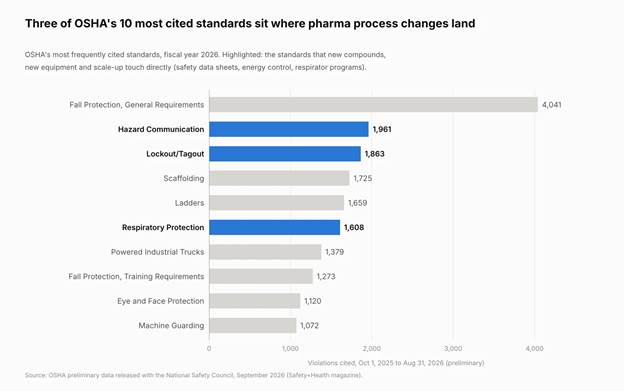
Hazard Communication was the second most cited OSHA standard in fiscal year 2026, with 1,961 violations recorded between October 1, 2025 and August 31, 2026, according to preliminary figures released with the National Safety Council in September 2026. Most of those citations go to ordinary employers with missing labels or thin training records.
Drug manufacturers carry an extra duty on top of that. Under 29 CFR 1910.1200(g)(1), a chemical manufacturer has to author a safety data sheet (SDS) for each hazardous chemical it produces, which is usually done by SDS creation software.
This EHS gap in pharmaceutical manufacturing comes from a split in ownership between the data and the document. Toxicology and occupational exposure band data for a new compound sit with development, while the SDS sits with EHS or regulatory affairs.
When a new study changes the hazard picture, the SDS often stays as it was, even though the standard gives the preparer three months to add significant new hazard information once they become aware of it.
OSHA's 2024 update to the standard, with the four-month extension announced in January 2026, set these compliance dates:
|
Who must comply |
Substances |
Mixtures |
|
Manufacturers, importers and distributors (SDSs and labels) |
May 19, 2026 |
November 19, 2027 |
|
Employers (workplace labels, written program, training) |
November 20, 2026 |
May 19, 2028 |
The substance deadline for manufacturers has already passed. Any in-house compound still on an SDS written to the old format is out of date under the rule. Some manufacturers now run SDS Authoring in-house, generating the document from the same composition and hazard data the process team maintains, so the two records can't drift apart.
2. Hazardous waste records that lag behind the process
EPA's June 9, 2026 settlement with Nitto Denko Avecia shows how waste gaps build up at a working drug manufacturing site. The company agreed to pay $858,889 to resolve federal RCRA and Massachusetts hazardous waste violations at two facilities in Milford, Massachusetts. EPA's list of problems covered five areas:
- Hazardous waste air emissions.
- Design and installation of hazardous waste tank systems.
- Equipment inspections.
- Labeling of waste and storage areas.
- Contingency planning.
None of these is exotic. The corrective measures the company put in place, including a leak detection program, daily tank inspections, and updated emergency response plans, are routine tasks for any site that generates hazardous waste.
There is a structural reason these tasks slip. Waste streams change every time a process is scaled up, a solvent is swapped, or a new product goes into a suite. The waste determination, the tank inspection log, and the contingency plan rarely sit in the same change request as the process update, so they fall behind by one revision, then two.
3. Corrective actions closed without an effectiveness check
Corrective action is where EHS and quality systems look most alike, and it is where EHS programs tend to be weaker. ISO 45001, the occupational health and safety standard many manufacturers certify to, requires an organization to review the effectiveness of any corrective action it takes. Also, it requires keeping documented information on the results, including whether the action worked.
Many EHS teams track the action and close it when the task is done. The guard goes on, the procedure is revised, the training is delivered. Nobody comes back 60 or 90 days later to confirm the original hazard is gone.
FDA observations show how regulators treat the same pattern on the quality side. Citations under 21 CFR 211.192, the production record review rule that requires investigation of unexplained discrepancies, rose 171% from 2023 to 2024 in Form 483 observations issued to sterile drug manufacturers, according to an analysis published by Pharmaceutical Online.
The EHS version of that finding is a repeat incident at a workstation that already has a closed corrective action against it. The record shows the investigation stopped at a symptom.
The fix is mostly about where the follow-up lives. EHS CAPA Management Software can hold the effectiveness check as a dated, assigned task, so the action can't be marked closed until someone confirms the fix held. A spreadsheet can do the same in principle, though the follow-up column is usually the one left blank.
4. Process changes that skip EHS review
Scale-up, technology transfer and new equipment introduce more new hazards in a shorter time than anything else a drug manufacturing site does. ISO 45001 clause 8.1.3 requires a process for implementing and controlling planned temporary and permanent changes that affect health and safety performance.
Most GMP change control systems already route changes to quality, regulatory, and validation reviewers. EHS is often an optional reviewer, or gets copied at the end.
The consequences are visible in OSHA's fiscal 2026 list. Lockout/Tagout ranked third with 1,863 violations and Respiratory Protection sixth with 1,608. A process change touches both directly.
New equipment needs its own energy control procedure, and a compound with a lower exposure band can move an operation from local exhaust ventilation to respirator use, which brings fit testing and medical evaluation with it.
Making EHS a required approver on change controls, with a short checklist covering new chemicals, new energy sources, new waste streams, and changed exposure levels, is a small addition to a process most sites already run, and it closes one of the more common EHS gaps in pharmaceutical manufacturing.
Closing the EHS gap in pharmaceuticals before the next inspection
Each gap above sits between two teams: development and EHS for safety data sheets, operations and EHS for waste, quality and EHS for corrective actions and change control.
Companies that publish their EHS approach tend to describe it as a single system. Alkermes, for example, describes a program built on an enterprise-wide risk management framework and aligned with ISO 14001 and ISO 45001.
A practical place to start is one recent process change, traced end to end. Check whether the SDS, the waste determination, the energy control procedure, and any related corrective action all updated with it. Where one didn't, the gap is already on record.


