
The advent of induced Pluripotent Stem Cells (iPSCs) was a landmark event in the history of regenerative medicine. By reprogramming somatic cells into an embryonic-like state, this technology bypassed ethical controversies and opened doors to patient-specific therapies. However, challenges encountered during commercialization such as immune rejection, risk of tumorigenicity, and complex manufacturing beg the question: "What is the next step for stem cell therapeutics beyond iPSCs?" The scientific community is now shifting its gaze toward a safer, more efficient, and universal "Next-Generation Regenerative Medicine Platform."
1. Opportunities: Innovative Approaches Surpassing iPSC Limitations
Building upon the path paved by iPSCs, researchers are developing more sophisticated and evolved forms of cell therapy.
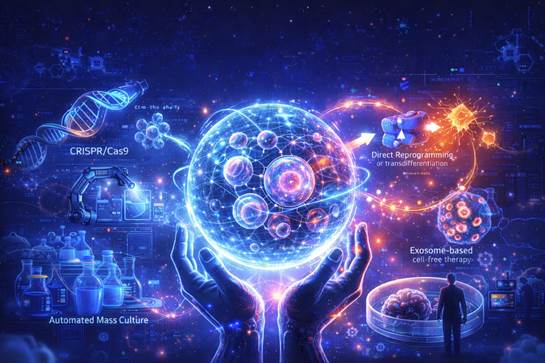
· Universal "Off-the-shelf" iPSCs: Instead of creating cells for each individual patient, this technology involves mass-producing "universal stem cells" with removed immune rejection markers to be administered immediately when needed. This will be the key driver in drastically lowering costs and accelerating accessibility.
· Direct Reprogramming (Transdifferentiation): This involves converting one type of somatic cell directly into another functional cell type (e.g., skin cells to neurons) without passing through an intermediate stem cell state. It is garnering attention as a next-generation alternative that inherently eliminates the risk of cancer and shortens treatment time.
· Exosome-based Cell-free Therapy: This approach utilizes "exosomes" the active signaling molecules secreted by stem cells—rather than injecting the cells themselves. It avoids the side effects associated with cell transplantation and is easier to store and distribute, holding immense industrial value.
2. Leap and Progress: Technical Maturity Toward Industrialization
To move stem cell therapies from the lab to the masses, the following technological leaps are taking place:
· Integration with Next-Generation Gene Editing: By utilizing CRISPR/Cas9 to precisely edit the immune genes of stem cells, researchers are maximizing post-transplant survival rates and making immunosuppressant-free treatments a reality.
· Automated Mass Culture and Quality Control: The introduction of AI and robotics is personalizing and standardizing the cell culture process, leading to manufacturing innovations that ensure a stable supply of consistent-quality cell therapeutics.
· Convergence with Organoid Technology: Evolution is occurring from simple cell injections to transplanting structured mini-organs (organoids) to restore organ function more fundamentally.
Conclusion: From Cellular Replacement to Systemic Reconstruction
The post-iPSC era will move beyond simply "swapping out cells" and toward "precisely controlling the body’s internal regenerative mechanisms." We are moving closer to universal therapeutic solutions that are safer, more economical, and applicable to everyone.
Stem cell technology is the backbone of a future industry where bioengineering, genomics, and advanced manufacturing converge. Building on the great foundation of iPSCs, humanity is now advancing toward the higher goals of conquering incurable diseases and achieving healthy aging. Next-generation regenerative medicine will not just extend life, but open a new horizon where humanity can fully recover lost functions and vitality.

About Unexakorea
Unexakorea conducts
innovative research to make advanced biotechnology accessible to everyone in
everyday life.
By operating a variety of connectivity-based services that reduce information
gaps and eliminate daily inconveniences, the company is building a
people-centered platform ecosystem.
unexakorea is also evolving into a total life-care platform. Grounded in research, science, and technology, the company designs everything from small daily routines to an individual’s entire life cycle with precision preparing for an era in which people can live healthily up to 123 years. To achieve this, unexakorea is establishing a structural health infrastructure that does not rely solely on individual effort, developing long-term generational strategies based on science, and creating a sustainable wellness model in which benefits are shared across society.
As an R&D-driven company specializing in healthcare and nutraceuticals, unexakorea pursues sustainable innovation backed by the financial stability and technological capabilities of its parent company. Moving beyond the nutraceutical market’s traditional focus on “rapid absorption,” unexakorea is advancing sustained-release formulation manufacturing technology designed to deliver stable efficacy in the body for more than 10 hours. Furthermore, the company is shaping a new paradigm for sustainable biotechnology through research in microbiome.


