
- MEDSIR has presented at the ASCO scientific congress, held in Chicago, the final results of its ZZ‑FIRST study, which support the potential of combining enzalutamide and talazoparib in high‑volume metastatic hormone‑sensitive prostate cancer.
- The study, which enrolled 54 patients from Spanish centers, evaluates a strategy to intensify standard therapy with the aim of blocking tumor progression before the cancer develops resistance to treatment, a frequent phenomenon in prostate cancer.
CHICAGO, June 1, 2026 /PRNewswire/ -- MEDSIR, a leading international oncology research company, has presented the final results of the ZZ‑FIRST study during an oral session at the ASCO 2026 scientific congress, held in Chicago. This study evaluates a therapeutic intensification strategy in patients with advanced prostate cancer. Previously, the study demonstrated relevant treatment response results in more than 70% of cases, reflected by a decrease in PSA (prostate‑specific antigen) levels, a biomarker used in the blood monitoring of prostate cancer.
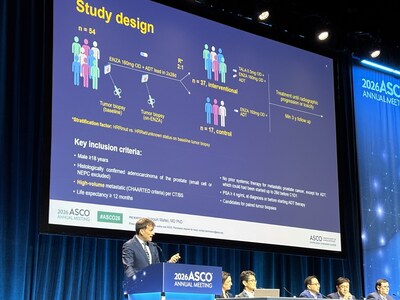
ZZ-FIRST: a new therapeutic strategy
In the ZZ‑FIRST study, a phase II, multicenter, randomized trial, 54 patients from eight centers across Spain were enrolled. Specifically, the trial included patients with high‑volume metastatic hormone‑sensitive prostate cancer (mHSPC), meaning a high tumor burden at diagnosis and typically a poorer prognosis.
For these patients, current treatment is based on androgen deprivation therapy, usually in combination with next‑generation hormonal treatments such as enzalutamide. Since many prostate cancer cells depend on male hormones for growth (androgens such as testosterone), these therapies aim to block these hormonal signals by reducing testosterone levels and inhibiting their downstream effectors. However, over time, some tumors develop resistance and continue to grow despite hormonal blockade, becoming hormone‑resistant.
In this context, the ZZ‑FIRST study evaluates the feasibility of intensifying initial treatment with enzalutamide by combining it with talazoparib (a PARP inhibitor, a protein involved in DNA repair) from earlier stages of the disease. By administering both drugs together while the disease is still hormone‑sensitive, the goal is to increase the accumulated DNA damage in tumor cells and promote their destruction before mechanisms of resistance to hormonal therapy emerge.
The results presented at ASCO show that patients treated with the experimental combination achieved a radiographic progression‑free survival of 45.3 months, compared with 31.1 months in those treated with enzalutamide alone. This endpoint measures the time from treatment initiation until tumor progression is detected by imaging tests. In addition, patients receiving the combination also showed a longer time to PSA progression and to the development of resistance to hormonal therapy.
In addition, adaptive tumor mechanisms were investigated before initiating therapy and during the first weeks of treatment with enzalutamide, providing key information to better understand how resistance develops. The ZZ‑FIRST results indicate that the combination of hormonal therapy with PARP inhibitors may particularly benefit patients whose tumors present certain mutation profiles in DNA repair genes. "Although patients with metastatic disease initially respond to hormonal therapy, the tumor eventually adapts and grows again. Therefore, it is essential to investigate the biological mechanisms that allow the tumor to develop resistance to hormonal treatment and to identify new therapeutic strategies capable of delaying or preventing this process," explained Dr. Joaquín Mateo, principal investigator of the study, oncologist at Vall d'Hebron University Hospital and Head of the Prostate Cancer Group at the Vall d'Hebron Institute of Oncology (VHIO), who presented the results at ASCO.
ZZ‑FIRST has received external funding from Pfizer S.L., the Spanish Association Against Cancer (AECC), and the United States Department of Defense (DoD). The drugs used in the study were provided by Pfizer S.L. (talazoparib) and Astellas Pharma Europe Ltd. (enzalutamide).
ADELA and CADILLAC: MEDSIR presence at the ASCO congress
In addition to the presentation of the ZZ‑FIRST study, MEDSIR also presented the design of other studies during the congress.
On the one hand, the company presented, in collaboration with the Menarini Group, the design of the ADELA study, an international phase III trial evaluating the selective estrogen receptor degrader (SERD) elacestrant combined with everolimus versus elacestrant monotherapy. The study includes patients with ER+/HER2‑ tumors who developed an ESR1 gene mutation after progression on prior endocrine therapy and CDK4/6 inhibitors. The trial is being implemented in more than 100 hospitals across nine countries, including Spain, Austria, the Czech Republic, Greece, the United Kingdom, France, Italy, Germany, and Brazil.
On the other hand, the CADILLAC study is also noteworthy. This is an international phase II trial evaluating the efficacy and safety of combining the SERD camizestrant with the CDK4/6 inhibitor ribociclib in patients with advanced HR+/HER2‑ breast cancer who have stopped responding to standard treatments. The study, currently ongoing at centers in Spain, Germany, and China, includes 150 patients whose data will be compared with historical records from more than 150 patients receiving conventional therapy.
About MEDSIR
Founded in 2012, MEDSIR is distinguished by its close collaboration with strategic partners to drive innovation in oncology research. With headquarters in Spain and the United States, the company provides comprehensive management of clinical trials, from study design through to publication, supported by an extensive global network of experts and integrated technology to streamline the process. The company offers support for proof‑of‑concept studies and a strategic approach that allows research partners to benefit from the best of both worlds: industry clinical research and investigator‑driven trials.
More information: www.medsir.org

 View original content to download multimedia:https://www.prnewswire.com/news-releases/a-combined-therapeutic-strategy-aims-to-improve-disease-control-in-advanced-hormonesensitive-prostate-cancer-302786960.html
SOURCE MEDSIR


