From ambient scribes to autonomous agents, AI is redefining the digital health landscape in the U.S., moving from isolated pilot projects to essential, mission-critical infrastructure. AI is transitioning from passive experimental initiatives into vital tools that utilize generative AI and automated workflows, significantly reducing months of administrative and diagnostic work to just hours. This shift toward proactive, value-based care, driven by electronic health record integration and real-time data, is empowering healthcare providers to move beyond time-consuming documentation and reshape the patient experience into an intelligent and personalized digital ecosystem.
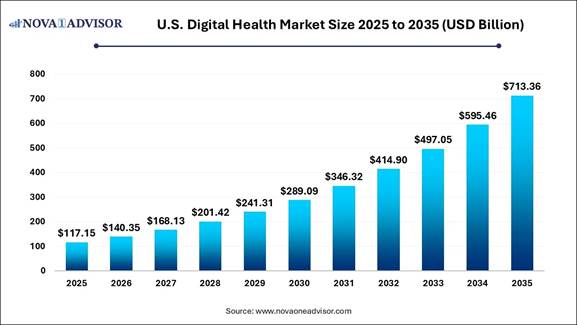
According to Nova One Advisor, the U.S. digital health market size was valued at USD 117.15 billion in 2025 and is poised to grow from USD 149.35 billion in 2026 to USD 713.36 billion by 2035, at a CAGR of 19.8% during the forecast period (2026-2035).
U.S. Digital Health Market Key Takeaways
⬥︎North America dominated with the largest market share in 2025.
⬥︎Asia Pacific is expected to have the fastest growth, with a notable CAGR, during the forecast period.
⬥︎By technology, the telehealth segment held a major market share in 2025.
⬥︎By technology, the mHealth segment is expected to expand at a notable CAGR from 2026 to 2035.
⬥︎By component, the services segment captured the highest market share in 2025.
⬥︎By component, the software segment is poised to grow at a healthy CAGR between 2026 and 2035.
⬥︎By application, the cardiovascular disease segment contributed the highest market share in 2025.
⬥︎By application, the diabetes segment is growing at a strong CAGR between 2026 and 2035.
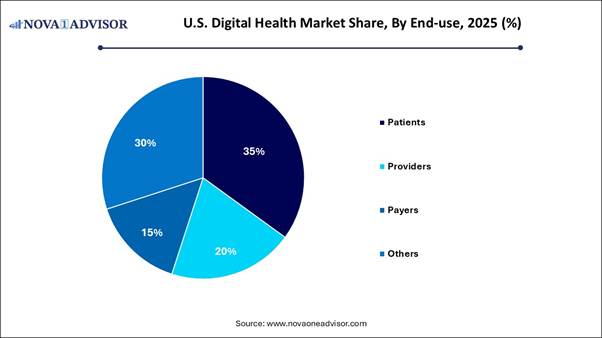
⬥︎By end-use, the providers segment captured the highest market share in 2025.
⬥︎By end-use, the patient segment is poised to grow at a healthy CAGR between 2026 and 2035.
The Complete Study is Now Available for Immediate Access | Download the Sample Pages of this Report@ https://www.novaoneadvisor.com/report/sample/8177
Market Overview: The Proactive, AI-Driven Future
The U.S. digital health market includes technologies that integrate software, hardware, and services, such as telehealth, wearables, and electronic health records. This market is experiencing explosive, AI-driven growth, transforming patient care into a high-tech, proactive ecosystem. As a global hub, this sector leverages remote patient monitoring and digital therapeutics to address rising healthcare costs and manage chronic conditions, delivering more personalized and cost-effective outcomes.
Generative AI and Ambient Intelligence: Major Potential
Generative and Ambient AI are evolving from pilot programs into the foundational operating layer of healthcare. They are transforming clinical encounters by automatically generating documentation and supporting real-time decision-making. This integration serves as a 'second brain' for clinicians, significantly reducing administrative burdens while converting care from episodic to continuous through wearable data analytics, ultimately enabling proactive disease prevention and highly personalized patient care.
Interoperability Gap: Major Limitation
Despite the rapid growth of digital health, the industry is still hindered by a fragmented ecosystem where crucial patient data is locked within proprietary EHR silos, impeding seamless data flow. Without universal, standardized adoption of protocols, essential vital signs may be collected but fail to reach the treating physicians, disrupting continuity of care and creating a data liquidity crisis. This lack of standardization hampers the data liquidity necessary for advanced AI tools to process complete patient contexts accurately, thus slowing down the pace of innovation.
U.S. Digital Health refers to the integration of digital technologies into the healthcare system to improve patient care, enhance healthcare delivery, and optimize the overall management of health data. It encompasses a wide range of tools, platforms, and innovations that leverage digital technologies like mobile apps, telemedicine, electronic health records (EHR), artificial intelligence (AI), wearable devices, and more.
Some of the key areas under U.S. digital health include:
- Telemedicine: The use of video calls, phone calls, or messaging platforms to provide healthcare services remotely. Telemedicine has been particularly important for expanding access to care in rural areas and reducing the burden on healthcare systems.
- Health Apps: Mobile applications that allow individuals to monitor and manage their health, track fitness, mental well-being, nutrition, medications, and more.
- Wearables: Devices like fitness trackers, smartwatches, and medical devices that collect real-time data such as heart rate, sleep patterns, physical activity, and even glucose levels. These devices help individuals and healthcare providers monitor health conditions.
- Electronic Health Records (EHR): Digital systems that store, manage, and share patient health information securely among healthcare providers, making patient care more efficient.
- Artificial Intelligence (AI) and Machine Learning: AI technologies are being used in diagnostics, personalized treatment planning, and drug discovery. For example, AI can analyze medical images to help detect diseases like cancer.
- Health Information Exchange (HIE): A system that facilitates the secure sharing of health data across different healthcare organizations and providers to improve the continuity of care.
- Remote Monitoring: Technologies that allow healthcare providers to track patients' health data remotely, enabling continuous care without in-person visits.
- Cybersecurity in Healthcare: As digital health systems become more widespread, ensuring the security of patient data is critical. Cybersecurity technologies are being developed to protect sensitive health information from breaches and unauthorized access.
Immediate Delivery is Available | Get Full Report Access@ https://www.novaoneadvisor.com/report/checkout/8177
Report Scope of The U.S. Digital Health Market
|
Report Coverage |
Details |
|
Market Size in 2025 |
USD 140.35 Billion |
|
Market Size by 2036 |
USD 713.36 Billion |
|
Growth Rate From 2026 to 2035 |
CAGR of 19.8% |
|
Base Year |
2025 |
|
Forecast Period |
2026-2035 |
|
Segments Covered |
Technology, Component, Application, End-use |
|
Market Analysis (Terms Used) |
Value (US$ Million/Billion) or (Volume/Units) |
|
Regional Scope |
U.S. |
|
Key Companies Profiled |
Apple Inc.; AT&T; Airstrip Technologies; Allscripts; Google Inc.; Orange; Qualcomm Technologies, Inc.; Softserve; MQure; Samsung Electronics Co. Ltd.; Telefonica S.A.; Vodafone Group; Cerner Corp.; McKesson Corp.; Epic Systems Corp.; NextGen Healthcare, Inc; Greenway Health LLC; CureMD Healthcare; HIMS; Computer Programs and Systems, Inc; Vocera Communications; IBM Corp.; Siemens Healthcare GmbH; Cisco Systems, Inc. |
For more information, visit the Nova One Advisor website or email the
team at sales@novaoneadvisor.com |
Call us: +1 804 420 9370 U.S. Digital Health Market: State
Analysis ·
California and Washington: Acting as premier hubs for digital health development, Silicon
Valley (CA) and Seattle (WA) leverage major players like Apple, Google, and
Amazon to drive innovation in wearables, such as smartwatches for continuous
health monitoring. They also focus on advanced AI integration for diagnostic
tools. ·
Massachusetts and New York: These states serve as central hubs for digital health infrastructure
and emphasize Electronic Health Records (EHR) interoperability, digital
therapeutics, and advanced AI-driven research, largely supported by
partnerships with leading academic and healthcare institutions. ·
Texas and Florida: Characterized by large, diverse populations and significant rural
areas that require accessible care, these states are major adopters of
telehealthcare and remote patient monitoring systems to manage patient care
outside traditional clinical settings. ·
Rural States: In
these regions, the focus is on expanding access to care through telehealth and
remote monitoring technology, helping to overcome geographical barriers and
reducing the need for patients to travel to urban hospitals for routine care. U.S. Digital Health Market: Segmental
Analysis By Technology Analysis The telehealth
segment was expected to dominate the market in 2025. This dominance is driven
primarily by the widespread adoption of virtual consultations, remote patient
monitoring, and supportive reimbursement policies. Telehealth platforms,
including video consultations and store-and-forward services, are extensively
used for remote consultations and faster diagnoses. The adoption of wearable
devices and sensors, such as smart inhalers and remote patient monitoring
tools, facilitates continuous care for chronic illnesses. The mHealth
segment is expected to grow the fastest during the forecast period. This growth
is primarily driven by the rapid adoption of health apps, increased management
of chronic
diseases, and widespread use of wearable sensors to track patient
vitals. The emergence of apps designed for managing diabetes, cardiovascular
diseases, and mental health enables continuous remote patient monitoring.
Additionally, increased reimbursement for remote patient monitoring and
mHealth-integrated care models is driving demand for wearable devices. By Component Analysis In 2025, the services segment was the
leading market sector, primarily due to the demand for essential
implementation, training, and ongoing support for telehealth and remote
monitoring. The increasing focus on managing chronic disorders
necessitates continuous monitoring services, which are predominantly delivered
through digital platforms, thus boosting the services segment. Additionally,
the widespread adoption of healthcare
IT software and hardware by providers has created a significant need
for installation, maintenance, and training services. The software segment is expected to
experience the fastest growth during the forecast period. This surge is largely
driven by the high demand for cloud-based solutions and AI-driven healthcare
analytics. Telehealthcare platforms are expanding rapidly, requiring robust
software back-ends for scheduling and remote monitoring. The rise of smartphones
and wearable devices that monitor vital signs, combined with the increased
consumer use of apps for chronic disease management, is fueling substantial
software adoption. By Application Analysis The cardiovascular disease segment
dominated the market in 2025, mainly due to the rapid adoption of AI-driven
diagnostics, wearable monitoring, and remote patient monitoring services.
Devices such as smartwatches and trackers, including those from Apple and other
companies, facilitate real-time monitoring of ECG and heart rates, empowering
proactive health management. The rising prevalence of cardiovascular diseases
drives the demand for specialized digital tools aimed at reducing healthcare
costs and improving patient outcomes. The diabetes segment is projected to have
the fastest growth during the forecast period. This growth is driven by the
high prevalence of diabetes, the adoption of AI-driven and interoperable
wearable devices, and advancements in remote monitoring technologies. The
increased use of telehealth and virtual care platforms enables better, more
continuous, and personalized care, thereby enhancing clinical outcomes. The
healthcare segment is also growing rapidly, as patients increasingly use
digital tools to manage their conditions, reducing the burden on clinics. By End-use Analysis The providers segment led the market in
2025, largely due to the rapid shift toward value-based care. Providers are
utilizing these technologies to optimize operations, enhance patient
engagement, and manage chronic conditions remotely. They are prioritizing
digital tools that improve patient outcomes and efficiency to secure
reimbursement under new care models. The extensive adoption of electronic
health record (EHR) systems and AI-driven predictive analytics helps providers
manage patient data, reduce operational errors, and personalize treatments. The patient segment is anticipated to
experience the fastest growth during the forecast period. This growth is mainly
driven by the increasing adoption of wearable devices, smartphone health
applications, and remote monitoring tools for chronic
disease management. Patients are increasingly using wearables and
mobile health apps to track real-time health data, including glucose monitoring
and physical activity. The convenience, cost-effectiveness, and safety of
virtual care are driving demand for telehealthcare platforms in the coming
years. Key Initiatives and Programs for the
U.S. Digital Health Market State Initiative and Program Focus Key Goal California Medi-Cal telehealth expansion Increase access to virtual care for low-income residents. New York Digital Health Accelerator Support tech startups in developing AI and diagnostics tools. Texas Rural Broadband Telemedicine expansion Enhance remote monitoring and telehealth in rural areas. Florida Senior Citizen RPM Program Use wearables and monitoring for geriatric chronic diseases. Massachusetts Health Information Exchange Interoperability Improve patient data sharing between hospital systems.
U.S. Digital Health Market Companies ·
Apple, Inc. ·
AT and T ·
Airstrip Technologies ·
Allscripts ·
Google, Inc. ·
Orange ·
Qualcomm Technologies, Inc. ·
Softserve ·
MQure ·
Samsung Electronics Co. Ltd. ·
Telefonica S.A. ·
Vodafone Group ·
Cerner Corp. ·
McKesson Corp. ·
Epic Systems Corp. ·
NextGen Healthcare, Inc. ·
Greenway Health LLC. Major shifts in the U.S. Digital Health
Market ·
In December 2025, DarioHealth Corp. launched the
Dario Health app with DarioIQ™, its new AI feature, aimed at hypertension
members for an enhanced user experience. This launch is part of a multi-phase
strategy to incorporate conversational AI into chronic condition management,
complementing Dario's existing human coaching and data-driven approach. The
DarioIQ™ system delivers personalized guidance and real-time insights, marking
a significant step in Dario's GenAI roadmap. ·
In January 2025, WHX Tech will unite Informa’s
global healthcare events under the WHX brand, including WHX Dubai and WHX Labs
Dubai. The inaugural WHX Tech event, focusing on digital healthcare innovation,
will take place at the Dubai World Trade Centre, in partnership with HIMSS. The
initiative aims to enhance collaboration and innovation within the healthcare
ecosystem, fostering a community dedicated to improving care delivery and
patient outcomes. Related Report – 🔹Europe Digital Health Market- https://www.novaoneadvisor.com/report/europe-digital-health-market 🔹Digital Health Market- https://www.novaoneadvisor.com/report/digital-health-market 🔹North America Digital Health Market- https://www.novaoneadvisor.com/report/north-america-digital-health-market 🔹UAE Digital Health Market- https://www.novaoneadvisor.com/report/uae-digital-health-market 🔹Asia Pacific Digital Health Market- https://www.novaoneadvisor.com/report/asia-pacific-digital-health-market
🔹Germany Digital Health Market - https://www.novaoneadvisor.com/report/germany-digital-health-market
🔹Saudi Arabia Digital Health Market- https://www.novaoneadvisor.com/report/saudi-arabia-digital-health-market 🔹Middle East Digital Health Market- https://www.novaoneadvisor.com/report/middle-east-digital-health-market
🔹Digital Therapeutic (DTx) Market- https://www.novaoneadvisor.com/report/digital-therapeutic-dtx-market
🔹Digital Brain Health Market- https://www.novaoneadvisor.com/report/digital-brain-health-market
Segments Covered in the Report This report forecasts revenue growth at
country levels and provides an analysis of the latest industry trends in each
of the sub-segments from 2021 to 2035. For this study, Nova one advisor, Inc.
has segmented the U.S. digital health market Technology Component Application End-use Immediate Delivery
Available | Buy This Premium Research https://www.novaoneadvisor.com/report/checkout/8177 About-Us Nova One Advisor is a global leader
in market intelligence and strategic consulting, committed to delivering deep,
data-driven insights that power innovation and transformation across industries.
With a sharp focus on the evolving landscape of life sciences, we specialize in
navigating the complexities of cell and gene therapy, drug development, and the
oncology market, enabling our clients to lead in some of the most revolutionary
and high-impact areas of healthcare. Our expertise spans the entire
biotech and pharmaceutical value chain, empowering startups, global
enterprises, investors, and research institutions that are pioneering the next
generation of therapies in regenerative medicine, oncology, and precision
medicine. Web: https://www.novaoneadvisor.com/ Our Trusted Data Partners: Nova One Advisor - Market
Research Reports & Consulting Firm Nova One Advisor offers
comprehensive market research reports with in-depth industry analysis and
market data. Call us: +1 804 420 9370 Email: sales@novaoneadvisor.com Web: https://www.novaoneadvisor.com/ You can place an order or ask any
questions, please feel free to contact at sales@novaoneadvisor.com | +1 804 441 9344