As healthcare systems worldwide transition from symptom management toward curative and precision-based therapies, regenerative medicine is emerging as one of the most transformative sectors in modern healthcare. Rising chronic disease prevalence, organ shortages, aging populations, and advances in cell engineering technologies are rapidly accelerating the adoption of next-generation regenerative therapies globally.
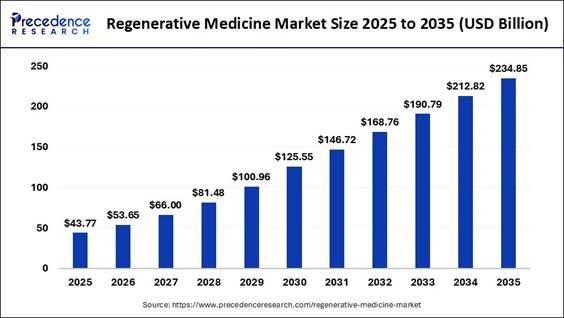
The global regenerative medicine market size stood at USD 43.77 billion in 2025 and is predicted to grow from USD 53.65 billion in 2026 to approximately USD 234.85 billion by 2035, expanding at a healthy CAGR of 18.29% from 2026 to 2035.
Across the world, the shift from high-cost experimental therapies to scalable off-the-shelf solutions, driven by advances in stem cell research (iPSCs), gene editing, and 3D bioprinting, is moving the industry toward standardized, automated manufacturing for treating chronic musculoskeletal, neurological, and cancer conditions. At the same time, the integration of AI-powered digital twins and smart bioreactors is improving yields and speeding up the journey from lab to market, reinforcing the move toward accessible, curative biotherapeutics.
Where Data Meets Strategic Clarity 📥 View Sample Pages of the Complete Report 👉 https://www.precedenceresearch.com/sample/1176
According to healthcare industry estimates, millions of patients globally continue to face limited treatment options for degenerative diseases, chronic wounds, organ failure, and rare genetic disorders. Regenerative medicine is increasingly viewed as a long-term solution capable of restoring tissue functionality while reducing dependence on lifelong disease management therapies.
Regenerative Medicine Market Key Takeaways
🔹North America dominated with the largest market share of 48% in 2025.
🔹Asia Pacific is anticipated to have the fastest growth with a notable CAGR during the forecast period.
🔹By product, the cell therapy segment held a major market share of 57% in 2025.
🔹By product, the tissue-engineering segment is expected to expand at a notable CAGR from 2026 to 2035.
🔹By material, the biologically derived materials segment captured the highest market share of 51% in 2025.
🔹By material, the synthetic materials segment is poised to grow at a healthy CAGR between 2026 and 2035.
🔹By application, the musculoskeletal segment contributed the highest market share of 32.86% in 2025.
🔹By application, the wound healing segment is growing at a strong CAGR between 2026 and 2035.
Market Overview: The New Standard of Care
The regenerative medicine market is growing rapidly, focusing on curing diseases by repairing, replacing, or regenerating damaged human cells, tissues, or organs. Using advanced technologies like stem cell therapy, gene editing such as CRISPR, and tissue engineering, this sector is shifting healthcare towards proactive, curative treatments.
Growth is mainly driven by the rising number of chronic conditions like cancer and heart disease, along with strong research and development investments and increasing approval of new therapies.
Regenerative medicine is transitioning from niche experimental science to mainstream clinical commercialization. The convergence of AI, gene editing, and scalable cell manufacturing is expected to redefine the future of chronic disease treatment over the next decade,” said a senior healthcare analyst at Precedence Research.
➡️ Become a valued research partner with us ☎ https://www.precedenceresearch.com/schedule-meeting
AI and 3D Bioprinting for Personalized Medicine: Major Potential
The groundbreaking combination of 3D bioprinting and AI is bridging the gap between tissue engineering and functional organ replacement, providing a patient-specific, scalable solution to address chronic organ shortages. By utilizing AI-enhanced bioreactors to cut production costs and advancing iPSC technology, this interdisciplinary approach enables the creation of vascularized, autologous tissue structures that reduce rejection. This ultimately transforms regenerative medicine from experimental research into personalized, accessible cures for end-stage organ failure.
Why Investors Are Watching the Regenerative Medicine Market?
Investors and biotechnology leaders are increasingly focusing on regenerative medicine due to rising clinical success rates, favorable regulatory incentives, expanding late-stage therapy pipelines, and growing demand for personalized medicine. The sector is witnessing increased venture capital funding, strategic partnerships, and acquisitions aimed at strengthening cell therapy manufacturing capabilities and accelerating commercialization.
In addition, orphan drug incentives, fast-track regulatory programs, and expanding reimbursement discussions for advanced therapies are improving the long-term commercial outlook for regenerative medicine companies.
The High Cost of Advanced Care: Major Limitation
The regenerative medicine revolution faces a key challenge: despite immense therapeutic potential, high-tech manufacturing difficulties and exorbitant costs, highlighted by the scaling struggles of therapies like Kymriah and the multimillion-dollar price tags of Zolgensma, threaten to limit patient access and market growth. This crisis is worsened by inadequate reimbursement systems and a fragmented global regulatory landscape, which turn pioneering science into a logistical and financial challenge.
Discover What’s Driving the Market Forward👉 https://www.precedenceresearch.com/regenerative-medicine-market
Regenerative Medicine Market Report Coverage
|
Market Scope |
Details |
|
Market Size in 2025 |
USD 43.77 Billion |
|
Market Size in 2026 |
USD 53.65 Billion |
|
Market Size in 2035 |
USD 234.85 Billion |
|
Market Growth Rate (2026–2035) |
CAGR of 18.29% |
|
Largest Regional Market |
North America |
|
Fastest Growing Region |
Asia Pacific |
|
Base Year |
2025 |
|
Forecast Period |
2026 to 2035 |
|
Key Growth Driver |
Rising demand for personalized and curative therapies |
|
Major Technology Trend |
AI-integrated biomanufacturing and 3D bioprinting |
|
Major Market Challenge |
High manufacturing and therapy costs |
|
Segments Covered |
By Product, By Material, By Application, Region |
|
Regions Covered |
North America, Europe, Asia Pacific, Latin America, MEA |
|
Key Companies Profiled |
Aspect Biosystems, Integra LifeSciences Corporation, AstraZeneca, Novartis AG, Baxter, Medtronic plc, Amgen Inc., and others |
|
Notable Industry Trend |
Shift toward off-the-shelf regenerative therapies |
|
Innovation Focus Areas |
Gene editing, iPSCs, CAR-T therapies, tissue engineering |
Built for leaders who move markets.
Access live, actionable intelligence with Precedence Q. https://www.precedenceresearch.com/precedenceq/ Regenerative Medicine Market Regional Analysis North America led the market in 2025, mainly due to
heavy research and development investments, a high number of chronic and
age-related diseases, and a supportive regulatory environment that speeds up
therapy approvals. The U.S. and Canada boast advanced healthcare
infrastructure, offering top clinical settings for regenerative treatments.
Significant public and private funding, including from the NIH, supports intense
research in stem cells, tissue engineering, and gene therapy. The region hosts many leading
biotech and pharmaceutical companies, such as Pfizer,
Novartis, Astellas Pharma, and Moderna. What is the U.S. Regenerative Medicine
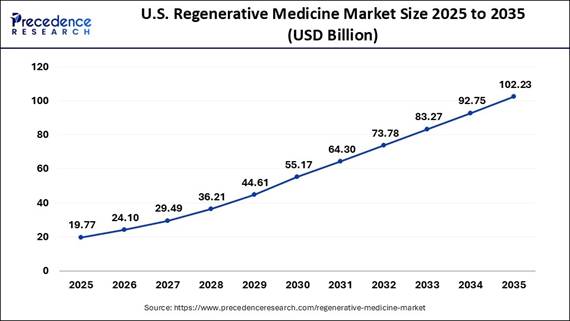
Market Size and Growth? The U.S. regenerative medicine market size was valued at USD
19.77 billion in 2025 and is expected to be worth around USD 102.23 billion by
2035, with a CAGR of 17.86% from 2026 to 2035. As the global hub for regenerative medicine, the U.S.
fosters innovation through top-tier academic research, sophisticated CDMO
manufacturing, and proactive FDA regulatory policies, especially through the
RMAT designation. Dominating in CAR-T, stem cell, and CRISPR therapies, the
U.S. ecosystem speeds up the transition from lab to clinic, setting the
worldwide benchmark for next-generation cures. 🔸 In September 2025, the FDA’s draft guidance
speeds up the development of regenerative medicines by creating clearer, faster
pathways for RMAT-designated therapies. This framework simplifies clinical
development through adaptive designs while maintaining quality with strict CMC
standards. (Source: FDA Gov) Canada has established itself as a North American leader in
regenerative medicine, pushing innovation by bridging basic research and
clinical application. With strong government backing and specialized
manufacturing capacity, the country is advancing stem cell research and tissue
engineering. Asia Pacific is expected to see the fastest growth during
the forecast period, driven mainly by supportive government policies, a
high prevalence of chronic diseases, increased research and development
investments, and a rapidly aging population. Countries like Japan and South
Korea have introduced expedited, conditional approval pathways for regenerative
therapies, making it easier to bring products to market. Governments in the
region are heavily funding stem cell research. There is a surge in AI use for
cell viability prediction and 3D bioprinting for tissue engineering, especially
in China and Singapore. India is quickly emerging as a global leader in affordable,
cutting-edge regenerative medicine, thanks to a large biotech talent pool and
rising investments in cell-based therapies. Key companies like Stempeutics
Research, Advancells, and Cryoviva Biotech are leveraging high-value market
growth to pioneer the next wave of precision medicine therapeutics. 🔸 In April 2025, India launched its first-ever human
gene therapy trial for Haemophilia A, conducted by BRIC-inStem and CMC Vellore.
Utilizing innovative lentiviral vector technology, this breakthrough aims to
provide a functional cure for the rare bleeding disorder, revolutionizing
indigenous biotech capabilities. (Source: PIB Gov) China is significantly transforming the global regenerative
medicine landscape. With advancements in CAR-T/TCR-T trials and leadership in
stem cell innovation, China's efforts are bolstered by intense government focus
and strategic funding. This has accelerated the translation of research into
clinical approvals for chronic conditions, shifting the nation from being
primarily a manufacturing hub to a source of first-in-class innovation, driving
the global research and development pipeline. 🔸 In March 2025, China's Boao Lecheng Pilot Zone made
significant strides in regenerative medicine by approving three cutting-edge
stem cell therapies for Knee Osteoarthritis, COPD, and Heart Failure. This
marks a new era of clinical accessibility to groundbreaking treatments for
degenerative diseases. (Source: Med Bridgenz) Get informed with deep-dive intelligence
on AI’s market impact https://www.precedenceresearch.com/ai-precedence Regenerative Medicine Market Segmental Analysis By Product Analysis The cell therapy segment dominated the market in 2025,
largely due to its widespread applications in oncology, chronic disease
treatment, and tissue repair. The sector is experiencing significant growth,
driven by an increase in GMP-certified production facilities, a growing adoption of CAR-T cell therapies, and
advancements in stem cell technology. Autologous therapies are particularly prominent.
Additionally, induced pluripotent stem cells are rapidly gaining traction,
providing a solution to the ethical concerns surrounding embryonic cells while
also offering superior differentiation capabilities. The tissue-engineering segment is expected to witness the
fastest growth during the forecast period. This is primarily due to
advancements in 3D bioprinting, increased demand for scaffold-based
technologies, and rising cases of chronic wounds. The growing incidence of
diabetes, cardiovascular diseases, and musculoskeletal injuries is driving the
need for advanced tissue repairs. Breakthroughs in 3D-engineered tissues are
enabling the creation of functional, personalized skin and organs, reducing
reliance on donor transplants and accelerating research and commercialization. By Material Analysis The biologically derived materials segment led the market
in 2025, primarily due to their superior biocompatibility, which mimics the
natural extracellular matrix to promote tissue healing and integration. These
materials are widely used in tissue engineering, particularly in creating
scaffolds for skin, bone, and cartilage repair, which are crucial for treating
chronic diseases and injuries. Their close resemblance to human biological
structures often results in better patient outcomes with fewer side effects,
solidifying this segment's market position. The synthetic materials segment is poised for significant
growth during the forecast period. This is mainly attributed to their high
reproducibility, low immunogenicity, and customizable degradation rates
suitable for tissue engineering scaffolds. These scaffolds are designed for
high porosity and biocompatibility to support stem cell proliferation,
differentiation, and tissue regeneration. They are generally less immunogenic
and more easily scalable for production, offering substantial advantages in
developing off-the-shelf regenerative products. By Application Analysis The musculoskeletal segment dominated the market in 2025
due to the high prevalence of bone, joint, and cartilage disorders, which is
further fueled by an aging population. This dominance is enhanced by advanced
stem cell research, tissue engineering, and 3D printing technologies for
repairing skeletal tissues. The segment leverages stem cells, particularly
mesenchymal stem cells, to regenerate damaged cartilage and bones. The
integration of 3D printing and scaffolding with tissue engineering provides
robust alternatives to traditional implants. The wound healing segment is projected to experience the
fastest growth during the forecast period. This surge is driven by the need
for advanced treatments for chronic and acute wounds through the use of stem cells, scaffolds, and growth
factors. Advanced therapies, including customizable nanofiber matrices and
bioengineered skin substitutes, are enhancing tissue integration and reducing
recovery times. There is a strong, ongoing shift from merely repairing tissue
to regenerating skin structures, utilizing both autologous and allogeneic cell
types. 🔓 Instant Access. Zero Waiting. 📥 Buy the Premium Market Research Report Now 👉 https://www.precedenceresearch.com/checkout/1176
✚ Related Topics You May Find Useful: ➡️
Regenerative Medicine in Dermatology Market:
Explore how stem cell therapies and tissue engineering are transforming
advanced skin repair and aesthetic treatments ➡️
Aesthetic Medicine Market: Discover how
minimally invasive procedures and personalized beauty solutions are reshaping
cosmetic healthcare demand ➡️
Nuclear Medicine Market: Analyze the growing
role of radiopharmaceuticals and precision imaging in cancer diagnosis and
targeted therapies ➡️
Preventive Medicine Market: Understand how
early disease detection and wellness-focused healthcare strategies are driving
market expansion ➡️
Concierge Medicine Market: Examine rising
consumer preference for personalized healthcare services and premium patient
experiences ➡️
Precision Medicine Market: Gain insights into
how genomics, AI, and targeted therapies are revolutionizing individualized
treatment approaches Regenerative Medicine Market Companies ➢ Aspect Biosystems ➢ AstraZeneca ➢ Novartis AG ➢ MiMedx Group ➢ Shenzhen SibionoGeneTech Co., Ltd. ➢ Integra LifeSciences Corporation ➢ Amgen, Inc. ➢ Medtronic plc ➢ Smith and Nephew plc ➢ Baxter Competitive Landscape and
Commercialization Trends Major pharmaceutical and biotechnology
companies are increasingly investing in regenerative medicine platforms through
acquisitions, licensing agreements, and manufacturing collaborations. Strategic
partnerships with CDMOs are becoming essential to address scalability
challenges, reduce production costs, and accelerate regulatory approvals. Companies focusing on scalable allogeneic
therapies, AI-powered manufacturing systems, and next-generation biomaterials
are expected to gain a significant competitive advantage over the next decade. Emerging Innovations in Regenerative Medicine Innovation Description
and Example Primary
Focus Area iPSC-Derived
Cell Therapies Example:
Aspen Neuroscience’s ANPD001, an autologous dopaminergic neuron replacement
therapy currently in clinical trials. Neurology
(Parkinson’s) and Personalized Medicine Exosome-Based
Therapies Example:
PranaX’s exosome-based wellness, focusing on delivering MSC-derived
extracellular vesicles to repair tissues without the risks of live cell
transplantation. Wound Care,
Cardiac repair, and Inflammation control 3D Bioprinted
Tissue/Organoids Example: 3D
bioprinted tissues for burn treatment or organoids (e.g., pancreas, liver)
that mimic human structure for transplant. Dermatology
(Burns), Organ Replacement and Drug Discovery In Vivo
CRISPR Gene Editing Example:
CRISPR-Cas9 to fix genetic defects directly in the body (e.g., treating
Sickle Cell, Muscular Dystrophy). Rare Diseases
and Genetic Disorders AI-Powered
Manufacturing Platforms Example:
Cellino’s autonomous, closed-loop platform using ML and laser-based
technology for rapid, patient-specific iPSC production. Scalability,
Quality Control, and Manufacturing
You can place an
order or ask any questions, please feel free to contact at sales@precedenceresearch.com | +1
804 441 9344 Major Shifts in the Regenerative Medicine Market 🔸 In March 2026, the U.S. FDA approved Kresladi
(marnetegragene autotemcel), the first gene therapy for severe Leukocyte
Adhesion Deficiency Type I (LAD-I) in pediatric patients lacking an HLA-matched
sibling donor. This accelerated approval provides a groundbreaking treatment
option by using genetically modified hematopoietic stem cells to restore CD18
and CD11a expression in white blood cells. (Source: FDA Gov) 🔸 In March 2026, MTF Biologics and Kolosis BIO
launched DBX Fiber, a new biomaterial for tissue regeneration. This innovative
product enhances surgical applications and promotes patient healing, expanding
its portfolio in regenerative medicine. (Source: National Today) 🔸 In February 2026, Japan-based Kidswell Bio and
Treehill Partners established Kidswell USA to expedite the development of stem
cell therapies for cerebral palsy. Their lead program, SQ-SHED, derived from
human deciduous teeth, has shown promising clinical efficacy, even in chronic
phases of the condition, focusing on advancing this therapy in the U.S. market,
with Thermo Fisher Scientific as their development partner. (Source: Cell Gene Therapy Review) Regenerative Medicine Market Segmentation By Product 🔸Gene
Therapies 🔸Cell
Therapies 🔸Tissue-Engineering 🔸Small
Molecules and Biologics By Material 🔸Synthetic
material → Biodegradable synthetic
polymers → Scaffold → Artificial
Vascular Graft → Materials
Hydrogel Material 🔸Biologically
derived material → Collagen → Xenogeneic
material 🔸Genetically
Engineered Material → Deoxyribonucleic
Acid Transfection Vectors → Genetically
Manipulated Cell → Three-Dimensional
Polymer Technology → Transgenics → Fibroblast → Neural
Stem Cell → Gene-Activated
Matrices 🔸Pharmaceutical → Biologics → Small
Molecules By Application 🔸Wound
Care 🔸Musculoskeletal 🔸Ophthalmology 🔸Oncology 🔸Cardiovascular 🔸Dermatology 🔸Neurology 🔸Others By Region 🔸North America 🔸Asia Pacific 🔸Europe 🔸Latin America 🔸Middle East and Africa Immediate
Delivery Available | Buy This Premium Research Report@ https://www.precedenceresearch.com/checkout/1176
Research Methodology 🔹Primary interviews with industry experts 🔹Secondary research from company reports, regulatory databases,
journals 🔹Market forecasting using top-down and bottom-up approaches 🔹Validation through triangulation models About Us Precedence Research is a global market
intelligence and consulting powerhouse, dedicated to unlocking deep strategic
insights that drive innovation and transformation. With a laser focus on
the dynamic world of life sciences, we specialize in decoding
the complexities of cell and gene therapy, drug development, and oncology markets,
helping our clients stay ahead in some of the most cutting-edge and high-stakes
domains in healthcare. Our expertise spans across the biotech and
pharmaceutical ecosystem, serving innovators, investors, and institutions that
are redefining what’s possible in regenerative
medicine, cancer care, precision therapeutics, and beyond. Web: https://www.precedenceresearch.com Our Trusted Data Partners: Towards
Healthcare | Nova
One Advisor | Market
Stats Insight Get Recent News: https://www.precedenceresearch.com/news For the Latest Update Follow Us: