
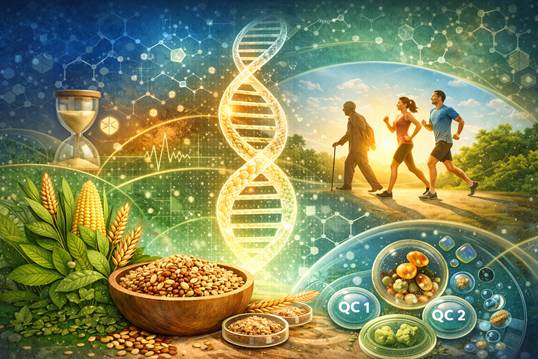
In recent years, one of the fastest-growing
areas in the biotechnology and health industry has been anti-aging and longevity
science.
Aging is no longer viewed merely as an inevitable natural process, but
increasingly as a biological phenomenon that can be understood, regulated, and
potentially optimized.
Global research trends are rapidly expanding beyond simply slowing down aging. They now encompass broader goals such as lifespan extension, improvement of healthspan, and even rejuvenation technologies aimed at restoring cellular function.
This shift signals a major transformation in the biotechnology industry—from a treatment-centered medical paradigm toward a preventive and regenerative approach that directly targets the biology of aging.
At this critical intersection, organic agricultural ingredients, particularly organic grains, are gaining renewed attention. They are emerging not only as natural food resources, but as sustainable and scientifically grounded platforms for next-generation longevity biotechnology.
Longevity Biotechnology Is Not Just
About Compounds, but About Organic Platforms That Regulate Aging Pathways The anti-aging market has long relied on
antioxidants and general immune-support ingredients. True longevity biotechnology is no longer about
simple nutritional supplementation. Instead, it focuses on regulating the core
hallmarks of aging, including key biological pathways such as: These pathways are now considered central
mechanisms in both lifespan extension and rejuvenation research. Within this context, organic
ingredient–based natural materials, supported by consumer trust and safety,
can evolve beyond traditional “natural extracts.” When integrated with
biotechnology, they hold the potential to become advanced platforms capable of
modulating aging-related pathways.
First, Fermentation and Enzymatic
Bioprocessing Enable Functional Design of Organic Ingredients Organic grain-based materials contain diverse
bioactive precursors, including proteins, polyphenols, and dietary fibers. During fermentation processes: This allows organic ingredients to expand
beyond conventional food applications and become scientifically engineered
longevity-targeted biomaterials. Ultimately, the future of longevity lies not
only in selecting good raw materials, but in developing bioprocess
technologies that can functionally design organic resources.
Second, QC Marker Standardization
Makes Organic Longevity Materials Industrially Viable Organic materials provide premium value and
sustainability, but they also naturally exhibit variability depending on
origin, season, and production lot. Therefore, for organic longevity ingredients to
succeed commercially, standardized quality control systems are essential. By defining two to three key QC markers and
applying them across the production process, organic materials can evolve into: Standardization is what scientifically
completes the trust and reliability of organic longevity materials.
Third, Autophagy Flux–Based Data Packages Enable Expansion Toward
Rejuvenation Biotechnology Rejuvenation technologies ultimately aim to
restore damaged cellular functions, and one of the most critical biological
mechanisms involved is autophagy. Autophagy plays a fundamental role in maintaining
cellular homeostasis through intracellular waste removal and renewal processes.
It is widely regarded as one of the strongest mechanistic pillars of lifespan
extension research. If fermentation-derived organic grain materials
can demonstrate measurable activation of autophagy flux, supported by
robust biological datasets, they can advance beyond basic antioxidant
positioning into: Such mechanistic data packages become key
assets that define the value of organic longevity materials.
Conclusion: Organic
Ingredient–Based Longevity Biotechnology Can Become a Core Industry of the
Future The biotechnology industry is rapidly
transitioning beyond disease treatment, toward technologies that manage aging,
extend healthspan, and restore biological function. Organic ingredient–based longevity materials,
when supported by: can emerge as highly competitive platforms
within the expanding fields of anti-aging, lifespan extension, and rejuvenation
biotechnology. Organic ingredients are no longer merely
“clean-label” resources. About Unexakorea Unexakorea conducts innovative research to make advanced
biotechnology accessible to everyone in everyday life. unexakorea is also evolving into a total life-care platform.
Grounded in research, science, and technology, the company designs everything
from small daily routines to an individual’s entire life cycle with precision preparing
for an era in which people can live healthily up to 123 years. To achieve this,
unexakorea is establishing a structural health infrastructure that does not
rely solely on individual effort, developing long-term generational strategies
based on science, and creating a sustainable wellness model in which benefits
are shared across society. As an R&D-driven company specializing in
healthcare and nutraceuticals, unexakorea pursues sustainable innovation backed
by the financial stability and technological capabilities of its parent
company. Moving beyond the nutraceutical market’s traditional focus on “rapid
absorption,” unexakorea is advancing sustained-release formulation
manufacturing technology designed to deliver stable efficacy in the body for
more than 10 hours. Furthermore, the company is shaping a new paradigm for sustainable
biotechnology through research in microbiome
However, modern longevity research is moving toward far more sophisticated
biological targets.
By applying fermentation or enzymatic biotechnology, these components can be
transformed and optimized into high-value functional biomaterials.
When integrated with longevity biotechnology, they represent a powerful and
sustainable foundation for the future healthspan industry.
By operating a variety of connectivity-based services that reduce information
gaps and eliminate daily inconveniences, the company is building a
people-centered platform ecosystem.