
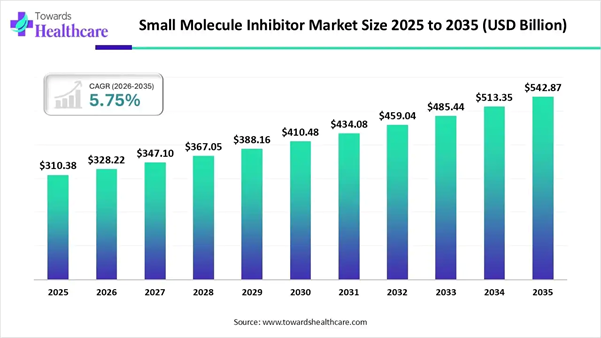
The global small molecule inhibitor market size was estimated at USD 310.38 billion in 2025 and is predicted to increase from USD 328.22 billion in 2026 to approximately USD 542.87 billion by 2035, expanding at a CAGR of 5.75% from 2026 to 2035.
The Complete Study is Now Available for Immediate Access | Download the Free Sample Pages of this Report @ https://www.towardshealthcare.com/download-sample/6512
The naturally occurring small molecule inhibitors are essential for life and regulate various metabolic processes. The laboratory-grown or natural small molecule inhibitors are widely applicable for use as drugs to treat diseases, used as pesticides and herbicides, and used in metabolic control. They are also used as analytical sensors in the monitoring of different environmental factors. Researchers are dedicated to understanding the mechanism of enzyme inhibition and degeneration, particularly when working with immobilized enzymes. The small molecule inhibitors are also referred to as natural toxins, which are natural inhibitors of many metabolic processes. The natural inhibitors target enzymes, structural protein functions, and receptor channels.
The Small Molecule Inhibitor Market: Highlights
• The small molecule inhibitor market will likely exceed USD 328.22 billion by 2026.
• Valuation is projected to hit USD 542.87 billion by 2035.
• Estimated to grow at a CAGR of 5.75% starting from 2026 to 2035.
• North America dominated the global small molecule inhibitor market in 2025.
• Asia Pacific is expected to be the fastest-growing region between 2026 and 2035.
• By drug class type, the immunomodulatory small molecules segment held the major revenue share in the market in 2025.
• By drug class type, the BCL-2 inhibitors segment is expected to be the fastest growing during the forecast period.
• By therapeutic area type, the oncology segment dominated the market in 2025.
• By therapeutic area type, the rare diseases segment is expected to be the fastest-growing during the forecast period.
• By sales channel type, the hospitals segment held the major revenue share in the market in 2025.
• By sales channel type, the cancer research institutes segment is expected to be the fastest-growing during the forecast period.
• By molecule type, the small organic molecules segment led the market in 2025.
• By molecule type, the peptidomimetics segment is expected to be the fastest growing during the forecast period.
You can place an order or ask any questions, please feel free to contact us at sales@towardshealthcare.com
Market Overview
Robust Research on High-Quality Small Molecule Inhibitors
The small molecule inhibitor market is accelerated by the huge potential of small molecule inhibitors in drug discovery and development, driven by their chemical properties, good spatial dispersion, and pharmacokinetic properties. These inhibitors show good interaction with proteins and can reduce the biological activity of target proteins, including transcription factor inhibitors, enzyme inhibitors, and ion channel blockers. They are categorized into potentially useful drugs, and related products are useful in medical research, pharmaceutical research, metabolic disease, cancer, neurological disease, and more. They act on signaling pathway targets such as apoptosis, cell cycle, DNA damage, PI3K/Akt/mTOR, JAK/STAT, and many more.
The Small Molecule Drug Approvals by the U.S. FDA in 2025
|
Sr. No. |
Therapeutic Areas |
Name of the Drug |
|
|
Oncology |
• treosulfan • avutometinib + defactinib • taletrectinib • sunvozertinib • dordaviprone |
|
|
Genetic Diseases |
• mirdametinib • elamipretide • doxecitine and doxribtimine |
|
|
Neurology and Pain |
• suzetrigine • Tradipitant |
|
|
Infectious Diseases |
• gepotidacin • zoliflodacin |
|
|
Hematology |
• rilzabrutinib |
Become a valued research partner with us - https://www.towardshealthcare.com/schedule-meeting
The Small Molecule Inhibitor Market: Regional Analysis
North America dominated the market in 2025, owing to robust oncology research and targeted therapies, technological advancements in AI and ML, and the growing shift towards strategic outsourcing. The funds and research, driven by the National Institutes of Health (NIH), support major industry breakthroughs, including cancer therapies, mRNA vaccines, and CRISPR. It also ensures national power and security, protects the health of Americans, and supports biopharmaceutical innovations in the U.S. The investments by the NIH deliver powerful economic returns and boost private R&D, startups, patents, and regional innovation hubs.
U.S. Market Analysis
The rising disease burden of cancer, obesity, metabolic disorders, diabetes, and cardiovascular diseases accelerates the small molecule inhibitor market in the U.S. The leading international research collaborations, global standards set by the NIH, and strong health security in the U.S. are strengthening American firms at the forefront of innovation.
• In June 2025, Actio Biosciences, the U.S.-based company, raised $66 million for a genetics-driven small molecule therapeutics pipeline, aiming to prevent and treat rare and common diseases. This financing round was backed by Deerfield Management and Regeneron Ventures to boost the development of the company’s lead oral programmes.
Asia Pacific is expected to grow at the fastest rate in the market during the forecast period due to robust manufacturing and infrastructure scaling, strategic government support and policies, investments in healthcare, global clinical trials, and technological innovations. Asia Pacific is growing through innovations in technology-driven platforms and advanced therapeutics. This region is witnessing the heavy investments in cell and gene therapies, mRNA therapeutics, and antibody drug conjugates.
India Market Trends
The small molecule inhibitor market in India witnesses a surge in high-potency APIs, the expanding presence of contract development and manufacturing organizations, and regulatory reforms that drive the country’s growth. Under the Promotion of Research and Innovation in Pharma MedTech Sector (PRIP) scheme, the seven centers of excellence are established in the areas of anti-bacterial and anti-viral drug discovery and development, bulk drugs, medical devices, novel drug delivery systems, flow chemistry, continuous manufacturing, phytopharmaceuticals, and biological therapeutics. On the other hand, the Production Linked Incentive (PLI) scheme aims to enhance India’s manufacturing capabilities through increased investments and production in the sector.
Get the latest insights on life science industry segmentation with our Annual Membership: https://www.towardshealthcare.com/get-an-annual-membership
The Small Molecule Inhibitor Market: Segmentation Analysis
Drug Class Type Insights
The immunomodulatory small molecules segment dominated the small molecule inhibitor market in 2025, owing to the rapid shift of researchers towards the development of small molecule-based cancer immunotherapy, driven by its potential to overcome the disadvantages related to antibodies. Moreover, therapeutic antibodies and small molecule-based immunomodulators are ideal solutions for cancer treatment. The global market has witnessed the rapid development of small molecule-based immunomodulators for cancer therapy.
The BCL-2 inhibitors segment is expected to be the fastest-growing in the small molecule inhibitor market during the forecast period due to their wide applications in treating blood-related malignancies, such as chronic lymphocytic leukemia, acute myeloid leukemia, and other blood cancers. These drugs are approved for use in older adults for intensive chemotherapy. The ongoing research also explores their applications for treating multiple myeloma and various types of Non-Hodgkin Lymphoma.
Therapeutic Area Type Insights
The oncology segment dominated the small molecule inhibitor market in 2025, owing to the wide potential of small-molecule cancer drugs in targeting extracellular and cell surface ligand-binding receptors, and intracellular proteins, including anti-apoptotic proteins. Research was conducted on molecularly targeted cancer drug discovery that has led to several small-molecule drugs in the clinic for cancer treatment. Most of these drugs inhibit critical cancer targets such as threonine, serine, or tyrosine kinase, heat shock proteins, and many others.
The rare diseases segment is expected to be the fastest-growing in the small molecule inhibitor market during the upcoming period due to the major role of small molecule inhibitors in enzyme inhibition, substrate reduction, chemical chaperoning, RNA splicing, translation modification, and precision oncology. The small-molecule inhibitor drugs are advantageous for oral administration, tissue penetration, lower manufacturing costs, and stability. The small molecules act as chaperones to stabilize misfolded proteins in the chemical chaperoning method.
Sales Channel Type Insights
The hospitals segment led the small molecule inhibitor market in 2025, owing to the major use of small-molecule inhibitor drugs in clinical settings for targeted cancer therapy, precision medicine, and management of chronic conditions. Certain small molecules are used for the management of acute events while meeting immediate hospital needs. These drugs are good solutions for radiation, traditional chemotherapy, or immunotherapy to enhance treatment durability and overcome drug resistance.
The cancer research institutes segment is expected to grow at the fastest rate in the small molecule inhibitor market during the studied period due to the wide use of small molecules for the development of targeted therapies. The chemical nature of these molecules makes them easier to modify in the laboratory to reduce off-target toxicity and improve potency. Research into small-molecule inhibitors focuses on precision blocking specific proteins or pathways that boost tumor growth.
Molecule Type Insights
The small organic molecules segment dominated the small molecule inhibitor market in 2025, owing to their potential to act as fundamental building blocks of life and the primary tools for modern technology and medicine. The biological roles of these molecules include sugars, fatty acids, amino acids, nucleotides, signaling, and regulation. The pharmaceutical role lies in modern medicine as enzyme inhibitors, receptor modulators, pain and inflammation management, and targeting undruggable sites.
The peptidomimetics segment is expected to grow rapidly in the small molecule inhibitor market during the predicted timeframe due to advances in peptide drug discovery, including organic chemistry and biotechnology, emerging as pivotal tools to develop peptidomimetics. They exhibit improved specificity, stability, and bioavailability over conventional peptides. The peptides and peptidomimetics are integrated into medicine and pharmacology, and are advancing due to modern biotechnological innovations for novel molecular transformations.
-------
Access our exclusive, data-rich dashboard dedicated to the healthcare market - built specifically for decision-makers, strategists, and industry leaders. The dashboard features comprehensive statistical data, segment-wise market breakdowns, regional performance shares, detailed company profiles, annual updates, and much more. From market sizing to competitive intelligence, this powerful tool is one-stop solution to your gateway.
Access our comprehensive healthcare dashboard for detailed market insights, segment breakdowns, regional performance, and company profiles: https://www.towardshealthcare.com/access-dashboard
The Small Molecule Inhibitor Market Companies
• Novartis AG
• Pfizer Inc.
• Gilead Sciences, Inc.
• Takeda Pharmaceutical Co
• Eli Lilly and Company
• Roche Holding AG
• AstraZeneca plc
• Bristol-Myers Squibb
• Amgen Inc.
• Merck & Co., Inc.
Segments Covered in the Report
By Drug Class
• Kinase inhibitors
• Proteasome inhibitors
• PARP inhibitors
• BCL-2 inhibitors
• BTK inhibitors
• CDK inhibitors
• Immunomodulatory small molecules
• CGRP inhibitors
• Others
By Therapeutic Area
• Oncology
• Autoimmune and inflammatory diseases
• Infectious diseases
• Neurology
• Cardiovascular and metabolic disorders
• Rare diseases
• Pain management
By Sales Channel
• Hospitals
• Cancer research institutes
• Specialty clinics
• Retail pharmacy chains
• Specialty pharmacies
• Mail order pharmacies
By Molecule
• Small organic molecules
• Peptidomimetics
• Natural product-derived molecules
By Region
• North America
• South America
• Europe
• Asia Pacific
• MEA
Immediate Delivery Available | Buy This Research Report Now @ https://www.towardshealthcare.com/checkout/6512
About Us
Towards Healthcare Research & Consulting is a leading global provider of technological solutions, clinical research services, and advanced analytics, with a strong emphasis on life science research. Dedicated to advancing innovation in the life sciences sector, we build strategic partnerships that generate actionable insights and transformative breakthroughs. As a global strategy consulting firm, we empower life science leaders to gain a competitive edge, drive research excellence, and accelerate sustainable growth.
You can place an order or ask any questions, please feel free to contact us at sales@towardshealthcare.com
Europe Region: +44 778 256 0738
North America Region: +1 8044 4193 44
APAC Region: +91 9356 9282 04
Web: https://www.towardshealthcare.com
Our Trusted Data Partners
Precedence Research | Towards Packaging | Towards Food and Beverages | Towards Chemical and Materials | Towards Dental | Towards EV Solutions | Healthcare Webwire
Find us on social platforms: LinkedIn | Twitter | Instagram | Medium | Pinterest
Browse More Insights of Towards Healthcare:
The hemophilia inhibitors market size stood at US$ 16.43 billion in 2025, grew to US$ 17.43 billion in 2026, and is forecast to reach US$ 29.54 billion by 2035, expanding at a CAGR of 6.04% from 2026 to 2035.
The global oral factor Xa inhibitors market is estimate at US$ 25.38 billion in 2026 and is projected to grow to US$ 43.75 billion by 2035, rising at a compound annual growth rate (CAGR) of 6.1% from 2026 to 2035.
The global factor Xa inhibitors market was estimated at US$ 22.1 billion in 2023 and is projected to grow to US$ 41.52 billion by 2034, rising at a compound annual growth rate (CAGR) of 5.9% from 2024 to 2034.
The global CDK4/6 inhibitors market size is calculated at USD 11.38 billion in 2024, grew to USD 13.12 billion in 2025, and is projected to reach around USD 46.96 billion by 2034. The market is expanding at a CAGR of 15.34% between 2025 and 2034.
The global hematologic malignancies treatment market size marked US$ 67.32 billion in 2024 and is forecast to experience consistent growth, reaching US$ 72.49 billion in 2025 and US$ 139.13 billion by 2034 at a CAGR of 7.61%.
The global molecule therapeutics market is emerging as a high-potential sector, set on a strong growth path from 2024 to 2034. This upward momentum is driven by rapid advancements in precision medicine, rising demand for targeted therapies, and a growing focus on individualized treatment approaches.
The global small molecule CMO and CDMO market size was estimated at USD 75.8 billion in 2025 and is predicted to increase from USD 79.7 billion in 2026 to approximately USD 125.13 billion by 2035, expanding at a CAGR of 5.14% from 2026 to 2035.
The global small molecule API market size is calculated at US$ 206.9 billion in 2025, grew to US$ 219.52 billion in 2026, and is projected to reach around US$ 374.03 billion by 2035. The market is expanding at a CAGR of 6.1% between 2026 and 2035.
The GLP-1 small molecule market is rapidly advancing on a scale, with expectations of accumulating hundreds of millions in revenue between 2026 and 2035.
The global small molecule CDMO market size is calculated at US$ 72.81 in 2024, grew to US$ 78.01 billion in 2025, and is projected to reach around US$ 145.12 billion by 2034. The market is expanding at a CAGR of 7.14% between 2025 and 2034.

