
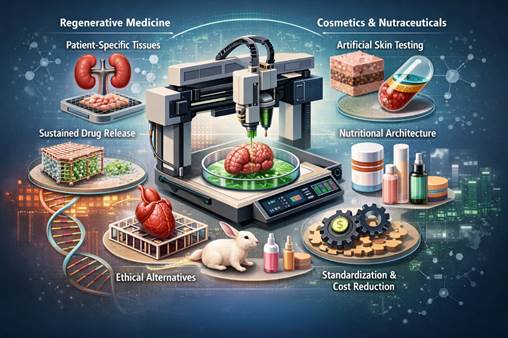
Bioprinting technology, which goes beyond simple ingredient delivery to replicate the structure and function of biological tissues, is emerging as a core driver in the regenerative medicine, cosmetics, and nutraceutical industries. The field is now expanding into the realm of precision medicine through Bio-ink technology, which integrates living cells with biomaterials.
1. Innovation in Regenerative Medicine: From Simple Healing to ‘Functional Reconstruction’
The greatest value of bioprinting in regenerative medicine lies in the production of patient-specific tissue.
● Biomimetic Constructs: Bio-inks are printed containing live cells to reproduce the complex extracellular matrix (ECM) of human tissue. This minimizes immune rejection during the transplantation of damaged organs or skin tissues and facilitates organic integration with surrounding tissues.
● Targeted and Sustained-Release Therapy: When scaffolds are manufactured using bio-inks infused with drugs, treatment efficiency can be maximized by precisely releasing nutrients and growth factors (Sustained Release) in synchronization with the rate of tissue regeneration.
2. Cosmetics and Nutraceuticals: Prospects as High-Value Future Growth Engines
Bioprinting will be the key to opening the 'Hyper-personalization' market, moving away from traditional mass-production methods.
● Alternatives to Animal Testing and Safety: Artificial skin models realized through 3D printing allow for more ethical and scientific verification of the efficacy of cosmetics and functional health foods. This will become an essential technological asset amidst the strengthening of global Environmental, Social, and Governance (ESG) regulations.
● Advancement of Functional Formulations: In the nutraceutical field, 'Nutritional Architecture'—the three-dimensional placement of ingredients with different release mechanisms within a single formulation—becomes possible. This signifies a high-level approach to health management that goes beyond convenience, controlling the Residence Time of nutrients within the body.
3. Technical Challenges and a Neutral Outlook
For bioprinting technology to establish itself as a long-term "future growth engine," a balanced perspective on several challenges is required.
● Standardization and Regulation: International guidelines must be established to ensure the biocompatibility of bio-inks and the reproducibility of printed outputs.
● Securing Economic Viability: Process automation and material innovation must occur simultaneously to lower current high manufacturing costs and disseminate the technology as a popular solution.
Conclusion: A New Ecosystem Built on Structural Design
Ultimately, the essence of bioprinting and bio-ink technology lies in the "control of time and space." By designing structures optimized for the internal physiological environment of the human body, we will enjoy safer, more effective regenerative treatments and personalized health solutions.
Beyond mere progress in medical
technology, this field is expected to serve as a pivotal axis of the future economy,
creating a massive new industrial ecosystem where biotechnology, ICT, and
chemical engineering converge.