Seattle, WA | Wednesday, June 10th, 2026 – The Allen Institute is using NeuroGlass to support team-based
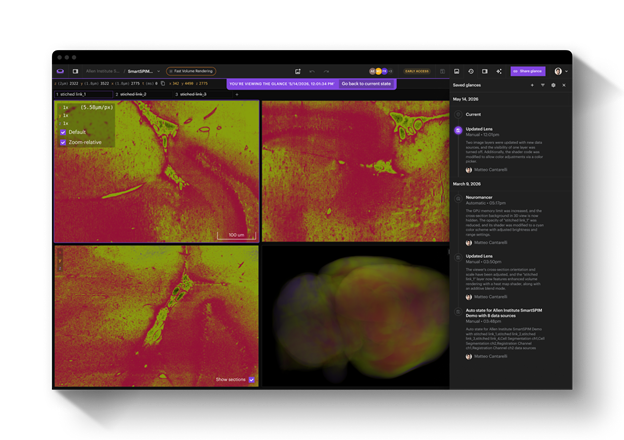
exploration of large brain imaging datasets. Built by MetaCell as a cloud-based
collaboration platform, NeuroGlass makes it easier to manage and explore
volumetric 3D imaging data by preserving context, decisions, and shareable
views.
The Allen Institute has long been a leader in
open, large-scale, team science. As imaging datasets grow in size and
complexity, a new challenge has emerged: making exploration and interpretation
truly collaborative, so insights don't live in scattered links, personal notes,
or one-off screenshots, but instead become shared, reusable context that
researchers can build on.
NeuroGlass is built for that shift.
"The Institute’s mission depends on
turning complex datasets into shared understanding across disciplines,"
said Forrest Collman, Associate Director at the Allen Institute. "Our
teams are using NeuroGlass to help us treat visualization not as a private
activity, but as an institute-wide workflow, where the context around a view is
preserved and easy to revisit."
Neuroglancer has become a foundational tool
for high-resolution visualization across modern neuroscience, widely used by
researchers working with large volumetric datasets because it can render
complex 3D image data directly in the browser and make those views easy to
share. NeuroGlass builds on that foundation by adding the collaborative layer
teams need around visualization and analysis: helping researchers capture
important views, annotate and revisit them, coordinate review, and keep work
organized across projects and time. The goal is simple: reduce friction in
collaboration so researchers spend less time managing links, screenshots, and
scattered context, and more time making decisions, testing hypotheses, and
communicating results.
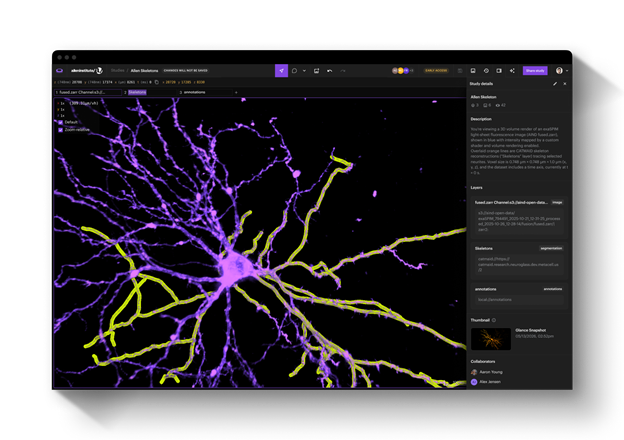
For the Allen Institute, NeuroGlass will
support workflows where many contributors need to stay aligned — including
neuron tracing, segmentation proofreading, and quality review of reconstructed
cells. Over time, the collaboration aims to help teams build on one another's
work, onboard new collaborators faster, and maintain a clear thread from raw
data to published conclusions.
The challenge is widespread: as imaging teams
generate ever-larger datasets, the imperative to collaborate on making sense of
imaging data grows, and collaboration tools haven't kept pace. Researchers
routinely pass around thousands of saved views with no shared way to organize,
annotate, or trace decisions back to the data. NeuroGlass was designed to close
that gap.
"When collaboration depends on passing
around links with no shared context, the science slows down," said Matteo
Cantarelli, CTO and co-founder of MetaCell. "We're building a platform
that can unify all imaging workflows in structural biology — making insights
fully traced, reproducible, and durable. We're hearing this need consistently
across the field.”
NeuroGlass (https://www.neuroglass.com/)
is a cloud platform that provides a novel, enhanced Neuroglancer experience for
teams working with large microscopy datasets, helping them explore, annotate,
and collaborate with less friction. It supports a broad spectrum of volumetric
3D imaging data, spanning connectomics, cryo-EM/ET, expansion microscopy,
high-resolution cellular imaging, spatial transcriptomics, developmental and
molecular imaging, as well as electron and fluorescence microscopy.
MetaCell (https://www.metacell.us/) is a life
science-focused software company composed of scientists and software engineers
with deep domain expertise in computational neuroscience, molecular biology,
data science, and enterprise-grade online software development. Their solutions
and products have been trusted for over 15 years by some of the world's largest
pharmaceutical companies, leading universities and research institutions.
The Allen Institute (https://alleninstitute.org/)
is an independent nonprofit bioscience research organization that brings
biologists, engineers, and data scientists together to tackle foundational
questions in neuroscience, cell biology, and immunology, and to accelerate discoveries
that advance human health. A core part of its model is large-scale, team-based
science and broadly sharing data and tools with the research community.
NeuroGlass by MetaCell | Paolo Lenotti, paolo@metacell.us,
+44 7450 948685