
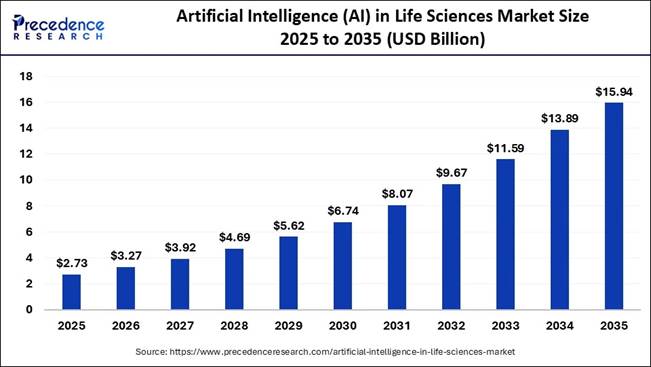
The AI in life sciences market is growing steadily as companies look for faster and more efficient ways to develop drugs and improve patient outcomes. The artificial intelligence in life sciences market size is expected to grow from USD 3.27 billion in 2026 to nearly USD 15.94 billion by 2035, growing at a strong CAGR of 19.30% over the next decade.
From pixels to patients, AI is transforming life sciences by evolving from pilot experiments to mission-critical infrastructure. This shift creates a revolution that compresses decades of research and development into just months. By integrating generative AI, multi-modal data, and automated robotics, companies are accelerating target identification, de novo molecular design, and trial efficiency, particularly in oncology and rare diseases. This transformation turns the journey from molecule to market into an intelligent, 24/7 digital enterprise.
Generative
AI technologies, including transformer-based models and
diffusion models, are increasingly being used to design novel molecular
structures, predict protein
folding, and optimize drug candidates. These approaches allow researchers to simulate
and refine compounds in silico before moving to laboratory validation,
significantly reducing experimental cycles.
Where Data Meets
Strategic Clarity 📥 View Sample Pages of the Complete
Report 👉 https://www.precedenceresearch.com/sample/1776
AI in Life Sciences Market Highlights
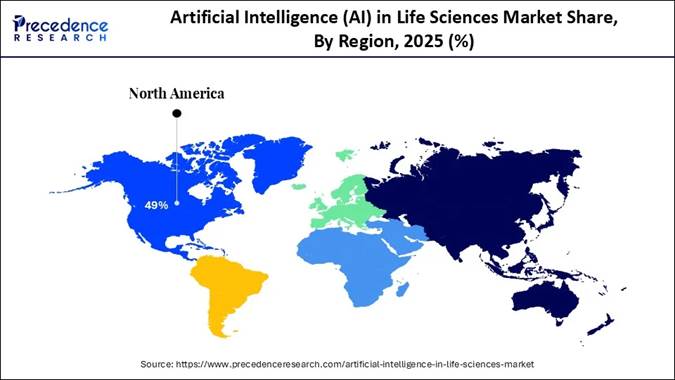
🔹 North America accounted for the highest market share of 49% in 2025.
🔹 Asia Pacific is anticipated to have the fastest growth with a notable CAGR during the forecast period.
🔹 By offering, the software segment contributed the highest market share in 2025.
🔹 By offering, the services segment is growing at a strong CAGR between 2026 and 2035.
🔹 By deployment, the cloud deployment segment held a major market share in 2025.
🔹 By deployment, the on-premise segment is expected to expand to a notable CAGR from 2026 to 2035.
🔹 By application, the drug discovery segment captured the highest market share in 2025.
🔹 By application, the clinical trials segment is poised to grow at a healthy CAGR between 2026 and 2035.
Market Overview: Redefining Life Sciences and Accelerating Drug Discovery
The Artificial Intelligence (AI) in the life sciences market combines machine learning, algorithms, and advanced analytics with biology, pharmaceuticals, and medicine to enhance drug discovery, optimize clinical trials, and personalize medicine. This technology enables pattern recognition and predictive insights that improve research and development efficiency, diagnostics, and therapeutic innovations.
Key drivers of market growth include the need for faster drug discovery, reduced research and development costs, and the abundance of genomic and clinical data. Regulatory acceptance of AI-derived biomarkers is also accelerating the adoption of these technologies.
Recent implementations of AI in drug discovery have demonstrated measurable gains, including reductions in early-stage discovery timelines by up to 30–50% and significant cost savings across preclinical and clinical phases. AI-driven patient stratification and protocol optimization are also contributing to improved clinical trial success rates and reduced attrition.
From a commercial perspective, these advancements are improving R&D productivity by lowering the cost per molecule, shortening time-to-market, and enabling earlier revenue realization. This is becoming increasingly critical as drug development costs continue to rise across the industry.
🔗 What’s Fueling the Next Wave of Growth? 👉 https://www.precedenceresearch.com/artificial-intelligence-in-life-sciences-market
Data Infrastructure: Foundation of AI-Driven Life Sciences
The effectiveness of AI in life sciences depends heavily on robust data infrastructure. Organizations are increasingly integrating diverse datasets, including genomics, electronic health records, medical imaging, and real-world evidence.
Technologies such as cloud-based data lakes, federated learning, and synthetic data generation are enabling secure, scalable, and privacy-compliant AI deployment across global research ecosystems.
AI-Powered Spatial and Single-Cell Transcriptomics: Major Opportunity
Integrating AI with spatial and single-cell transcriptomics presents a transformative opportunity, delivering a subcellular Google Maps for gene expression, revealing the hidden architecture of tissue heterogeneity and cellular communication.
By leveraging deep learning to analyze high-dimensional, complex datasets, researchers can uncover novel biomarkers, accurately map the tumor microenvironment, and simulate treatment outcomes in 3D. This synergy between spatial omics and AI accelerates target identification and streamlines drug discovery, fundamentally reshaping precision medicine and translational research.
Data Heterogeneity and Regulatory Inconsistency: Major Limitations
The widespread adoption of AI-driven transcriptomics
faces significant hurdles due to data heterogeneity and a fragmented regulatory
landscape. A lack of standardized protocols across diverse platforms produces
noisy, low-reproducibility data that complicates AI generalization.
The widespread adoption of AI-driven transcriptomics faces significant hurdles
due to data heterogeneity and a fragmented regulatory landscape. A lack of
standardized protocols across diverse platforms produces noisy, low-reproducibility
data that complicates AI generalization. At the same time, evolving regulatory
frameworks such as the EU AI Act and the U.S. Food and Drug Administration’s
guidance on AI/ML-based software introduce compliance complexities related to
transparency, validation, and lifecycle monitoring, which can extend approval
timelines.
Additional challenges include potential bias in training datasets, limited model interpretability, and concerns around data privacy and cybersecurity. The use of AI-generated outputs in clinical decision-making also raises questions about accountability and validation, particularly in high-risk therapeutic areas.
➡️ Become a valued research partner with us https://www.precedenceresearch.com/schedule-meeting
Artificial Intelligence (AI) in Life Sciences Market Key Players
The competitive landscape is characterized by a mix of technology providers, AI-native biotech firms, and healthcare analytics companies, each contributing distinct capabilities across the value chain, from data processing and model development to clinical application and commercialization.
➢ IBM Corporation
➢ Atomwise, Inc.
➢ Nuance Communications, Inc.
➢ NuMedii, Inc.
➢ AiCure LLC.
➢ APIXIO, Inc.
➢ Insilico Medicine, Inc.
➢ Enlitic, Inc.
➢ Sensely, Inc.
➢ Zebra Medical Vision
Scaling AI Across the Life Sciences Value Chain
AI is increasingly being embedded across the entire life sciences value chain, including target identification, preclinical modeling, clinical trial design, regulatory submission, and post-market surveillance. This end-to-end integration is enabling more connected, data-driven decision-making across all stages of product development.
|
Company |
Latest Updates |
|
Insilico Medicine (March 2026) |
Announced a global R&D collaboration with Eli Lilly to accelerate drug discovery using their proprietary AI platform. (Source: https://www.pharmexec.com) |
|
AstraZeneca & Daiichi Sankyo (March 2026) |
Secured FDA Priority Review for Enhertu, guided by AI-identified biomarkers, highlighting advancements in AI-driven precision medicine. (Source: https://www.biopharminternational.com) |
|
Integra Therapeutics (Oct 2025) |
Validated that generative AI outperforms natural processes in designing proteins for genome editing. (Source: https://www.biopharminternational.com) |
|
Ginkgo Bioworks (September 2025) |
Introduced Datapoints, specialized curated datasets for training AI models, emphasizing data quality. (Source: https://www.prnewswire.com) |
Major Shifts Defining Artificial
Intelligence (AI) in Life Sciences Technology
Recent developments indicate a shift toward platform-based ecosystems, where AI capabilities are being embedded directly into clinical and operational workflows.
🔸 In February 2026, Supreme Group launched Supreme Intelligence, a specialized AI platform for healthcare and life sciences. This proprietary solution enhances how client work is planned and measured, offering significant improvements in campaign speed and quality. This can solve complex business problems more effectively, stated CEO Tom Donnelly. (Source: https://www.prnewswire.com)
🔸 In January 2026, Anthropic introduced Claude for Healthcare, designed for providers and payers with HIPAA-ready infrastructure and models tailored for healthcare tasks. This marks Anthropic’s entry into the healthcare sector, realizing potential in accelerating workflows by integrating with tools professionals use daily. (Source: https://www.fiercehealthcare.com/ai-and-machine-learning/jpm26-anthropic-launches-claude-healthcare-targeting-health-systems-payers)
🔸 In June 2025, IQVIA revealed custom-built AI agents using NVIDIA technology to improve workflows in life sciences. These agents enhance insights and operations, with applications in target identification, clinical data review, and HCP engagement. (Source: https://www.biospectrumasia.com)
AI in Life Sciences Market Report Coverage
|
Report Coverage |
Details |
|
Market Size in 2025 |
USD 2.73 Billion |
|
Market Size in 2026 |
USD 3.27 Billion |
|
Market Size by 2035 |
USD 15.94 Billion |
|
Market CAGR (2026–2035) |
CAGR of 19.30% |
|
Largest Market |
North America (driven by strong R&D investment, advanced healthcare infrastructure, and early adoption of AI across pharma and biotech industries) |
|
Fastest Growing Region |
Asia-Pacific (driven by rapid digital transformation, expanding healthcare infrastructure, and increasing availability of large-scale clinical and genomic datasets) |
|
Base Year |
2025 |
|
Forecast Period |
2026 to 2035 |
|
Segments Covered |
Offering (Software, Hardware, Services); Deployment (Cloud, On-premise); Application (Drug Discovery, Clinical Trials, Medical Diagnosis, Precision & Personalized Medicine, Biotechnology, Patient Monitoring) |
|
Regions Covered |
North America, Europe, Asia-Pacific, Latin America, Middle East & Africa |
|
Key Growth Drivers |
Rising R&D costs, increasing demand for faster drug discovery, expansion of multi-omics and real-world evidence datasets, and growing adoption of generative AI in life sciences workflows |
|
Key Technology Trends |
Generative AI, machine learning, deep learning, natural language processing (NLP), predictive analytics, and AI-driven automation across research and clinical development |
|
Major Opportunity |
Integration of AI with spatial and single-cell transcriptomics enabling advanced biomarker discovery, tumor mapping, and precision medicine innovation |
|
Key Challenge |
Data heterogeneity, lack of standardization across platforms, regulatory complexity, and concerns around model transparency, validation, and clinical accountability |
|
Leading Market Participants |
IBM Corporation, Insilico Medicine, Atomwise, IQVIA, NVIDIA-powered healthcare AI platforms, and other emerging AI-native biotech firms |
Life Sciences Market Overview: Strategic Foundation Powering AI-Driven Transformation
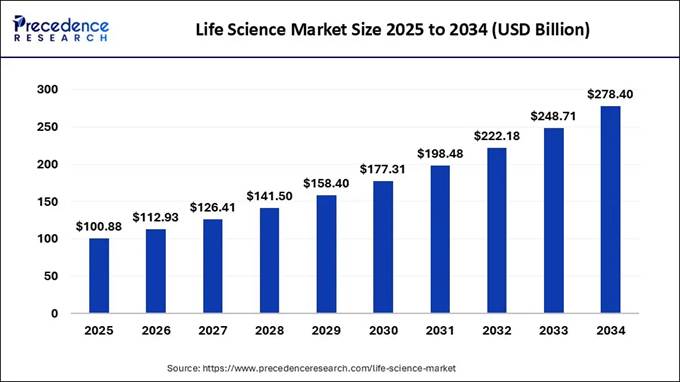
The global life sciences market is a highly advanced and innovation-led sector covering pharmaceuticals, biotechnology, diagnostics, and medical devices. It is estimated at around USD 112.93 billion in 2026 and is projected to reach approximately USD 280,40 billion by 2034, expanding at a CAGR of 11.94% during the forecast period. Growth is being supported by rising global healthcare demand, increasing prevalence of chronic diseases, and continuous expansion in biologics and precision medicine.
At the same time, the industry is becoming increasingly data-intensive and research-heavy, with organizations generating massive volumes of clinical, genomic, and real-world evidence data. This complexity is making traditional R&D approaches less efficient, particularly in drug discovery and clinical development where timelines remain long and costly.
As a result, life sciences companies are shifting toward more advanced, technology-enabled research models. The need for faster innovation cycles, improved trial success rates, and reduced development costs is pushing the industry toward greater adoption of intelligent and data-driven systems.
This structural evolution is creating strong alignment between market expansion and technological transformation, reshaping how therapies are discovered, tested, and delivered across global healthcare systems.
Note: This report is readily available for immediate delivery. We
can review it with you in a meeting to ensure data reliability and quality for
decision-making.
Try Before You Buy – Get the Sample Report@ https://www.precedenceresearch.com/checkout/6255
Artificial Intelligence (AI) in Life Sciences Market Regional Analysis
The global AI in life sciences market is also being shaped by increasing geopolitical competition, with major economies investing heavily to build leadership in AI-driven drug development and healthcare innovation. Strategic collaborations, national AI policies, and access to large-scale health datasets are emerging as key differentiators across regions.
North America dominated the market with the largest market share of 49% in 2025, driven by substantial investments in research and development, a strong concentration of tech giants like Google, Microsoft, and IBM, and a high adoption rate in drug discovery. There is significant demand for personalized medicine and early adoption of AI-powered tools for drug target identification and clinical trials.
The FDA has shown openness to innovation, approving AI-based tools like IDx-DR for diagnostic purposes. The region also benefits from robust AI research institutions and a strong startup ecosystem supported by venture capital.
What is U.S. AI in Life Sciences Market Size?
According to Precedence Research, the U.S. artificial intelligence (AI) in life sciences market size is valued at USD 1.20 billion in 2025 and is projected to increase from USD 1.44 billion in 2027 to approximately USD 5.97 billion by 2035. The market is poised to grow at a healthy CAGR of 19.56% from 2026 to 2035.
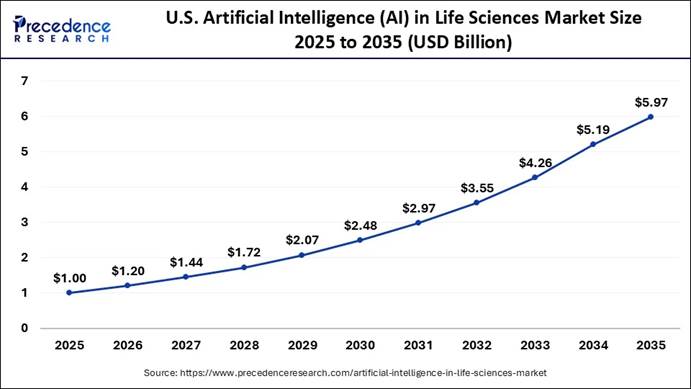
The U.S. is solidifying its position as a global leader in AI-driven life sciences, supported by extensive R&D financing, strategic tech-pharma partnerships, and over 70 FDA submissions that integrate AI. By accelerating drug discovery and optimizing clinical trials with groundbreaking AI tools, the U.S. is setting the standard for efficient and secure healthcare innovation, backed by proactive FDA frameworks that ensure safety in the age of algorithmic research.
🔸 In September 2025, Eli Lilly is set to revolutionize drug discovery with Lilly TuneLab, a new AI platform that unlocks over $1 billion worth of proprietary research data for biotech innovators. By sharing top-tier, battle-tested AI models, the platform aims to level the playing field and accelerate the development of the next generation of life-saving medicines. (Source: https://www.prnewswire.com)
The AI in Life Sciences Market Report is Readily Available 📥 Download Sample Pages of the Report 👉 https://www.precedenceresearch.com/sample/1776
Canada is establishing itself as a global AI powerhouse in life sciences by linking elite academic research through hubs like Mila, Vector, and Amii with impactful commercial applications. By leveraging national health data and genomics for predictive medicine, Canadian AI platforms are transforming drug discovery, improving preclinical efficiency, and advancing molecular docking and diagnostics.
🔸 In February 2025, Health Canada’s new guidance tightens regulations on AI in healthcare, enforcing strict GMLP for pre-market approval. This proactive framework ensures safety, transparency, and high-quality standards throughout the entire lifecycle of AI/ML-enabled medical devices, focusing on trustworthy, patient-centric innovation. (Source: https://www.blg.com)
Asia Pacific region is projected to have the fastest growth during the forecast period. This growth is primarily driven by rapid digitalization, extensive population datasets, and substantial government support. Countries such as China, South Korea, and India are making significant investments in AI infrastructure, establishing AI-based health research programs, and creating regulatory sandboxes to foster innovation. Traditional, costly drug development processes are being replaced by AI-driven methodologies. The increasing adoption of 5G technology, cloud-based AI platforms, and the digitization of health records are facilitating the swift deployment.
India is quickly emerging as a global leader in AI-driven life sciences, combining rapid healthcare adoption with a rising pool of skilled talent to spearhead biotechnology innovation. Supported by a vibrant startup ecosystem, homegrown generative AI solutions are revolutionizing drug discovery and personalized patient care. Government initiatives, such as BHASHINI and national digital health policies, are enhancing infrastructure.
🔸 In March 2026, India launched its largest pregnancy cohort study, enrolling 12,000 women as part of the DBT-led GARBH-INi initiative to address preterm births through AI-driven predictive models. This landmark initiative merges clinical epidemiology with multi-omics data to develop indigenous solutions aimed at significantly reducing neonatal mortality. (Source: https://theindianpractitioner.com)
China is also emerging as a leader in the AI life sciences market, driven by extensive datasets and robust government support. The country is utilizing platforms to accelerate drug discovery and is pioneering advanced diagnostic imaging techniques. China is transitioning from generic manufacturing to high-value innovation, implementing a security-first regulatory framework to manage data privacy and algorithm development.
🔸 In December 2025, the Beijing-based GHDDI launched AI Kongming, an open-access, homegrown AI platform designed to expedite early-stage drug discovery from target analysis to design. This AI-driven tool integrates biological and chemical data, streamlining the research and development process. (Source: https://en.tmtpost.com/news/7807410)
✚ Related Topics You May Find Useful:
➡️ Life Science AI and Machine Learning Market: Understand how AI and ML technologies are transforming research, diagnostics, and drug development
➡️ AI in Life Science Analytics Market: Discover how advanced analytics is enabling data-driven insights across clinical and research workflows
➡️ Generative AI in Life Sciences Market: Analyze how generative AI is accelerating molecule design, drug discovery, and personalized medicine
➡️ Next Generation AI in Life Sciences Market: Gain insights into emerging AI innovations driving the future of precision healthcare and automation
➡️ Artificial Intelligence Market: Track the broader impact of AI adoption across industries, from healthcare to manufacturing and beyond
➡️ AI in Medical Imaging Market: See how AI is improving diagnostic accuracy and transforming radiology and imaging workflows
➡️ Life Science Big Data Market: Explore how big data is enabling faster research, predictive analytics, and smarter healthcare decisions
➡️ Artificial Intelligence in Diagnostics Market: Understand how AI-powered diagnostics are enhancing early disease detection and clinical outcomes
Artificial Intelligence (AI) in Life Sciences Market: Segmentation Analysis
By Offering Analysis
In 2025, the software segment led the market by offering essential, scalable platforms for drug discovery, clinical trial optimization, and data analysis. AI software is crucial for analyzing large datasets in genomics, imaging, and predictive modeling, outperforming manual methods in speed and accuracy. Cloud-based software allows for real-time analysis of extensive datasets and is increasingly favored by major pharmaceutical and biotech companies. This segment is bolstered by specialized AI tools that enhance drug discovery and improve clinical trial patient selection.
The services segment is expected to experience the fastest growth because many life sciences firms lack the in-house expertise to effectively implement, customize, and maintain these advanced AI technologies. A significant shortage of talent in both AI and life sciences drives organizations to outsource training and model tuning to specialized service providers. As the industry transitions from pilot studies to value-driven applications, these service providers play a vital role in integrating AI solutions into existing workflows, automating processes in quality clinical trial data management.
By Deployment Analysis
The cloud deployment segment dominated the market in 2025, primarily due to its scalability, cost-effectiveness, and rapid access to advanced computing power for data-intensive tasks. Cloud providers offer subscription-based models, which minimize the initial capital expenditure on hardware. This enables organizations to access cutting-edge AI tools and quickly update algorithms, improving their speed to market. Cloud-native platforms eliminate data silos, allowing researchers, developers, and clinicians to collaborate remotely and access unified, real-time data.
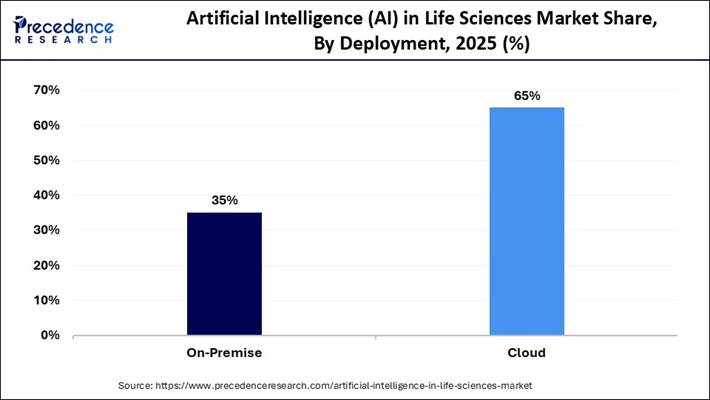
The on-premise segment is projected to experience the fastest growth, driven by increasing demand for superior data security, regulatory compliance, and control over intellectual property. On-premise solutions allow direct control over infrastructure, making it easier for companies to ensure compliance, maintain audit trails, and manage data sovereignty requirements. These environments enable organizations to optimize their infrastructure, including specialized hardware like GPUs for high-performance, low-latency AI training for complex drug discovery tasks.
By Application Analysis
The drug discovery segment led the market in 2025. This is mainly due to significantly accelerating research, reducing the high costs and long timelines associated with traditional drug development. AI accelerates hit-to-lead identification and reduces laboratory workload by simulating experimental outcomes in silico. AI processes vast datasets of chemical, structural, and biological data, finding patterns that traditional methods miss, enhancing drug design. Generative AI is increasingly used for creating novel molecular structures with desired therapeutic properties.
The clinical trials segment is expected to have the fastest growth during the forecast period. This is mainly driven by the urgent need to reduce high costs and lengthy timelines. AI boosts efficiency by identifying eligible participants faster through electronic health record analysis, addressing a major industry bottleneck. Technologies like machine learning and NLP optimize trial protocols, predict trial outcomes, and reduce Protocol Amendments, increasing the probability of success. AI processes vast, unstructured datasets to enhance real-time monitoring and data quality.
Artificial Intelligence (AI) in Life Sciences Market Segmentation:
By Offering
🔹Software
🔹Hardware
🔹Services
By Deployment
🔹On Premise
🔹Cloud
By Application
🔹Medical Diagnosis
🔹Drug Discovery
🔹Precision and Personalized Medicine
🔹Biotechnology
🔹Clinical Trials
🔹Patient Monitoring
By Region
🔹North America
🔹Asia Pacific
🔹Europe
🔹Latin America
🔹Middle East and Africa (MEA)
Thanks for reading you can also get individual chapter-wise sections or region-wise report versions such as North America, Europe, or Asia Pacific.
Don’t Miss Out! | Instant Access to This Exclusive Report 👉 https://www.precedenceresearch.com/checkout/1776
You can place an order or ask any questions, please feel free to contact at sales@precedenceresearch.com | +1 804 441 9344
Stay Ahead with Precedence Research Subscriptions
Unlock exclusive access to powerful market intelligence, real-time data, and forward-looking insights, tailored to your business. From trend tracking to competitive analysis, our subscription plans keep you informed, agile, and ahead of the curve.
Browse Our Subscription Plans@ https://www.precedenceresearch.com/get-a-subscription
About Us
Precedence Research is a global market intelligence and consulting powerhouse, dedicated to unlocking deep strategic insights that drive innovation and transformation. With a laser focus on the dynamic world of life sciences, we specialize in decoding the complexities of cell and gene therapy, drug development, and oncology markets, helping our clients stay ahead in some of the most cutting-edge and high-stakes domains in healthcare. Our expertise spans across the biotech and pharmaceutical ecosystem, serving innovators, investors, and institutions that are redefining what’s possible in regenerative medicine, cancer care, precision therapeutics, and beyond.
Web: https://www.precedenceresearch.com
Our Trusted Data Partners:
Towards Healthcare | Nova One Advisor | Statifacts
Get Recent News 👉 https://www.precedenceresearch.com/news
For Latest Update Follow Us:

