
A small group of blockbuster medicines is reshaping the global pharmaceutical industry, combining billions of dollars in annual sales with expanding clinical applications and growing patient demand.
Among the most commercially important therapies are Mounjaro, Keytruda, Ozempic, Dupixent and Skyrizi. They span diabetes, obesity, cancer, asthma, eczema, psoriasis and inflammatory bowel disease, showing how modern drug development is increasingly focused on chronic diseases with large patient populations and long-term treatment needs.
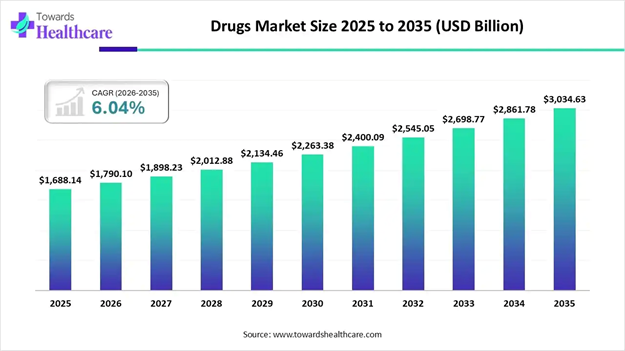
According to Towards Healthcare, the global drugs market is projected to grow from approximately $1.79 trillion in 2026 to $3.03 trillion by 2035, representing a 6.04% CAGR. Prescription medicines accounted for about 60% of the global drugs market in 2025, while branded drugs represented approximately 40%. Oncology remained the leading therapeutic area.
From strategy to investment decisions, let’s discuss what can move your drugs business forward: https://www.towardshealthcare.com/download-sample/5713
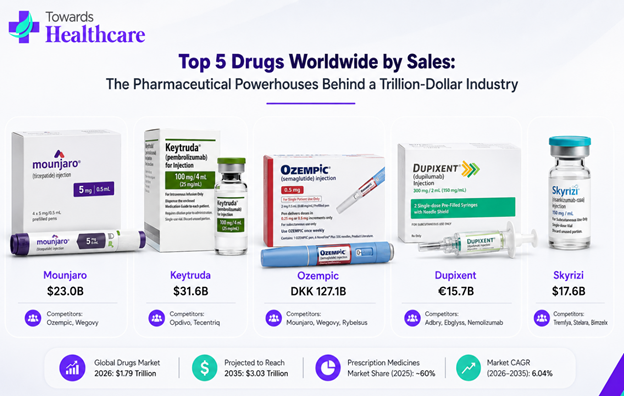
The commercial performance of these five medicines demonstrates the scale of the opportunity: Keytruda generated more than $31 billion in 2025, Mounjaro nearly $23 billion, Skyrizi more than $17.5 billion, and Dupixent more than €15.7 billion. Ozempic alone generated more than DKK 127 billion in sales.
1. Mounjaro: The New Powerhouse in Diabetes and Weight Management
What is Mounjaro?
Generic name: Tirzepatide
Brand name: Mounjaro
Manufacturer: Eli Lilly and Company
First FDA approval: 2022
Mounjaro is an injectable prescription medicine used with diet and exercise to improve blood-glucose control in people with type 2 diabetes.
Its key difference from traditional GLP-1 medicines is its dual GIP and GLP-1 receptor activity. By activating both pathways, tirzepatide helps increase insulin secretion when glucose levels are elevated, reduce glucagon, slow digestion and influence appetite.
The same active ingredient is marketed as Zepbound for chronic weight management and certain obesity-related indications.
Why are people using Mounjaro?
The combination of blood-sugar control and significant weight reduction has made tirzepatide one of the fastest-growing medicines in the world. Demand is also being strengthened by expanding cardiovascular evidence.
In August 2026, the FDA approved Mounjaro to reduce the risk of major cardiovascular events, including heart attack and stroke, in certain adults with type 2 diabetes and high cardiovascular risk. Lilly reported that Mounjaro sales reached $9.94 billion in the second quarter of 2026, up 91% year over year.
Mounjaro pricing and sales
In the U.S., Lilly's list pricing has historically been substantially above prices in many international markets, while insurance and self-pay programs can reduce actual patient costs.
In India, Mounjaro pricing varies by dose and formulation. Current reported prices range from approximately ₹3,281 for a 2.5 mg vial to ₹25,781 for a 15 mg KwikPen, with monthly costs depending on the prescribed strength.
Mounjaro generated $22.97 billion in revenue in 2025, almost twice its 2024 sales of approximately $11.5 billion.
Who is competing with Mounjaro?
The strongest competitor is Novo Nordisk's semaglutide franchise, including Ozempic and Wegovy. Eli Lilly is also developing next-generation metabolic medicines, including retatrutide, a triple GIP/GLP-1/glucagon agonist, while Novo Nordisk continues advancing next-generation semaglutide therapies.
2. Keytruda: The $31 Billion Cancer Drug
What is Keytruda?
Generic name: Pembrolizumab
Brand name: Keytruda
Manufacturer: Merck & Co.
First FDA approval: 2014
Keytruda is an immunotherapy used to treat numerous cancers. Instead of directly attacking tumor cells, pembrolizumab blocks the PD-1 immune checkpoint, allowing the immune system to recognize and attack cancer cells more effectively.
Its indications now cover a wide range of cancers, including lung cancer, melanoma, breast cancer, head and neck cancer, bladder cancer and several other malignancies.
Why are patients using Keytruda?
Cancer treatment is increasingly moving toward targeted and immune-based therapies. Keytruda's ability to work across multiple tumor types has allowed Merck to expand its patient population and build one of the world's largest oncology franchises.
Keytruda pricing and sales
The U.S. list price for a six-week Keytruda dose is currently approximately $24,544, although the actual amount paid by patients depends on insurance, reimbursement and assistance programs.
In Australia, government reimbursement has dramatically changed patient access. From September 2026, Keytruda became available through the Pharmaceutical Benefits Scheme for a broader range of cancers, with eligible patients generally paying a maximum of A$25 per infusion.
Merck reported $31.64 billion in Keytruda sales in 2025, compared with $29.48 billion in 2024.
Keytruda's biggest competitors
Bristol Myers Squibb's Opdivo (nivolumab) remains a major competitor. Other companies are also developing next-generation immunotherapies and bispecific antibodies.
The competitive landscape is becoming particularly important as Keytruda approaches major patent-expiration milestones. In September 2026, Indian pharmaceutical company Cipla announced a partnership with China's Qilu Pharmaceutical to commercialize a Keytruda biosimilar for the U.S. market.
3. Ozempic: From Diabetes Treatment to Global Phenomenon
What is Ozempic?
Generic name: Semaglutide
Brand name: Ozempic
Manufacturer: Novo Nordisk
First FDA approval: 2017
Ozempic is a GLP-1 receptor agonist used primarily to improve blood-glucose control in adults with type 2 diabetes.
Semaglutide mimics the naturally occurring GLP-1 hormone. It stimulates insulin release when blood glucose is elevated, reduces glucagon secretion, slows gastric emptying and suppresses appetite.
The same molecule is marketed under different brands, including Wegovy for obesity and Rybelsus as an oral formulation for diabetes.
Why are people using Ozempic?
The drug's appeal has moved beyond glucose control. Its appetite-suppressing and weight-reducing effects have made semaglutide one of the most recognizable prescription medicines globally.
Gallup reported in July 2026 that 91% of U.S. adults were aware of GLP-1 drugs used for weight loss, compared with 80% in 2024.
Novo Nordisk reported DKK 127.09 billion in Ozempic sales in 2025, compared with DKK 120.34 billion in 2024.
Ozempic pricing around the world
Pricing differs dramatically according to healthcare systems and reimbursement.
In the U.S., historical list pricing has been around $1,000 or more per month, although manufacturer self-pay programs can offer eligible patients substantially lower prices.
In India, reported 2026 treatment costs are approximately ₹5,660–₹9,100 per month, depending on dose and pharmacy pricing.
An international comparison by KFF found that the U.S. list price for one month of Ozempic was about $936, compared with approximately $169 in Japan and substantially lower prices in countries including the UK, Australia, France and Sweden.
Who competes with Ozempic?
The strongest competitor is Eli Lilly's Mounjaro/tirzepatide franchise. Other companies developing metabolic medicines include Amgen, which is advancing MariTide; Viking Therapeutics, which is developing VK2735; and Structure Therapeutics, which is developing oral GLP-1 therapies.
We understand your goals, study the competitive landscape, uncover the right opportunities, and help you turn your next move into real growth.
Contact us today at: https://www.towardshealthcare.com/contact-us
4. Dupixent: A Multibillion-Dollar Immunology Franchise
What is Dupixent?
Generic name: Dupilumab
Brand name: Dupixent
Manufacturers: Sanofi and Regeneron
First FDA approval: 2017
Dupixent is a monoclonal antibody designed to reduce type-2 inflammation. It blocks the IL-4 receptor alpha pathway, inhibiting signaling associated with IL-4 and IL-13.
The medicine began primarily as a treatment for atopic dermatitis but has expanded into several conditions, including asthma, chronic rhinosinusitis with nasal polyps and eosinophilic esophagitis.
Why are people using Dupixent?
The attraction is its targeted approach to chronic inflammatory disease. Instead of broadly suppressing the immune system, Dupixent targets specific inflammatory pathways involved in type-2 inflammation.
Dupixent pricing and revenue
The U.S. list price is approximately $4,193 per carton, although actual patient costs depend heavily on insurance and assistance programs.
Australia's PBS lists a 300 mg Dupixent pack at approximately A$1,756, while eligible patients can face a general patient charge of A$25 under the subsidized system.
Dupixent generated approximately €15.71 billion in Sanofi sales in 2025, up more than 20% from the previous year.
Dupixent competitors
The competitive landscape includes Adbry, Ebglyss, Nemolizumab and other targeted immunology medicines. Sanofi and Regeneron are continuing to expand Dupixent into additional inflammatory diseases while competing companies are developing biologics against IL-13, IL-31, IL-23 and other immune pathways.
5. Skyrizi: AbbVie's Fast-Growing Immunology Leader
What is Skyrizi?
Generic name: Risankizumab-rzaa
Brand name: Skyrizi
Manufacturer: AbbVie
First FDA approval: 2019
Skyrizi is an IL-23 inhibitor used for inflammatory diseases including plaque psoriasis, psoriatic arthritis, Crohn's disease and ulcerative colitis.
It works by selectively blocking IL-23, a cytokine involved in chronic inflammation.
Why are patients using Skyrizi?
Its appeal comes from sustained disease control, targeted immune modulation and expansion into multiple chronic inflammatory diseases. Its growing use in gastroenterology has significantly increased its commercial opportunity beyond dermatology.
Skyrizi pricing and sales
The U.S. wholesale acquisition cost for one Skyrizi dose is $23,838.42 as of January 6, 2026. This is a list price rather than the amount every patient pays.
In Australia, the PBS lists a 150 mg Skyrizi pen at approximately A$5,140, while eligible patients can have a general patient charge of A$25.
AbbVie reported $17.56 billion in Skyrizi revenue in 2025, representing approximately 50% growth from 2024.
Skyrizi's competitors
Major competitors include Tremfya, Stelara, Bimzelx and AbbVie's own Rinvoq, depending on the disease indication.
The larger immunology competition is increasingly focused on selective cytokine inhibition, oral small molecules and therapies that can deliver durable control with fewer administrations.
Celebrity Influence Turns GLP-1 Drugs Into a Cultural Phenomenon
Celebrity influence is strongest around Ozempic and other GLP-1 medicines.
In the U.S., Zocdoc reported a 42% rise in weight-loss appointments after celebrity weight-loss announcements, while GLP-1 consultations increased sharply within 72 hours of high-profile disclosures.
A global survey found that 22% of online GLP-1 buyers were influenced by celebrities or influencers, compared with 15% of other online prescription purchasers.
With 91% of Americans aware of GLP-1 medicines, celebrity discussions can quickly turn prescription treatments into mainstream topics. However, personal endorsements are not medical evidence and do not prove a medicine is suitable for everyone.
In India, growing Mounjaro use for pre-wedding weight loss, with some users losing 10–15 kilograms. Experts warn that these medicines should be used only when medically appropriate.
Local semaglutide products reportedly cost ₹3,500–₹8,000 per month, compared with ₹11,000–₹16,000 for branded treatments.
Towards Healthcare Research and Consulting has researched the global drugs landscape, analyzing market size, therapeutic categories, leading pharmaceutical products, regional trends, competitive developments and the companies shaping the future of the global pharmaceutical industry.
“Exclusive Opportunity for Pharma Leaders”
With 15+ years of expertise behind us, we create drug dashboards customized to the exact data and insights you want to track.
Personally designed for pharma leaders, investors, biotech companies, and healthcare strategists.
What’s Included in the Dashboard?
- Competitive Intelligence
- Drug Pipeline Tracking
- Clinical Trial Insights
- FDA & Regulatory Alerts
- Drug Sales & Revenue
- Pricing & Access Intelligence
- Company Performance
- Product Benchmarking
- Market Growth Signals
- Emerging Drug Trends
- Patent & Exclusivity Insights
- Future Opportunity Mapping
Request for a demo: https://www.towardshealthcare.com/access-dashboard
About Us
Towards Healthcare Research & Consulting is a leading global provider of technological solutions, clinical research services, and advanced analytics, with a strong emphasis on life science research. Dedicated to advancing innovation in the life sciences sector, we build strategic partnerships that generate actionable insights and transformative breakthroughs. As a global strategy consulting firm, we empower life science leaders to gain a competitive edge, drive research excellence, and accelerate sustainable growth.
You can place an order or ask any questions, please feel free to contact us at sales@towardshealthcare.com
Europe Region: +44 778 256 0738
North America Region: +1 8044 4193 44
APAC Region: +91 9356 9282 04
Web: https://www.towardshealthcare.com
Our Trusted Data Partners
Precedence Research | Towards Packaging | Towards Food and Beverages | Towards Chemical and Materials | Towards Dental | Towards EV Solutions | Healthcare Webwire
Find us on social platforms: LinkedIn | Twitter | Instagram | Medium | Pinterest

