
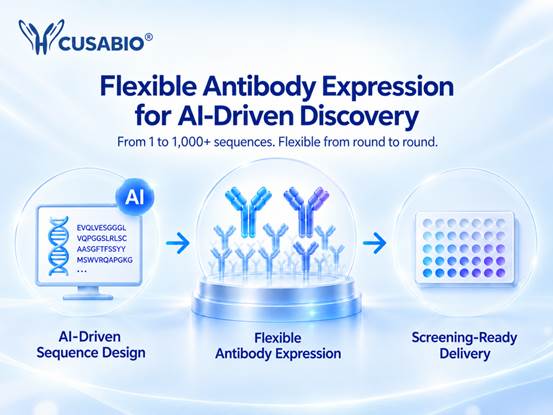
Flexible sequence counts, configurable expression scales and optional binding validation support iterative antibody discovery programs.
HOUSTON, Sept. 23, 2026 — CUSABIO announced the expansion of its flexible recombinant antibody expression service for AI-driven antibody discovery, offering biotechnology and pharmaceutical research teams configurable wet-lab support as antibody candidates progress through successive discovery and optimization rounds.
The service supports projects ranging from a single antibody sequence to more than 1,000 candidates, with 3 mL, 10 mL and 20 mL expression options and optional experimental validation. Researchers can configure the scope of expression and testing according to the requirements of each project.
AI-enabled antibody discovery typically involves multiple cycles of computational design, candidate selection and experimental assessment. However, the number of candidates requiring expression, the quantity of antibody material needed and the extent of binding characterization can differ between rounds.
CUSABIO's workflow addresses these varying requirements through three independently configurable parameters:
• Candidate number: From one antibody sequence to 1,000+ candidates.
• Expression scale: 3 mL, 10 mL or 20 mL options, selected according to experimental needs.
• Validation scope: Recombinant antibody expression alone or expression combined with optional ELISA, LSPR/SPR or BLI analysis.
Rather than applying a fixed batch configuration to every stage of antibody discovery, the service allows research teams to adjust experimental requirements as their candidate pools and project objectives change.
“AI-driven antibody discovery rarely progresses in identical batch sizes from one round to the next,” said Dr. Ying Zhou, Product Director at CUSABIO. “A team may need to test only several candidates in one cycle and hundreds in another. We designed this service so that the wet-lab workflow can adapt to the discovery process, rather than requiring discovery teams to adapt their projects to a fixed expression model.”
Configurable Expression and Validation Workflows
CUSABIO offers two service configurations for antibody discovery teams with different experimental capabilities.
Expression Service Only provides recombinant antibody expression, purification and associated quality control for organizations that perform downstream screening and characterization using their own laboratory platforms.
Expression + Activity/Binding Validation combines recombinant antibody production with experimental testing. Depending on the antibody format, target and research objective, available methods include ELISA for target-binding screening, SPR or LSPR for binding affinity and kinetics analysis, and BLI for label-free binding characterization.
This configurable approach can support initial candidate assessment, focused sequence optimization, larger candidate screening campaigns and subsequent characterization of prioritized antibodies.
For example, researchers may initially express a small panel of computationally designed antibody candidates, expand production to a larger variant library during optimization, and later incorporate additional binding characterization for selected candidates. Expression scale and validation requirements can be adjusted at each stage.
“Flexibility is not only about processing a large number of sequences,” added Dr. Zhou. “For iterative discovery, it is equally important to support a single candidate, a small focused panel or a larger screening campaign under consistent project and QC standards.”
Further details about available expression configurations and validation options are provided on the CUSABIO Flexible Antibody Expression for AI Discovery service page.
Founded in 2007, CUSABIO provides research-use reagents and CRO services to academic, biotechnology, pharmaceutical and research organizations worldwide. Its portfolio includes recombinant proteins, antibodies, ELISA kits and custom protein and antibody services supporting applications from basic biological research to preclinical drug discovery.