
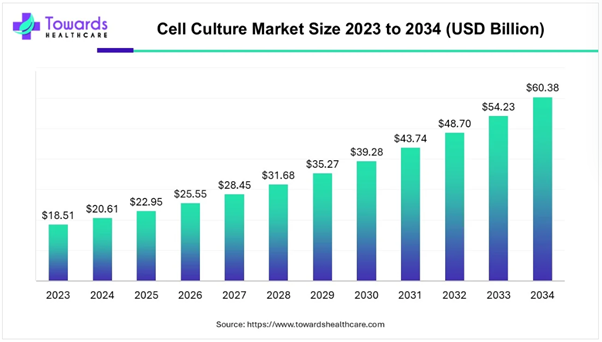
The global cell culture market was valued at USD 22.95 billion in 2025 and is projected to reach USD 25.55 billion in 2026 and approximately USD 60.38 billion by 2035, registering a CAGR of 11.35% from 2026 to 2035. The expansion reflects the growing use of cell-based methods in biologics manufacturing, drug discovery, vaccine production, diagnostics and regenerative medicine.
Download a sample of the Cell Culture Market report – https://www.towardshealthcare.com/download-sample/5385
|
Market indicator |
Value |
|
Market size, 2024 |
USD 20.61 billion |
|
Market size, 2025 |
USD 22.95 billion |
|
Estimated market size, 2026 |
USD 25.55 billion |
|
Forecast market size, 2035 |
USD 60.38 billion |
|
CAGR, 20262035 |
11.35% |
|
Leading region, 2023 |
North America |
|
Fastest-growing region |
Asia Pacific |
Market Definition
Cell culture is the process of growing and maintaining living cells in a controlled laboratory environment. Cells may come from humans, animals, plants or microorganisms and are maintained using suitable nutrients, temperature, pH, humidity and gas conditions.
The market covers the products and equipment required for this work, including culture media, sera, reagents, vessels, incubators, centrifuges, cryostorage equipment and automated culture systems. These products support research laboratories as well as commercial manufacturing facilities producing vaccines, monoclonal antibodies and other biological medicines.
Market Key Takeaways
➝ Consumables held the leading product position in 2024, supported by repeated purchases of media, sera, reagents and culture plastics.
➝ Biopharmaceutical production was the largest application in the report's 2023 assessment.
➝ Diagnostics is identified as a fast-growing application, supported by infectious disease testing and cell-based analytical methods.
➝ North America accounted for 36% of the global market in 2023.
➝ Asia Pacific is expected to record the fastest regional growth.
➝ Stem cell culture media, 3D culture models, automation and organoid technologies are creating new product opportunities.
Market Trends
Cell culture is moving beyond conventional two-dimensional laboratory methods. Researchers and manufacturers are adopting 3D culture systems, organoids, scaffold-based platforms and organ-on-a-chip technologies to create models that more closely represent human tissue behaviour. These approaches can support drug screening, toxicity testing and disease research.
Automation is another important development. Automated feeding, passaging, imaging and cell monitoring can reduce manual work and improve consistency. AI-assisted analysis may also help researchers identify changes in cell growth and culture conditions earlier. For manufacturers, these tools can support process monitoring and more reproducible production.
A further shift is the growing use of serum-free and chemically defined media. These formulations can help reduce variability associated with biological raw materials and support more controlled manufacturing processes. Demand for specialized media is also increasing as cell types and production applications become more diverse.
Market Drivers, Restraints and Opportunities
Drivers: Rising demand for monoclonal antibodies, vaccines, recombinant proteins and other biologics is increasing the need for reliable cell culture systems. Pharmaceutical and biotechnology companies also use cell cultures throughout drug discovery, development and process optimization. Growth in cell and gene therapy research adds demand for specialized media, reagents and cell expansion technologies.
Restraints: Contamination and cell misidentification remain important concerns. Bacterial, fungal, viral or chemical contamination can compromise experiments, delay manufacturing and increase operating costs. Maintaining consistent cell lines, validated procedures and quality-controlled raw materials requires skilled staff and investment.
Opportunities: Regenerative medicine, stem cell research, tissue engineering and advanced disease models create opportunities for specialized culture products. Suppliers that can offer validated media, reliable cell lines, scalable systems and integrated monitoring solutions are well positioned to serve both research and manufacturing customers.
Market Segmentations
By Product
|
Segment |
Market position |
Growth trend |
Business opportunity |
|
Consumables |
Leading product segment |
Recurring demand from research and production |
Media, sera, reagents and sterile plastics offer repeat-purchase opportunities |
|
Instruments |
Supporting product segment |
Demand for advanced and automated equipment |
Incubators, culture systems, centrifuges and cryostorage equipment support laboratory and manufacturing upgrades |
Consumables benefit from their regular use across research and production workflows. Media, sera and reagents are essential for maintaining cell growth, while culture vessels and plastics support sterile handling. Stem cell culture media is identified as a notable growth area within consumables. Instruments serve a different purchasing cycle, with demand linked to laboratory expansion, automation and manufacturing capacity.
By Application
|
Segment |
Market position |
Growth trend |
Business opportunity |
|
Biopharmaceutical production |
Dominant application |
Supported by biologics and vaccine manufacturing |
High-volume demand for scalable culture systems and specialized media |
|
Diagnostics |
Fast-growing application |
Increasing use in infectious disease and genetic testing |
Cell-based testing and analytical solutions |
|
Drug development |
Established application |
More complex screening and preclinical models |
Advanced cell lines, assay platforms and automated analysis |
|
Tissue culture and engineering |
Emerging growth area |
Increasing research in tissue models |
Specialized media, scaffolds and 3D systems |
|
Cell and gene therapy |
Emerging strategic application |
Expanding therapy development and manufacturing needs |
Cell expansion, processing and quality-monitoring solutions |
|
Toxicity testing and other uses |
Supporting applications |
Demand for improved experimental models |
Reproducible cell-based testing platforms |
Biopharmaceutical production remains central to market demand because cell culture is used to manufacture monoclonal antibodies, vaccines and therapeutic proteins. Diagnostics is expected to grow quickly as cell-based methods support pathogen identification and other laboratory applications. Meanwhile, tissue engineering and cell and gene therapy offer opportunities for suppliers able to meet more specialized quality and process requirements.
Market Regional and Country-Level Analysis
|
Region / country |
Market position |
Key development or trend |
Business opportunity |
|
North America |
Largest region; 36% share in 2023 |
Established biotechnology ecosystem and strong R&D infrastructure |
Biologics manufacturing, advanced instruments and specialized media |
|
United States |
Major regional contributor |
Investment in domestic biomanufacturing and cell therapy capacity |
Manufacturing supply, automation and process development |
|
Canada |
Established research base |
Biotechnology research and biomanufacturing investment |
Research-grade products and cell therapy supply chains |
|
Asia Pacific |
Fastest-growing region |
Expanding biologics production and government-backed life-science development |
Local manufacturing, media supply and laboratory infrastructure |
|
China |
Major growth market |
Expansion of biologics manufacturing and domestic biotechnology |
Scalable culture products and production technologies |
|
Japan and South Korea |
Advanced research markets |
Progress in 3D culture and regenerative medicine |
Specialized cell models and advanced research systems |
|
India |
Growing biotechnology and vaccine base |
Expanding pharmaceutical research and biologics production |
Cost-effective consumables, media and manufacturing support |
|
Europe |
Established market |
Strong pharmaceutical research and biologics development |
Quality-focused media, process solutions and advanced culture systems |
|
Latin America |
Developing market |
Growth in biomedical research and vaccine development |
Laboratory modernization and research consumables |
|
Middle East and Africa |
Emerging market |
Investment in healthcare research and advanced treatment capabilities |
Laboratory infrastructure and specialist cell culture products |
North America benefits from established biotechnology companies, research institutions and biopharmaceutical manufacturing infrastructure. The report identifies a 36% regional share in 2023. Asia Pacific is expected to grow fastest, supported by expanding manufacturing capabilities and research activity in China, Japan, South Korea and India. Europe remains important for pharmaceutical research and biologics development, while Latin America and the Middle East and Africa offer developing opportunities as laboratory capabilities expand.
Company and Competitive Intelligence
The competitive landscape includes global life-science suppliers, specialist cell technology companies and manufacturers of research products and bioprocess equipment.
|
Company |
Market role and competitive focus |
|
Thermo Fisher Scientific |
Cell culture media, reagents, laboratory products and bioprocess solutions |
|
Danaher Corporation |
Bioprocessing technologies and life-science platforms through its businesses |
|
Merck KGaA |
Cell culture media, raw materials and bioprocessing products |
|
Sartorius AG |
Bioprocess equipment, cell culture products and manufacturing solutions |
|
Lonza Group |
Cell culture media, cell line development and biologics manufacturing services |
|
Corning Incorporated |
Cell culture vessels, surfaces and laboratory consumables |
|
STEMCELL Technologies |
Specialized cell culture products and stem cell research solutions |
|
Bio-Techne Corporation |
Reagents, growth factors and research products |
|
Terumo Blood and Cell Technologies |
Cell processing and cell expansion technologies |
|
FUJIFILM Corporation |
Cell culture products, biomanufacturing and advanced therapy manufacturing |
Recent Industry Developments
Investment in manufacturing infrastructure is strengthening the supply side of the market. In May 2026, FUJIFILM Cellular Dynamics opened a new 175,000-square-foot iPSC development and manufacturing facility in Madison, Wisconsin. The facility is part of a USD 200 million investment and is expected to quadruple the company's manufacturing capacity for iPSC-based research products and services.
Sartorius announced a new competence centre in Freiburg, Germany, in May 2026. The approximately 18,000-square-metre site is focused on developing and producing quality-critical materials, including cytokines and growth factors used in cell and gene therapy. Production was planned to begin toward the end of 2026.
In July 2026, FUJIFILM Biotechnologies announced that its Holly Springs, North Carolina, manufacturing facility had been selected for the FDA PreCheck Pilot Program. The site operates mammalian cell culture bioreactors and is expanding its drug-substance capacity. This development highlights the importance of manufacturing readiness and regulatory engagement for large-scale biologics production.
Johnson & Johnson also announced a more than USD 1 billion investment in a next-generation cell therapy manufacturing facility in Pennsylvania in February 2026. Although focused on cell therapy rather than the broader research cell culture market, the investment reflects the increasing need for specialized manufacturing infrastructure and skilled production capacity.
On November 2, 2026, the FDA issued final guidance on potency assurance for cellular and gene therapy products. The guidance emphasizes quality controls across development and manufacturing, including consideration of raw-material variability and testing throughout production. This reinforces the importance of reliable cell processes, analytical methods and quality systems across advanced therapy manufacturing.
Emerging Opportunities for Cell Culture Companies
The next phase of market competition will depend on more than product availability. Buyers increasingly need suppliers that can demonstrate consistency, traceability, scalability and technical support. Opportunities include serum-free media, specialized stem cell formulations, automated monitoring, 3D culture platforms, organoids and manufacturing-grade cell expansion systems.
Suppliers can also differentiate themselves through regional production, validated raw materials, customization and partnerships with biotechnology companies, research institutes and CDMOs. Understanding where competitors are expanding, which technologies they are prioritizing and what customers require can support better commercial decisions.
How Towards Healthcare Supports Cell Culture Market Decisions
Towards Healthcare Research & Consulting provides market intelligence and customized research to help companies assess opportunities, compare competitors and plan commercial strategies.
|
Solution |
What clients receive |
How it helps in the cell culture market |
|
Master Dataset |
Company, product, facility, capacity, supplier, technology and partnership data |
Identifies competitors, suppliers, manufacturing footprints and market opportunities |
|
Towards Healthcare Strategic Positioning Quadrant™ |
Company benchmarking, portfolio comparison and strategic positioning |
Compares suppliers by product range, capabilities, technology and market presence |
|
Interactive Dashboard |
Market, company, segment, regional and investment indicators |
Tracks changes and supports faster decisions than static reports |
|
Quality & Manufacturing Intelligence |
Facility locations, production capacity, manufacturing processes and quality-related intelligence |
Supports supplier assessment, sourcing and manufacturing planning |
|
Customized Research |
Market entry, buyer intelligence, pricing, competitor analysis and opportunity mapping |
Helps companies evaluate countries, customer groups and commercial strategies |
Continuous Market Intelligence Updates
Monthly updates can track company announcements, product launches, partnerships and investment activity. Quarterly reviews can assess market shifts, competitor positioning, pricing and regional developments. Six-monthly assessments can evaluate capacity changes, technology adoption and supplier movements. Annual updates can refresh market sizing, forecasts, segment performance and long-term strategy.
These updates help manufacturers, suppliers, investors and biotechnology companies respond to changes in demand and competition.
Request Cell Culture Market Intelligence
Fill out the form for relevant samples, case studies, and examples.
➝ Purchase the Cell Culture Market report - https://www.towardshealthcare.com/checkout/5210
➝ Schedule a meeting with Towards Healthcare - https://www.towardshealthcare.com/contact-us
Related Reports
- Cell Culture Media Market
- Cell Culture Media & Cell Lines Market
- Primary Cell Culture Market
- Cell Line Development Market
- 3D Cell Culture Market
- Stem Cells Market
- Cell Therapy Market
- U.S. Cell Therapy Market
- Regenerative Medicine Market
- Upstream Bioprocessing Market
Partner
Towards Chemical and Materials
Connect With Us
USA: +1 804 441 9344
APAC: +61 485 981 310 or +91 87933 22019
Singapore: +65 3105 1271
Europe: +44 7383 092 044
Email: sales@towardshealthcare.com
Follow Towards Healthcare

