
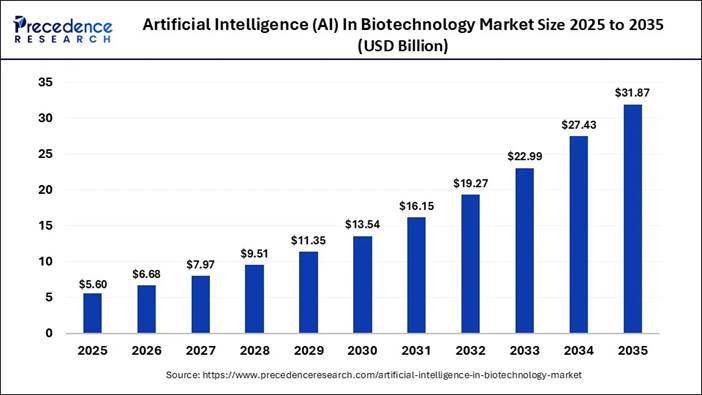
According to Precedence Research, the global artificial intelligence (AI) in biotechnology market size is projected to reach USD 31.87 billion by 2035, increasing from USD 6.68 billion in 2026. The market is poised to grow at a healthy CAGR of 18.99% between 2026 and 2035. The market is mainly driven by the growing demand for rapid, data-driven drug discovery and personalized medicine. The rapid shift toward complex, integrated digital solutions that streamline processes from target identification to clinical trials also supports market growth. Key growth drivers of the market include:
🔹A heightened demand for biological data analysis, which is necessary for advancements in genomics, proteomics, and bioinformatics.
🔹Increasing research and development outsourcing by large pharmaceutical companies to specialized AI biotechnology firms, aimed at reducing costs.
🔹Rapid growth in the Asia Pacific region is attributed to cost-effective computational capabilities and a skilled workforce of data scientists.
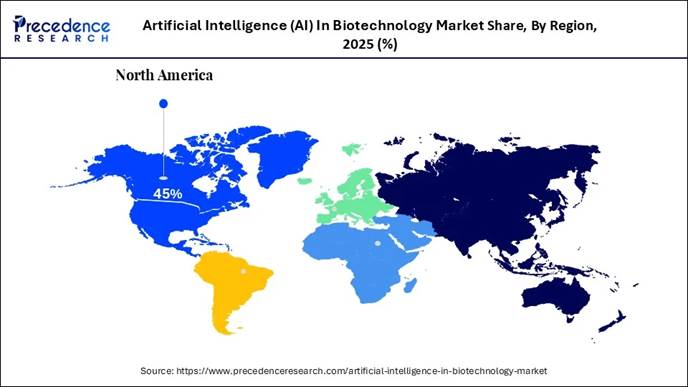
🔹North America continues to dominate the market due to substantial investments in structural biology models, machine learning, and favorable regulatory environments.
Emerging paradigms such as end-to-end cloud-based software platforms, strategic partnerships between technology and biopharmaceutical companies, and AI-powered predictive toxicity modeling are positioning artificial intelligence as a critical enabler of next-generation therapeutic development.
The biotechnology industry is transitioning from traditional broad-spectrum screening approaches to autonomous, AI-driven molecular design, drug discovery, and genomic analysis aimed at addressing complex diseases. By identifying disease mechanisms at the molecular level and leveraging predictive analytics, these advanced technologies accelerate research and development timelines, improve target specificity, reduce development costs, and increase the likelihood of clinical success. As a result, AI-enabled biotechnology solutions are attracting significant investment.
Where Data Meets Strategic Clarity 📥 View Sample Pages of the Complete Report 👉 https://www.precedenceresearch.com/sample/2611
Market Key Takeaways
🔹North America dominated the artificial intelligence (AI) in biotechnology market by holding the largest share in 2025.
🔹Asia Pacific is expected to grow at the fastest CAGR between 2026 and 2035.
🔹The software segment accounted for the largest market share in 2025.
🔹The services segment is projected to grow at a solid CAGR between 2026 and 2035.
🔹The drug target identification segment captured the highest market share in 2025.
🔹The predictive modeling segment is poised to grow at a healthy CAGR between 2026 and 2035.
🔹The agriculture biotechnology segment held the highest market share in 2025.
🔹The medical biotechnology segment is growing at a strong CAGR between 2026 and 2035.
Transition from Traditional Biotechnology to AI-Driven Innovation
Traditionally, the biotechnology industry relied on broad-spectrum compound screening, labor-intensive laboratory experiments, and manual analysis of biological data to discover and develop new therapies. Drug discovery and development were largely based on trial-and-error approaches, requiring extensive preclinical testing and lengthy research timelines. While these methods led to significant scientific advancements, they were often associated with high costs, low success rates, and limited ability to predict drug efficacy and safety during the early stages of development.
The industry is increasingly transitioning toward AI-driven biotechnology, enabled by advances in machine learning, cloud computing, big data analytics, and genomic technologies. AI algorithms can rapidly analyze vast biological datasets, identify novel drug targets, predict molecular interactions, optimize candidate selection, and assess toxicity risks before laboratory testing begins. This shift allows biotechnology companies to accelerate research timelines, improve target specificity, reduce development costs, and support the development of precision therapies tailored to individual patient profiles. As a result, AI is evolving from a supporting analytical tool to a core technology platform that drives innovation across drug discovery, genomics, clinical development, and personalized medicine.
➡️ Become a valued research partner with us ☎ https://www.precedenceresearch.com/schedule-meeting
Market Overview: AI's Massive Disruption in Biotech
Artificial Intelligence (AI) in the biotechnology market utilizes machine learning, deep learning, and predictive modeling to analyze complex biological datasets and automate biological processes. It accelerates critical workflows such as drug discovery, genomics research, and biomanufacturing while laying the groundwork for personalized medicine. The growing demand for AI is driven by the massive expansion of genomic datasets and the urgent need to shorten research and development timelines for new therapeutics.
Transforming Drug Discovery from Serendipity to Simulation: Major Potential
AI is revolutionizing the biotech market by circumventing the expensive and time-consuming trial-and-error phases of traditional drug development. By employing predictive algorithms, machine learning models, and deep-learning engines, researchers can map protein structures and virtually screen molecular compounds within days. This innovation enhances target identification, optimizes drug-target binding, and ensures that only the most promising drug candidates move on to physical preclinical testing, significantly reducing time-to-market.
Black Box Interpretability in Biological Modeling: Major Limitation
Despite its tremendous potential, AI in biotechnology faces challenges due to the complexity of modeling human biology. This complexity can lead to unpredictable clinical failures when translating data from computational models to live organisms. Additionally, the "black box" nature of advanced machine learning models creates issues of interpretability. Algorithms can identify patterns but do not always explain the underlying biological mechanisms, leading to difficulties in digital interpretation and increasing regulatory scrutiny.
How are AI Digital Twins and Predictive Modeling Transforming Wet Labs into Computational Designs?
The market is evolving from experimental pilot programs to fully integrated production workflows, changing the way drugs are discovered and developed. Generative AI is revolutionizing biopharmaceuticals by shifting drug discovery away from traditional wet lab screening towards dry lab computational design, where novel proteins are created from scratch before reverse-engineering their DNA. As AI becomes a foundational technology, it accelerates development across target identification and clinical trials, prompting significant financial investments to rejuvenate aging pipelines.
AI-generated digital twins utilize multi-modal, real-world data to create precise virtual patient profiles, allowing biotechnology firms to simulate treatment responses and optimize clinical trial designs prior to human dosing. This technology aims to reduce costs and patient dropout rates significantly while enabling highly tailored therapies through advanced predictive modeling.
Discover What’s Driving the Market Forward👉 https://www.precedenceresearch.com/artificial-intelligence-in-biotechnology-market
Artificial Intelligence (AI) In Biotechnology Market Report Coverage
|
Market Scope |
Details |
|
Market Size in 2025 |
USD 5.60 Billion |
|
Market Size in 2030 |
USD 13.54 Billion |
|
Market Size in 2035 |
USD 31.87 Billion |
|
Market Growth Rate (2026-2035) |
CAGR of 18.99% |
|
Largest Regional Market |
North America |
|
Fastest Growing Region |
Asia Pacific |
|
Base Year |
2025 |
|
Forecast Period |
2026 to 2035 |
|
Key Growth Driver |
Growing demand for rapid AI-driven drug discovery, increasing adoption of personalized medicine, expanding biological data analysis in genomics and proteomics, and rising R&D outsourcing by pharmaceutical companies. |
|
Major Technology Trend |
Generative AI, machine learning, deep learning, AI-powered predictive toxicity modeling, cloud-based biotechnology platforms, digital twins, and AI-driven genomic analysis. |
|
Key Market Opportunity |
Expansion of AI-assisted drug target identification, precision medicine development, predictive modeling, automated molecular design, and growing adoption of AI-enabled biotechnology solutions in emerging markets. |
|
Major Market Challenge |
Black-box interpretability of AI models, regulatory scrutiny, complexity of biological systems, clinical translation risks, and data quality challenges. |
|
Segments Covered |
By Offering, By Applications, By Usage, By Geography |
|
Regions Covered |
North America, Europe, Asia-Pacific, Latin America, and Middle East & Africa |
|
Key Companies Profiled |
AstraZeneca, Bristol-Myers Squibb, Gilead Sciences, Inc., Sanofi, Abbott Laboratories, Biogen, Pfizer, Inc., Novo Nordisk A/S, Amgen, Inc., Merck KGaA |
Built for leaders who move markets. Access live, actionable intelligence with Precedence Q. https://www.precedenceresearch.com/precedenceq/
Regional Analysis
What Made North America the Dominant Region in the Market?
North America registered dominance in the artificial intelligence (AI) in biotechnology market by holding a major share in 2025, driven primarily by robust venture capital funding, strong research investments, and exclusive technology hubs like Boston and Silicon Valley. Unmatched venture capital investments and continued NIH grants facilitate AI-based biological discoveries. Furthermore, regulatory initiatives from the FDA create an innovation-friendly environment. The presence of leading biotechnology companies and major pharmaceutical corporations fosters early adoption of AI, enhancing the commercialization of complex, AI-assisted gene-editing therapies.
What is the U.S. Artificial intelligence (AI) in Biotechnology Market Size and Growth Rate?
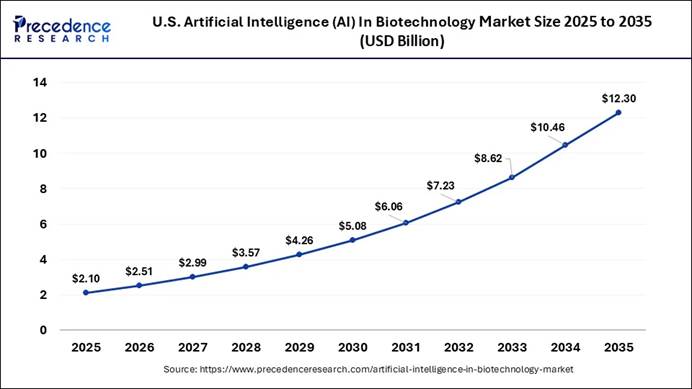
The U.S. artificial intelligence (AI) in biotechnology market size stood at USD 2.10 billion in 2025 and is projected to be worth around USD 12.3 billion by 2035, expanding at a CAGR of 19.34% from 2026 to 2035.
The U.S. Artificial Intelligence (AI) In Biotechnology Market Report is Readily Available 📥 Download Sample Pages of the Report 👉 https://www.precedenceresearch.com/sample/7102
U.S. Market Analysis
The U.S. plays a significant role within the North American artificial intelligence (AI) in biotechnology market, supported by its well-established biotechnology ecosystem, strong research infrastructure, and growing adoption of AI technologies across drug discovery and development. The integration of AI has significantly reduced timelines for virtual screening, accelerated target identification, and enhanced advancements in structural biology, enabling biotechnology companies to improve research efficiency and therapeutic innovation.
The country is home to leading AI and biotechnology companies, including NVIDIA Corporation, Schrödinger, Inc., and Recursion Pharmaceuticals, which leverage computational modeling, machine learning, and high-throughput biological automation to streamline drug development processes. Additionally, the U.S. Food and Drug Administration supports innovation through initiatives such as the Digital Health Innovation Action Plan, providing regulatory guidance for AI-enabled medical technologies and fostering the adoption of AI across the healthcare and biotechnology sectors.
🔸 According to the "Artificial Intelligence for the American People," to maintain global leadership in AI, the U.S. government is promoting collaborative efforts across industry, academia, and government to accelerate innovation. The Administration's policies focus on advancing AI for innovation and workforce enhancement, guided by American values. (Source: Trump White House)
Exploring Canada’s Significance in the Market
Canada also plays a vital role, characterized by national networks like CIFAR and regional institutes like the Vector Institute, which connect academic research to commercial applications. Canadian facilities leverage AI and robotics to develop customized cell and gene therapies. Health Canada regulates AI-enabled medical devices under the stringent Medical Devices Regulations to ensure their safety and clinical efficacy.
🔸 In June 2026, Amii launched the Health Innovation Lab, a USD 10 million initiative in partnership with the Government of Alberta. This initiative aims to accelerate the development and adoption of AI-driven healthcare solutions. By transitioning AI from theory to practical application in healthcare, Amii is committed to enabling world-class patient care and promoting economic prosperity in the province. (Source: Amii)
How will Asia Pacific Grow in the Artificial Intelligence (AI) in Biotechnology Market?
Asia Pacific is expected to grow at the fastest rate during the forecast period, driven by a robust digital healthcare infrastructure, substantial government funding for research and development, and a large patient population available for clinical trials. Supportive government initiatives in countries like China, India, and Japan actively subsidize AI research and expedite commercialization. The expansion of electronic health records, along with the region's diverse genetic makeup, provides vast datasets for ML algorithms targeting precision medicine and genetic engineering, thereby lowering the barriers to entry.
India Market Analysis
India is emerging as a significant player in the region, with its primary goal of achieving biotech sovereignty by integrating extensive clinical databases, diverse genomic data, and a strong IT talent pool for predictive healthcare, modular biomanufacturing, and AI-driven drug discovery. The Department of Biotechnology and BIRAC have initiated various programs aimed at funding start-ups and researchers to develop AI algorithms for biomolecular design, predictive pharmacology, and Ayurveda.
🔸 In February 2026, the Department of Biotechnology (DBT) in the Government of India initiated AI-driven gene sequencing, which is poised to facilitate India's shift towards personalized medical prescriptions and predictive medicine. This genomics infrastructure serves as the nerve center for India's AI advancements in biotechnology, as noted by Dr. Jitendra Singh.
How is China Contributing to the Asia Pacific Market?
China is also pioneering the Asia Pacific artificial intelligence (AI) in biotechnology market. The country is recognized as a global leader in AI for science. It is streamlining traditional drug development cycles through fully automated and efficient domestic foundation models. A multi-omics precision health management system utilizes AI to analyze extensive datasets for early disease prevention. International technological collaborations, such as the Malaysia-China Joint Research Program, co-fund research that applies AI to human vaccine development and biotechnology.
Key Regulatory Landscape for Artificial Intelligence (AI) in Biotechnology Market
|
Regulatory Framework |
Authority |
Scope and Key Objective |
Regulatory Framework |
|
EU AI Act |
European Union |
Classifies AI systems used in regulated medical and pharmaceutical environments as High-Risk. |
EU AI Act |
|
AI Draft Guidance for Drug Development |
U.S. FDA |
Establishes a risk-based credibility assessment framework for AI models supporting regulatory decisions. |
AI Draft Guidance for Drug Development |
|
Principle-Based AI Governance Framework |
Ministry of Electronics and IT |
Focuses on inclusive growth, algorithmic accountability, and mitigating biases. |
Principle-Based AI Governance Framework |
|
AI in Software as a Medical Device (SaMD) |
U.S. FDA |
Mandates a Predetermined Change Control Plan (PCCP) for adaptive, self-learning AI algorithms. |
AI in Software as a Medical Device (SaMD) |
|
Ethical Guidelines for AI in Biomedical Research |
ICMR |
Enforces core pillars like Autonomy, Data Privacy, and Risk Minimization during research. |
Ethical Guidelines for AI in Biomedical Research |
How Government Initiatives Are Supporting the Artificial Intelligence (AI) in Biotechnology Market
Government initiatives are playing a crucial role in accelerating the adoption of artificial intelligence (AI) in biotechnology by providing funding for research and development, establishing regulatory frameworks, promoting public-private collaborations, and supporting the creation of large-scale biological and healthcare datasets. These efforts help biotechnology companies leverage AI for drug discovery, genomic analysis, precision medicine, and predictive modeling, reducing development timelines and improving the efficiency of therapeutic innovation. Governments are also investing in digital infrastructure and national AI strategies to strengthen their biotechnology ecosystems and encourage the commercialization of AI-enabled healthcare solutions.
🔸 For instance, the U.S. Food and Drug Administration took an initiative through its Digital Health Innovation Action Plan and related AI-focused regulatory programs. This initiative provides guidance for the development and evaluation of AI-enabled medical technologies, helping companies navigate regulatory requirements while fostering innovation.
Get informed with deep-dive intelligence on AI’s market impact https://www.precedenceresearch.com/ai-precedence
Artificial Intelligence (AI) in Biotechnology Market: Segmental Analysis
Offering Insights
How does the Software Segment Dominate the Market in 2025?
By Offering, the software segment dominated the artificial intelligence (AI) in biotechnology market in 2025, primarily due to its critical role in analyzing complex biological data, facilitating drug discovery, and reducing research and development costs. AI-driven platforms and generative AI algorithms can quickly screen compounds, design molecules, and predict bioactivity, greatly shortening the hit-to-lead timeline. These software solutions allow researchers to simulate biological processes and run predictive models before conducting physical lab experiments, thus improving success rates and minimizing costly failures in bringing biotechnological products to market.
The services segment is anticipated to experience the fastest growth during the forecast period, driven by the high demand for custom model tuning, an increasing need to outsource AI implementations, and a shortage of in-house expertise, leading to specialized CROs. Services are focused on adapting pre-trained generative AI and active learning models to specific genomic research, precision medicine, and biological datasets. Companies are outsourcing project-based tasks to avoid the high upfront capital costs associated with building internal capabilities, allowing them to focus on their core scientific research.
Applications Insights
Why did the Drug Target Identification Segment Dominate the Market in 2025?
By application, the drug target identification segment held a dominant share of the artificial intelligence (AI) in biotechnology market in 2025, as it addresses one of the biotechnology industry's most significant and costly bottlenecks. Breakthrough AI models, such as Google DeepMind’s AlphaFold, successfully mapped the 3D structures of nearly all known proteins. By employing predictive analytics, AI can assess a target's validity and likelihood of success before companies invest millions in wet lab experiments. As the market transitions from one-size-fits-all blockbuster drugs to precision medicine and specialized oncology, target identification is becoming increasingly complex and critical for high-growth areas.
The predictive modeling segment is expected to grow at the fastest rate during the forecast period, driven by the shift away from expensive, time-consuming wet lab experiments towards rapid computational forecasts. AI systems like AlphaFold can predict 3D protein structures and folding mechanisms from amino acid sequences instantly. Advanced machine learning models can screen and forecast the efficacy, toxicity, and binding affinity of chemical compounds, generating entirely novel molecular structures and repurposing existing drugs by analyzing massive, complex datasets in genomics, proteomics, and metabolomics.
Usage Insights
What Made Agriculture Biotechnology the Leading Segment in the Market in 2025?
By usage, the agriculture biotechnology segment led the artificial intelligence (AI) in biotechnology market in 2025. This is due to its use of AI for crop yield prediction, pest management, and genetic engineering, addressing global food security and climate challenges. AI algorithms analyze vast datasets from satellites, drones, and sensors to accelerate sustainable precision agricultural practices. By applying AI to plant genomics, scientists shorten crop breeding cycles, resulting in the development of climate-resilient and disease-resistant seeds. AI-driven image screening and neural networks facilitate the early detection of plant diseases and pests, helping to reduce crop losses and improve farm resilience.
🔸 In December 2025, Bayer’s Integrated Weed Management (IWM) program addresses resistant weeds and safeguards crop yields by combining innovative herbicides with sustainable agricultural practices like crop rotation. Supported by digital precision tools such as AI and GPS-guided sprayers, optimizing chemical use promotes soil health, especially with the breakthrough Icafolin-methyl herbicide. (Source: Bayer)
The medical biotechnology segment is expected to experience the fastest growth during the forecast period, due to applications in drug discovery and development. Machine learning algorithms and generative AI optimize the design of targeted protein binders, antibodies, and mRNA vaccines tailored to individual patient profiles and rare diseases. High-throughput computational models minimize manual trial-and-error processes in laboratories, streamlining the prediction of compound efficacy and simulating clinical trials while also enhancing health security, pathogen surveillance, and diagnostics integration.
🔓 Instant Access. Zero Waiting. 📥 Buy the Premium Market Research Report Now 👉 https://www.precedenceresearch.com/checkout/2611
✚ Related Topics You May Find Useful:
➡️ Artificial Intelligence in Precision Medicine Market: Explore how AI-powered analytics and genomic insights are enabling personalized treatment strategies and improving patient outcomes.
➡️ Artificial Intelligence in Oncology Market: Discover how advanced algorithms are enhancing cancer detection, treatment planning, and predictive diagnostics across oncology care.
➡️ Artificial Intelligence in Life Sciences Market: Understand how AI is accelerating research workflows, optimizing clinical development, and transforming data-driven decision-making in life sciences.
➡️ Artificial Intelligence in Biopharmaceutical Market: Analyze how machine learning and predictive modeling are streamlining biologics development and improving manufacturing efficiency.
➡️ Artificial Intelligence in Drug Discovery Market: Gain insight into how AI technologies are reducing drug development timelines and identifying promising therapeutic candidates faster than traditional methods.
➡️ Biotechnology Contract Manufacturing Market: Examine how growing demand for biologics and specialized production capabilities is driving outsourcing across biotechnology manufacturing.
➡️ Biotechnology and Pharmaceutical Services Outsourcing Market: Explore how companies are leveraging external expertise to enhance operational efficiency, reduce costs, and accelerate innovation.
➡️ Biotechnology Reagents and Kits Market: Discover how expanding research activities and advancements in molecular biology are fueling demand for high-performance reagents and laboratory kits.
➡️ Biotechnology Instruments Market: Track innovations in laboratory technologies that are supporting breakthroughs in genomics, proteomics, and cell-based research.
➡️ Microalgae Biotechnology Market: Understand how sustainable bio-based products and renewable resource applications are creating new opportunities for microalgae technologies.
➡️ Marine Biotechnology Market: Analyze how marine-derived compounds are driving innovation in pharmaceuticals, nutraceuticals, cosmetics, and environmental solutions.
➡️ Pharmaceutical and Biotechnology Analytics Market: Gain insight into how advanced analytics and AI-driven platforms are improving research productivity, clinical outcomes, and commercial performance.
➡️ White Biotechnology Market: Explore the growing adoption of industrial biotechnology for sustainable manufacturing, biofuels, and eco-friendly production processes.
➡️ Red Biotechnology Market: Discover how medical biotechnology innovations are advancing therapeutics, vaccines, diagnostics, and regenerative medicine applications.
➡️ North America Marine Biotechnology Market: Examine regional developments in marine-based research and the commercialization of ocean-derived products across healthcare and industrial sectors.
You can place an order or ask any questions, please feel free to contact at sales@precedenceresearch.com | +1 804 441 9344
Key Innovations by Major Companies in the Artificial Intelligence (AI) in Biotechnology Market
|
Company |
Core AI Innovation |
Specific Biotechnology Focus |
|
Recursion Pharmaceuticals |
High-throughput automation and ML |
Maps complex cell morphology at scale to decode human biology and identify rare disease targets. |
|
Insilico Medicine |
End-to-end Generative AI |
Uses generative models and reinforcement learning to design novel molecules, successfully advancing AI-generated drugs into human clinical trials. |
|
EvolutionaryScale (Meta/Biohub) |
ESM3 foundation model |
Generates novel proteins and edits biological functions by simulating hundreds of millions of years of evolutionary data. |
|
Illumina |
AI-enhanced genomic sequencing |
Employs deep learning to analyze next-generation sequencing data for precision medicine, biomarker discovery, and diagnostics. |
|
Schrödinger |
Physics-informed machine learning |
Combines physics-based computational modeling with AI algorithms for virtual screening and highly accurate molecular designs. |
Artificial Intelligence (AI) in Biotechnology Market Companies
➢ AstraZeneca
➢ Bristol-Myers Squibb
➢ Gilead Sciences, Inc.
➢ Sanofi
➢ Abbott Laboratories
➢ Biogen
➢ Pfizer, Inc.
➢ Novo Nordisk A/S
➢ Amgen, Inc.
➢ Merck KGaA
Recent Developments in the Artificial Intelligence (AI) in Biotechnology Market
🔸 In June 2026, British techbio Genomics launched Mystra AI, a human genetics-based AI platform that helps drugmakers identify better targets for drug discovery using a conversational interface for large-scale genetic data. (Source: The Pharma Letter)
🔸 In February 2026, Union Minister Jitendra Singh introduced SUJVIKA, an AI-driven data portal for biotechnology products, during the 40th foundation day of the Department of Biotechnology. The portal offers structured import data on biotechnology, aiding researchers and industry in identifying import dependencies and supporting public-private partnerships for domestic biomanufacturing. (Source: Rediff)
🔸 In January 2026, REPROCELL announced the launch of StemEdit, a clinical gene editing service utilizing the OpenCRISPR-1™ system. StemEdit combines REPROCELL's clinical technology with AI-designed workflows, ensuring a GMP-aligned and regulatory-ready platform. This service supports off-the-shelf cell therapy development and streamlines intellectual property complexities for therapeutic developers. (Source: News Wise)
🔸 In September 2025, Eli Lilly unveiled TuneLab, an AI platform that allows biotech companies access to drug discovery models based on over USD 1 billion in proprietary research, aimed at accelerating drug development and fostering partnerships. (Source: Reuters)
Segments Covered in the Report
By Offering
🔸 Software
🔸 Hardware
🔸 Services
By Applications
🔸 Drug Target Identification
🔸 Drug Screening
🔸 Image Screening
🔸 Predictive Modeling
By Usage
🔸 Agriculture Biotechnology
🔸 Medical Biotechnology
🔸 Animal Biotechnology
🔸 Industrial Biotechnology
By Geography
🔸 North America
🔸 Europe
🔸 Asia-Pacific
🔸 Latin America
🔸 The Middle East and Africa
Immediate Delivery Available | Buy This Premium Research Report@ https://www.precedenceresearch.com/checkout/2611
Research Methodology
🔹Primary interviews with industry experts
🔹Secondary research from company reports, regulatory databases, journals
🔹Market forecasting using top-down and bottom-up approaches
🔹Validation through triangulation models
About Us
Precedence Research is a global market intelligence and consulting powerhouse, dedicated to unlocking deep strategic insights that drive innovation and transformation. With a laser focus on the dynamic world of life sciences, we specialize in decoding the complexities of cell and gene therapy, drug development, and oncology markets, helping our clients stay ahead in some of the most cutting-edge and high-stakes domains in healthcare. Our expertise spans across the biotech and pharmaceutical ecosystem, serving innovators, investors, and institutions that are redefining what’s possible in regenerative medicine, cancer care, precision therapeutics, and beyond.
Web: https://www.precedenceresearch.com
Our Trusted Data Partners:
Towards Healthcare | Nova One Advisor | Market Stats Insight
Get Recent News:
https://www.precedenceresearch.com/news
For the Latest Update Follow Us:
LinkedIn | Medium | Facebook | Twitter


