
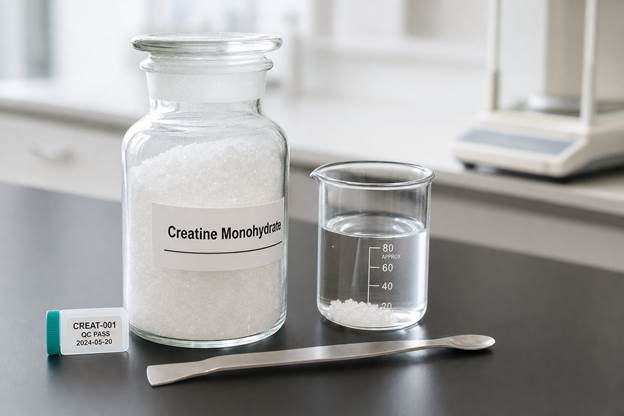
Manufacturing creatine monohydrate at industrial scale requires precise control over raw materials, synthesis processes, and quality testing to deliver a supplement that consistently meets rigorous specifications. Each step, from chemistry to final packaging, impacts purity and performance for consumers. Brands evaluating a creatine monohydrate manufacturer often review audited systems and documentation for consistency, and a best creatine manufacturer will demonstrate repeatable control across every production phase.
The journey of creatine monohydrate from chemical synthesis to finished supplement involves a complex set of industrial chemistry processes. For brands and buyers, selecting a creatine manufacturer with expertise in these steps ensures product integrity and quality. Procurement teams seeking a creatine manufacturer in the USA may also compare regional regulatory expectations and lead times when qualifying sources. In bulk categories, a creatine powder manufacturer is typically assessed on particle size consistency and moisture control. Understanding these core phases helps stakeholders evaluate supply partners and safeguard consumer trust.
Chemical synthesis and raw material control
Manufacturing creatine monohydrate begins with the precise sourcing of raw materials such as sodium sarcosinate and cyanamide, both of which must meet defined purity requirements. Chemical synthesis involves a series of controlled reactions typically performed under GMP-compliant conditions, with temperature control, pH monitoring, and regulated mixing to drive efficiency and prevent unwanted byproducts. A creatine manufacturer in the USA may place additional emphasis on documented traceability for inbound precursors to support downstream compliance needs.
By maintaining strict oversight during these early stages, manufacturers are able to set the foundation for purity and yield. Any deviation in raw material quality or reaction parameters can introduce impurities, necessitating consistent supplier qualification and in-house testing systems to assure that each production lot starts with reliable building blocks. For brands that rely on a creatine powder manufacturer, upstream purity targets directly influence how efficiently later stages can meet final assay specifications.
Advanced manufacturers also implement real-time monitoring systems during the synthesis phase, utilizing automated sensors to track reaction kinetics and detect any anomalies immediately. This continuous monitoring approach allows for rapid adjustments to maintain optimal reaction conditions, minimizing batch-to-batch variability. Additionally, rigorous supplier audits and qualification programs ensure that raw material vendors consistently deliver ingredients meeting stringent specifications, with certificates of analysis verified against internal standards before materials enter production streams. When buyers compare a creatine monohydrate manufacturer to peers, these controls often differentiate routine output from exceptional reproducibility.
Purification, crystallization, and downstream processing
Once the initial synthesis is complete, the solution undergoes filtration and purification to remove secondary products and residual reactants. Crystallization is then conducted with careful control over solvent ratios, temperature, and seeding to direct consistent crystal formation of creatine monohydrate. This process is critical for setting uniform particle size and moisture content, which will affect both ease of handling and final supplement performance. For a best creatine manufacturer, crystallization consistency is also a key driver of downstream handling efficiency.
Drying and milling follow, with specialized equipment ensuring that moisture is reduced to targeted levels and the particle size distribution meets specification. Consistent downstream processing also prevents issues such as caking, dustiness, and flow variability, which are important in maintaining batch uniformity. Equipment maintenance and process validation ensure these physical attributes are repeatable from lot to lot. In private label operations, a manufacturer of creatine capsules in usa will often require milling controls that support predictable blending and encapsulation weights.
Modern crystallization techniques may incorporate controlled cooling rates and agitation patterns that optimize crystal habit and minimize the formation of undesirable polymorphs. The centrifugation and washing steps that follow crystallization are equally critical, as they remove mother liquor and residual impurities that could compromise final product quality. Vacuum drying systems operating at precisely controlled temperatures prevent thermal degradation while achieving target moisture levels, and air classification or sieving during milling ensures that the final powder exhibits consistent flow properties suitable for various supplement formulations, from capsules to powdered drink mixes.
A creatine powder manufacturer may also validate these steps with in-process sampling to confirm that size distribution remains within specification windows.
Analytical testing, quality assurance, and packaging
Comprehensive analytical testing is essential at multiple stages, including assessment of assay (purity), moisture content, and an impurity profile. Techniques like HPLC for purity, FTIR for identity, laser diffraction for particle size, and ICP-MS for heavy metals enable manufacturers to verify that each batch meets precise criteria. Statistical process control tools add another layer of reliability, identifying any trends or anomalies early in production. A best creatine manufacturer will typically pair these methods with stability and packaging-compatibility checks to protect finished goods quality.
Final steps involve secure packaging and clear documentation, preserving product quality and providing the traceability required by supplement brands and regulatory authorities. Manufacturers issue detailed certificates of analysis, maintain electronic batch records, and retain reference samples for future checks. For brands sourcing finished dosage forms, a manufacturer of creatine capsules in usa commonly aligns packaging configurations with tamper evidence, lot coding, and shelf-life documentation.
For bulk buyers, a creatine monohydrate manufacturer may also supply validated transport and storage recommendations to maintain moisture limits. By integrating robust quality systems throughout, leading producers ensure that creatine monohydrate reaches the market as a trustworthy, high-performing supplement, highlighting the role of industrial chemistry at every phase of production.