
Wuhan Hiteck Biopharmaceutical Co., Ltd. (300683.SZ) and LexBio Therapeutics announced a poster presentation on their collaborative program, HT016, at the 109th Annual Meeting of the American Association of Immunologists (AAI 2026) in Boston. HT016 is a novel VAV1 molecular glue degrader (MGD) designed to selectively target VAV1, a key signaling protein in T- and B-cell receptor pathways that plays a central role in immune cell activation.
Despite its well-established therapeutic relevance, VAV1 has historically been considered a challenging target for conventional small-molecule approaches. The discovery of HT016 highlights the potential of molecular glue degraders to address previously intractable targets and opens new avenues for therapeutic intervention in immune-mediated diseases.

On-site at IMMUNOLOGY 2026™, the 109th Annual Meeting of The American Association of Immunologists (AAI)
Presentation Overview
- Poster Title: Discovery of highly potent and selective VAV1 molecular glue degraders for the treatment of inflammatory disorders
- Abstract: #704
- Session Time: Saturday, April 18, 2:30 PM – 3:30 PM US ET
- Location: Exhibit Hall
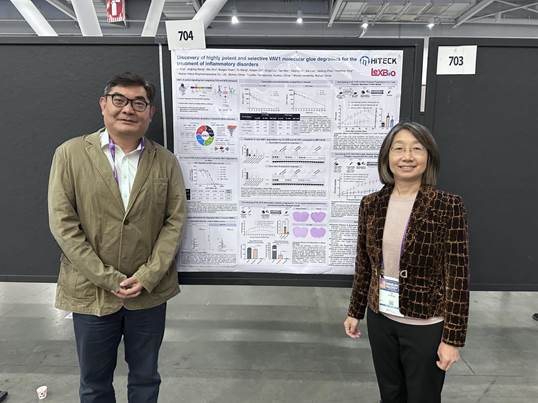
Mr. Ya Chen, Chairman of Wuhan Hiteck Biopharmaceutical (left), and Dr. Li Xing, Founder and CEO of Lexbio, at the HT016 poster presentation during AAI 2026.
Project Highlights
· Addressing a Challenging Target: VAV1 is a central signaling hub in T- and B-cell receptor pathways and plays a critical role in immune cell activation. Despite its high therapeutic potential, its structural and functional complexity has historically limited druggability. HT016 leverages an innovative molecular glue degrader approach to enable selective and efficient targeting of VAV1.
· Superior In Vitro Potency: Preclinical studies demonstrate that HT016 lead compounds achieve sub-nanomolar degradation activity, with DC50 values as low as 0.10 nM—representing more than a 70-fold improvement over the benchmark compound.
· Robust In Vivo Target Degradation: In mouse pharmacodynamic (PD) studies, HT016 induced potent VAV1 degradation. A single oral dose resulted in near-complete depletion of VAV1 protein in peripheral blood mononuclear cells (PBMCs) and spleen tissue. Compared with the benchmark, HT016 achieved deeper and more sustained target degradation at equivalent dose levels.
· Broad Efficacy Across Disease Models: In multiple preclinical models of autoimmune diseases—including rheumatoid arthritis, multiple sclerosis, and inflammatory bowel disease—HT016 significantly reduced disease severity and slowed disease progression.
About Hiteck
Wuhan Hiteck Biopharmaceutical Co., Ltd. (300683.SZ), founded in 1992 at the Medical School of Wuhan University, is a research driven company dedicated to translating complex biological insights into life changing therapies. Hiteck focuses on oncology, neurology, and immunology.
Building on its legacy of pioneering first in class therapies, notably Aponermin and Jinlujie, Hiteck is now scaling its innovation through the HiSMART™ platform, an integrated engine for small molecule discovery. By embedding computational biology and data science throughout the R&D process, Hiteck is deciphering complex mechanisms of protein degradation to expand its pipeline of novel modalities. The identification of HT016 serves as a key validation of this approach.
Following the filing of NCE patents, Hiteck is prioritizing the program's transition into clinical development to deliver next generation solutions to patients globally.
About LexBio
LexBio Therapeutics is an AI-driven drug discovery company leveraging advanced deep learning technologies to enable predictive modeling and molecular generation. Recognized as an “Honored Enterprise” in the NVIDIA Inception Program (2025), LexBio has established a differentiated platform that accelerates the discovery of innovative therapeutics with speed and efficiency.
The company’s research and development pipeline spans oncology, inflammation and immunology, and neurodegenerative diseases. LexBio focuses on addressing key challenges in drug discovery, including overcoming resistance in solid tumors, achieving selective brain penetration, and developing molecular glue degraders for traditionally undruggable targets.
Through a broad network of collaborations with industry partners and academic institutions, LexBio is advancing its mission to transform drug discovery.