
The study demonstrates mutation-resistant antibodies with 269× affinity improvement, a critical proof point for achieving CEPI’s 100 Days Mission and closing the therapeutic gap for 2.5 billion people at risk
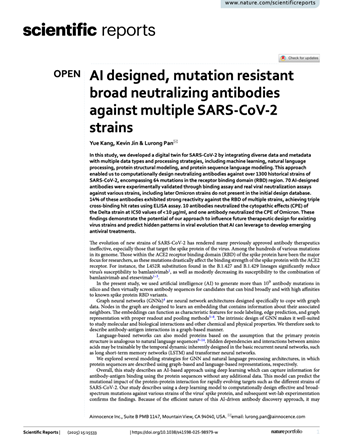
Ainnocence Inc., a biotechnology company pioneering AI-driven therapeutic antibody design, today announced the publication of its landmark study, “AI designed, mutation resistant broad neutralizing antibodies against multiple SARS-CoV-2 strains”, in Nature Scientific Reports (May 2025). The article demonstrates that artificial intelligence can design antibodies capable of neutralizing viral variants that did not yet exist at the time of design, effectively predicting and pre-empting viral evolution.
What the Study Demonstrated
The published research describes the construction of a “digital twin” for SARS-CoV-2, a computational model that integrates viral genomic data, protein structural modeling, graph neural networks, and protein sequence language modeling to simulate how the virus mutates and how antibodies interact with its spike protein.
Using this digital twin, the Ainnocence team computationally designed neutralizing antibodies against more than 1,300 historical strains of SARS-CoV-2, encompassing 64 distinct mutations in the receptor binding domain (RBD). More than 10⁹ antibody mutation candidates were generated and screened in silico before the most promising candidates were selected for experimental validation.
· 70 AI-designed antibodies were experimentally validated through binding assays and live viral neutralization assays across multiple SARS-CoV-2 strains.
· 14% achieved triple cross-binding reactivity against the RBD of multiple strains in ELISA assays, demonstrating broad-spectrum potential from a single design cycle.
· 10 antibodies neutralized the Delta variant with IC50 values below 10 µg/mL, and one antibody neutralized the Omicron variant, a strain that was not present in the original design database, confirming the model’s predictive power against future variants.
· Sub-nanomolar binding affinity was achieved with a 269× improvement over parental antibody candidates, representing one of the highest affinity gains reported in AI-driven antibody design to date.
“What makes this work significant is not just the binding numbers,” said Dr. Lurong Pan, Founder and CEO of Ainnocence. “It is that our AI designed antibodies that worked against viral variants the model had never seen. That is not optimization. That is prediction. And prediction is what you need when the next pandemic pathogen emerges and you have days, not years, to respond.”
The SentinusAI® Methodology: Sequence-First, Structure-Free, Animal Free
Ainnocence’s proprietary SentinusAI® platform, built on the AINN-P1 protein foundation model, a 167-million-parameter deep learning model trained on more than 53 million protein sequences.
Unlike conventional antibody discovery, antibody discovery approaches that rely on structural data and animal immunization and months of iterative phage display or hybridoma screening; SentinusAI® operate from sequence alone. The platform requires only the amino acid sequence of a target protein to initiate antibody design, no 3D structure, no prior lead compound, no animal model.
The methodology described in the Nature Scientific Reports publication integrates multiple AI architectures in parallel:
· Graph Neural Networks (GNNs) to model antibody-antigen molecular interactions as graph structures, capturing spatial and topological relationships between residues.
· Protein Sequence Language Models (transformer and LSTM architectures) to learn the “grammar” of protein sequences, identifying hidden dependencies between amino acids that govern folding, binding, and stability.
· De novo generation and virtual screening of up to 10¹⁰ candidate antibody sequences per target, with simultaneous multi-objective optimization for binding affinity, humanization, developability, and off-target safety.
· DevProScore™ manufacturability assessment evaluating thermal stability, aggregation propensity, post-translational modification liabilities, and isoelectric point to ensure candidates are developable before entering the wet lab.
The entire pipeline from target sequence input to fully characterized; developability-scored antibody leads operates in approximately 30 days, compared with 3-6 months for traditional methods. This represents an 80% reduction in both timeline and cost, with hit rates reaching 80% versus approximately 50% for conventional approaches.
Why This Matters for the 100 Days Mission
The Coalition for Epidemic Preparedness Innovations (CEPI) has set what it calls a “moonshot” goal: the 100 Days Mission. The ambition, endorsed by G7 and G20 leaders, is for the world to be able to develop safe, effective vaccines, therapeutics, and diagnostics within 100 days of recognizing a pathogen with pandemic potential. Had this capability existed at the start of the COVID-19 pandemic, modeling by Imperial College London suggests that 8 million excess deaths and $1.4 trillion in productivity losses could have been averted.
The 100 Days Mission is achievable for vaccines, where platform technologies like mRNA have already compressed development timelines. But for therapeutic antibodies, which serve as critical first-line countermeasures before vaccines achieve population-scale immunity, no equivalent acceleration technology existed.
Until now.
SentinusAI® is the antibody equivalent of what mRNA platforms achieved for vaccines. When a novel pathogen is identified and its genome sequenced, SentinusAI® can generate therapeutic antibody candidates within 30 days, leaving 70 days within the 100-day window for preclinical validation, manufacturing scale-up, and regulatory filing. The published Nature Scientific Reports data proves this is not theoretical: AI-designed antibodies already neutralized variants that emerged after the design phase, demonstrating exactly the kind of rapid, predictive countermeasure development the 100 Days Mission demands.
“The 100 Days Mission cannot be met with conventional antibody discovery,” said Dr. Pan. “Traditional methods require 12-18 months from target identification to lead candidate. That timeline does not bend to political will. It bends only to fundamentally different technology. SentinusAI® provides that technology and our published results prove it works.”
A Career Built for This Moment
Ainnocence's infectious disease capabilities are rooted in the expertise of founder Dr. Lurong Pan, who holds a PhD in Computational Chemistry (UAB) and an MS in AI (Georgia Tech), with 16+ years at the intersection of computational science, AI, and drug discovery.
In 2020, at the height of the COVID-19 pandemic, Dr. Pan was awarded the Merck Pandemic Preparedness Award by Merck KGaA for her “Digital Twin for COVID-19” project, the foundational research that would become the SentinusAI® platform and the basis for the subsequently published Nature Scientific Reports paper.
A Call for Collaboration: 60+ Disease Targets, Zero Approved Antibody Therapeutics
The need is urgent and the gaps are staggering. More than 2.5 billion people live in regions where the deadliest infectious diseases, Nipah virus (40-75% case fatality), Lassa fever (300,000+ cases annually), Marburg virus (up to 88% mortality), MERS-CoV (35% case fatality) have zero approved monoclonal antibody therapeutics. For diseases like Oropouche fever, which caused explosive outbreaks across Latin America in 2024, there is no therapeutic pipeline of any kind.
Ainnocence has mapped 60+ infectious disease targets across all six continents where SentinusAI® can make an immediate impact. These span WHO Blueprint priority pathogens, neglected tropical diseases, and emerging outbreak threats.
Ainnocence Inc. is inviting collaborations:
· Government agencies and multilateral health organizations seeking to accelerate pandemic preparedness programs and stockpile development under the 100 Days Mission framework.
· Product development partnerships (PDPs) working on neglected tropical diseases where conventional antibody discovery is too slow and too expensive for the available funding.
· Pharmaceutical and biotechnology companies looking to add AI-accelerated antibody candidates to their infectious disease pipelines or license the SentinusAI® platform for internal discovery.
· Academic and public health research institutions study high-consequence pathogens who need rapid, cost-effective antibody design against novel targets.
Ainnocence offers three engagement models:
1. Fee-for-service (target to leads in 3-4 weeks)
2. Co-development partnerships (discovery through IND with shared milestones)
3. Platform licensing (dedicated SentinusAI® deployment within partner organizations).
Looking Ahead
“COVID-19 taught the world a painful lesson: we cannot discover our way out of a pandemic at the speed of traditional R&D,” said Dr. Pan. “Our published data shows that AI can design antibodies that not only bind today’s pathogens but anticipate tomorrow’s variants. That capability, predictive, rapid, and scalable is exactly what the 100 Days Mission requires. We have the platform and the proof. Now we need partners who share the urgency.”
About Ainnocence Inc.
Founded in 2021 and headquartered in Mountain View, California, Ainnocence Inc. is a next-generation biotechnology company uses its proprietary generative AI platform to screen up to 10 billion molecules within hours to accelerate drug discovery across antibodies, small molecules, cell therapies, and synthetic biology. Working directly from sequence data, without 3D structural modeling; the platform has been applied across 60+ therapeutic programs. The company partners with leading pharmaceutical companies, academic institutions, and global health organizations to accelerate the discovery of life-saving biologics. For more information, visit www.ainnocence.com.
Media Contact:
Ainnocence Inc. | service@ainnocence.com | www.ainnocence.com | Mountain View, CA
Publication Reference:
Kang, Y., Jin, K., & Pan, L. (2025). AI designed, mutation resistant broad neutralizing antibodies against multiple SARS-CoV-2 strains. Scientific Reports, 15, 15533. https://doi.org/10.1038/s41598-025-98979-w
Forward-Looking Statements
This press release contains forward-looking statements regarding Ainnocence’s technology, potential partnerships, and future applications. Actual results may differ materially from those anticipated. These statements reflect current expectations and involve risks and uncertainties, including the outcomes of regulatory processes, partnership negotiations, and clinical development timelines.