
Funding to Propel POP BIO SNAP™ Nanoparticle Vaccine Platform into Phase 1 Clinical Trials in the U.S.
Buffalo, NY, June 03, 2026 (GLOBE NEWSWIRE) -- POP Biotechnologies, Inc. (“POP BIO”), a Buffalo-based biotechnology company developing next-generation vaccines and therapeutics using proprietary porphyrin-phospholipid liposome technologies, announces that the Coalition for Epidemic Preparedness Innovations (“CEPI”) will provide up to US $9.7 million in additional funding to advance the POP BIO SNAP™ (Spontaneous Nanoliposome Antigen Particle) protein vaccine platform into a Phase 1 clinical trial.
POP BIO announces collaboration with CEPI to address pandemic influenza
The new funding will support the continued development of a pioneering vaccine platform that uses protein-tagging technology in nanoparticles to accelerate the development of vaccines against epidemic and pandemic threats, including H5N1 avian influenza and a future Disease X. The technology could also enable more potent, targeted vaccine delivery and boost immune responses.
CEPI’s additional investment builds on an initial US $1.5 million award announced in July 2025, which supported early-stage research into the SNAP platform. The new funding will now support the continued development and early clinical testing of a SNAP-based vaccine candidate targeting H5N1 avian influenza, a virus that has spread widely in birds and increasingly infected mammals, raising concerns about its pandemic potential.
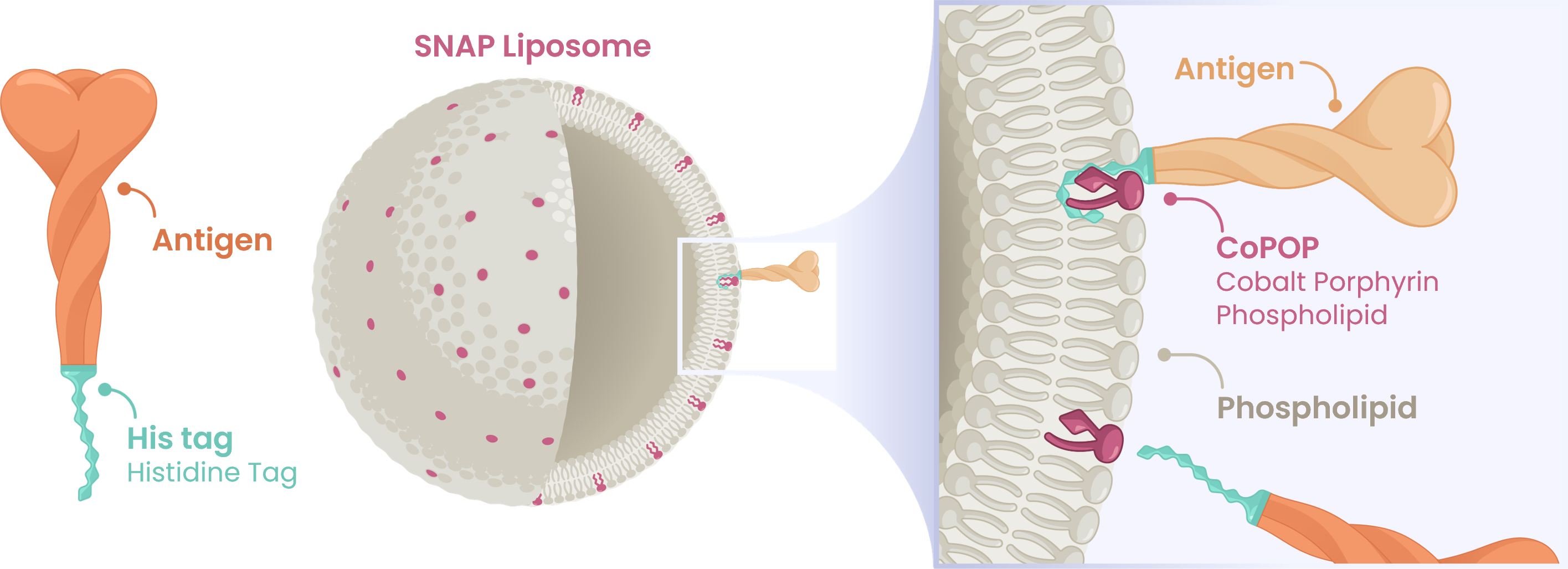
The POP BIO SNAP™ platform enables seamless generation of vaccines against a wide range of targets
“CEPI’s continued support is a significant validation of SNAP’s potential as a rapid-response vaccine platform and of POP BIO’s ability to translate innovative nanoparticle technologies into clinically relevant products,” said Jonathan Smyth, Esq., co-founder of POP BIO. “This investment advances a clear clinical pathway for our H5N1 vaccine candidate while strengthening a broadly adaptable platform that can rapidly respond to emerging infectious disease threats and reduce suffering on a global scale.”
POP BIO’s SNAP platform has been designed to accelerate the development of nanoparticle-based vaccine candidates while also streamlining the purification of the antigens used in them. Using an innovative approach, the SNAP technology uses a small protein tag attached to vaccine antigens — a purification technique commonly used in protein research — to embed the antigens into small, spherical lipid particles called liposomes. This design can help stimulate and enhance immune responses by improving how antigens are presented to the immune system, thereby generating stronger, more focused immune responses.
“We are excited to continue our partnership with CEPI to translate SNAP technology into an H5N1 protein nanoparticle vaccine candidate,” said Jonathan Lovell, PhD, technology inventor and co-founder of POP BIO. “The dual use of the his-tag to facilitate protein purification and then rapidly and stably convert those proteins into potent nanoparticle vaccine candidates has been instrumental to SNAP’s progress. Advancing this work toward a Phase 1 clinical trial in the United States is a significant step forward for POP BIO and for rapid-response vaccine development.”
“Antigens added to vaccine formulations have to be purified to ensure safety, efficacy, and consistency. Conventional purification methods can be costly and complex, typically lasting several days,” said Kent Kester, Executive Director of Vaccine R&D at CEPI. “As every day counts during an outbreak, faster development of purified vaccine constructs could help more quickly contain a fast-spreading viral threat, in line with the 100 Days Mission. By validating the platform against H5N1, we’ll be able to see how SNAP could also be rapidly adapted to respond to other epidemic and pandemic threats, including a Disease X.”
Compared to traditional approaches, SNAP’s design improves antigen presentation to the immune system while enabling rapid removal of potential contaminants from vaccine antigens in as little as 30 minutes. The platform’s versatile plug-and-play design could also be beneficial in an outbreak, as antigens from a disease-causing pathogen can be quickly “plugged” into the vaccine platform for faster development and deployment.
With fewer and less complex stages involved in its purification process, the technology is expected to improve manufacturing efficiency compared to traditional protein vaccine approaches, producing higher antigen yields that may help extend available vaccine supplies and allow more people to be vaccinated.
This investment supports CEPI’s 100 Days Mission — a global effort to develop vaccines against a new pandemic threat within 100 days of its identification — by advancing platform technologies designed for speed and adaptability. It also aligns with CEPI’s 3.0 Strategy, which places greater emphasis on enabling rapid-response vaccine platforms that can be deployed quickly and equitably in future outbreaks.
CEPI and POP BIO are committed to enabling equitable access to the outputs of their partnership, in line with CEPI’s Equitable Access Policy. Project results, including related data, will be published, giving open access for the benefit of the global scientific community.
About POP Biotechnologies
POP Biotechnologies, Inc. is a privately held biotechnology company developing novel therapeutics and vaccines based on its proprietary porphyrin-phospholipid (“PoP”) liposome technology. The PoP platform, exclusively licensed from the State University of New York Research Foundation, is the invention of POP BIO co-founder Dr. Jonathan Lovell at the University at Buffalo. POP BIO operates from the University at Buffalo incubator at Baird Research Park in Buffalo, New York. Learn more at pop.bio.
About POP BIO’s SNAP™ Technology
POP BIO’s SNAP™ (Spontaneous Nanoliposome Antigen Particleization) technology enables the rapid development and manufacturing of highly immunogenic particle-based vaccines and immunotherapies directed against infectious diseases, cancer, and other diseases through the use of a cobalt-modified variant of PoP technology, known as CoPoP. SNAP enables stable, spontaneous liposome display of protein and peptide antigens, resulting in substantial improvements in antigen-specific immune responses. The platform has undergone substantial human validation, including completion of Phase 3 clinical trials for a COVID-19 vaccine and ongoing clinical studies in other vaccine indications.
About CEPI
CEPI is a global partnership between public, private, philanthropic, and civil organizations. Its mission is to accelerate the development of vaccines and other biologic countermeasures against epidemic and pandemic threats so they can be accessible to all people in need. Central to CEPI’s pandemic-beating plan is the 100 Days Mission — the goal to developsafe, effective and accessible vaccines against new threats in just 100 days.CEPI is seeking US $2.5 billion to execute CEPI 3.0, its 2027–2031 strategy, which will systematically reduce the likelihood, impact, and cost of epidemics and pandemics by driving the 100 Days Mission towards an operational reality. Learn more at CEPI.net.
Press Inquiries
Media Contact:
Jonathan R. Smyth, Esq.
President, Cofounder
POP Biotechnologies
jrsmyth@pop.bio
https://pop.bio


