
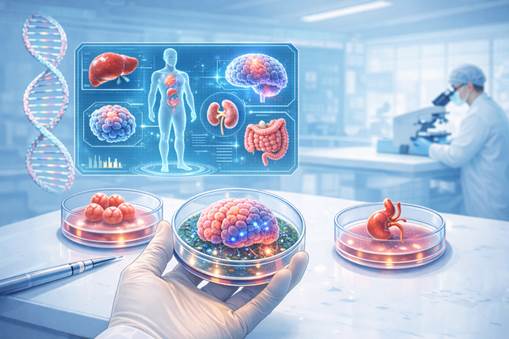
Organoids miniature organs self-organized from stem cells have emerged as a game-changer in medicine by mimicking the structure and function of actual human organs. However, some critics argue that describing them as "complete organs" creates "scientific hype" by fostering excessive public expectation. To leap beyond being a mere sophisticated model and become a practical therapeutic solution, what technical breakthroughs must we focus on?
1. The Bottleneck: Why They Remain "Models"
The reason current organoid technology cannot yet be called a "complete organ" is its inability to fully replicate the complex networks of the human body.
- Lack of Vascular Systems: Without blood vessels, organoids cannot receive oxygen and nutrients at their core, limiting their growth size and hindering the efficient removal of metabolic waste.
- Immature Cellular Differentiation: Current organoids often exhibit embryonic characteristics rather than those of adult organs, lacking the functional maturity required to study geriatric or complex metabolic diseases.
2. The Solution: Three Leaps Toward Functional Realization
The answer to this debate lies in enhancing "functional completeness" by integrating organoids with other advanced technologies.
- Integration of Organoid-on-a-Chip: By using microfluidic technology to provide artificial blood flow, we must extend the lifespan of organoids and precisely mimic interactions between different organs (e.g., the gut-liver axis). When this is achieved, organoids gain value as a "living system."
- Structuring via 4D Bioprinting: Instead of relying solely on random self-organization, "structural design" must be employed using bioprinting to precisely place vascular and neural cells. This is the key to solving the reproducibility issue in organoid production.
- AI-Driven Maturity Control: We need process standardization that utilizes Artificial Intelligence to monitor and provide real-time feedback on culture environments, pushing cellular maturity to adult levels.
Conclusion: Bridging the Gap through Convergence
Ultimately, the debate over whether an organoid is an "organ" or a "model" is less important than how closely the technology is evolving toward mimicking the actual physiological environment of the human body. Currently, organoids serve as the most sophisticated "models" available, and through convergence with bioprinting and ICT, they are gradually entering the realm of "functional organs."
The scientific community must remain transparent about current limitations while focusing on deriving solutions through convergent technologies. When supported by such efforts, organoids will transcend scientific hype and establish themselves as a practical scientific reality for extending human life and conquering incurable diseases. Through this precise emulation technology, humanity will overcome the spatial constraints of disease treatment and enjoy a healthier future.

About unexakorea
unexakorea conducts innovative research to make advanced biotechnology
accessible to everyone in everyday life.
By operating a variety of connectivity-based services that reduce information
gaps and eliminate daily inconveniences, the company is building a
people-centered platform ecosystem.
unexakorea is also evolving into a total life-care platform. Grounded in research, science, and technology, the company designs everything from small daily routines to an individual’s entire life cycle with precision—preparing for an era in which people can live healthily up to 123 years. To achieve this, unexakorea is establishing a structural health infrastructure that does not rely solely on individual effort, developing long-term generational strategies based on science, and creating a sustainable wellness model in which benefits are shared across society.
As an R&D-driven company specializing in healthcare and nutraceuticals, unexakorea pursues sustainable innovation backed by the financial stability and technological capabilities of its parent company. Moving beyond the nutraceutical market’s traditional focus on “rapid absorption,” unexakorea is advancing sustained-release formulation manufacturing technology designed to deliver stable efficacy in the body for more than 10 hours. Furthermore, the company is shaping a new paradigm for sustainable biotechnology through research in microbiome