
The Global Nocturia Market is estimated to be valued at USD 4.41 Bn in 2025 and is expected to reach USD 7.61 Bn by 2032, exhibiting a compound annual growth rate (CAGR) of 8.1% from 2025 to 2032. This growth is driven by the rising prevalence of nocturia across multiple age groups, supported by increased awareness, advancements in diagnostic technologies, and expanding treatment options. Market expansion is further reinforced by the growing geriatric population and the increasing incidence of related underlying conditions, including diabetes and cardiovascular diseases
Request a Sample Copy of the Report @. https://www.coherentmarketinsights.com/insight/request-sample/9058
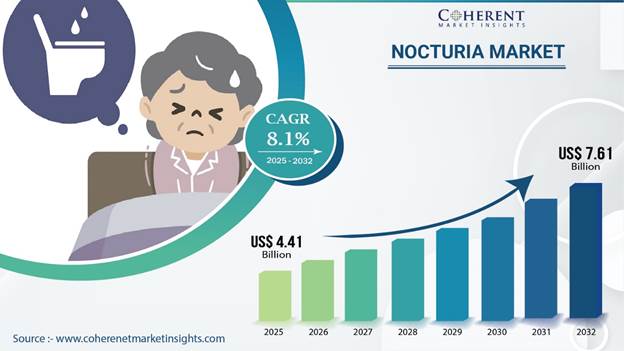
Global Nocturia Market Key Takeaways
Demand remains especially high for antidiuretic agents, including vasopressin analogs like desmopressin, with the target segment accounting for a market share of 33.8% in 2025.
By route of administration, oral nocturia drugs segment is projected to lead the market with a 34.5% share in 2025.
Immediate-release tablets or capsules segment accounted for 35.6% of the global nocturia market share in 2025.
North America, with an estimated 39.2% share in 2025, is expected to retain its dominance in the global nocturia industry.
Asia Pacific, with a share of 23.4% in 2025, is projected to emerge as a highly lucrative market for nocturia drug manufacturers during the forecast period.
Increasing Geriatric Population Spurring Nocturia Market Growth
Coherent Market Insights’ latest nocturia market analysis highlights key factors driving market growth. These include growing geriatric population, rising prevalence of chronic diseases, growing awareness and diagnosis of nocturnal urinary frequency, and advancements in nocturia treatment options.
According to the World Health Organization (WHO), the global population aged 80 or older is estimated to reach around 426 million by 2050. This demographic shift is expected to fuel demand for nocturia treatments because older adults are at higher risk of nocturnal urinary frequency. Nocturia prevalence increases significantly with age, especially in adults over 60 years.
Studies show that nocturia affects around 10–20% of adults aged 40–59 and nearly 50–60% of people aged 60 and above. As people age, changes in bladder function, sleep patterns, and long-term health conditions become more common, which increases the need for effective nocturia therapies. Therefore, the rising geriatric population across the world is expected to boost growth of the nocturia market during the forecast period.
Also Read: Urinary Incontinence Treatment Drugs Market Size, Share, Trends & Opportunities for 2025-2032
Side Effects and Underdiagnosis Hampering Nocturnal Urinary Frequency Market Growth
The global nocturia market outlook indicates steady growth, owing to the increasing aging population and growing demand for effective nocturia therapies. However, side effects associated with nocturia treatments and underdiagnosis may limit market growth to some extent during the forecast period.
Many patients think nocturia is a normal part of aging and not a medical condition, which leads to low diagnosis and treatment rates. Cultural stigma and embarrassment about urinary symptoms also make patients less likely to talk about their condition, reducing physician screening. In addition, adverse effects such as dry mouth, constipation, and dizziness from existing medications can cause low treatment adherence and patient dropout. This limits long-term use and reduces overall nocturia market demand.
Rising Burden of Chronic Diseases Creating Growth Opportunities
Chronic conditions such as diabetes, hypertension, cardiovascular disease, sleep disorders, and kidney dysfunction are closely linked to nocturia. As these diseases become more common worldwide, more patients are seeking nocturia diagnosis and treatment. Thus, increasing prevalence of chronic diseases is expected to create lucrative growth opportunities for manufacturers of nocturia drugs during the forecast period.
Buy the Complete Report with an Impressive Discount (Up to 40% Off ) at: https://www.coherentmarketinsights.com/offernew/buy-now/9058
Emerging Nocturia Market Trends
Rising awareness and diagnosis are playing a key role in fueling sales of nocturia drugs globally. Growing public and healthcare-provider awareness that nocturia is a treatable medical condition (rather than a normal part of aging) leads to higher diagnosis rates and treatment uptake. Educational campaigns and clinical focus on urinary symptoms are contributing to this trend.
Telemedicine platforms, mobile health apps, bladder tracking tools, wearable monitors, and advanced diagnostics are improving symptom tracking, patient engagement, and treatment adherence. These digital health and diagnostic technologies are expanding market opportunities for nocturia therapies.
Growing interest in personalized medicine is providing tailwinds to the nocturia industry. There is a rising shift towards tailored nocturia treatment plans based on factors like age, gender, and comorbidities.
Pharmaceutical innovations, including new drugs like Beta-3 agonists, improved anticholinergics, and desmopressin formulations, are expanding the therapeutic landscape. These advances offer improved efficacy, better safety profiles, and patient-friendly formulations, which support higher adoption. Likewise, combination therapies are gaining popularity because of their added advantages.
Also Read: Overactive Bladder Therapeutics Market Outlook for 2025-2032
Analyst’s View
“The global nocturia market is expected to grow steadily during the forecast period, fueled by the rising prevalence of sleep disorders and urinary tract conditions, increasing awareness of nocturia management, and advancements in therapeutic interventions and treatment options,” said a senior CMI analyst.
Current Events and Their Impact on the Nocturia Market
|
Event |
Description and Impact |
|
Aging Population Demographics |
|
|
Digital Health Revolution and Telemedicine Expansion |
|
Competitor Insights
Key companies listed in the nocturia market report include:
- Astellas Pharma Inc.
- Ferring Pharmaceuticals
- Pfizer Inc.
- Merck & Co., Inc.
- AbbVie Inc.
- Sanofi S.A.
- Teva Pharmaceutical Industries Ltd.
- GlaxoSmithKline plc
- Glenmark Pharmaceuticals Ltd.
- Sumitomo Pharma Co., Ltd.
- Urigen Pharmaceuticals Inc.
- Avadel Pharmaceuticals plc
- Vantia Therapeutics Ltd.
- Allergan (an AbbVie company)
- Viatris Inc.
Request For Customization: https://www.coherentmarketinsights.com/insight/request-customization/9058
Key Developments
· In July 2025, Eisai (Thailand) Marketing Co., Ltd launched Beova® Tablets, a treatment for overactive bladder, in Thailand. Beova® Tablets (generic name vibegron) were approved by Thai authorities in June 2024 before being launched in 2025.
· In May 2024, Sumitomo Pharma announced FDA acceptance of a supplemental application for Vibegron in men with overactive bladder (OAB) receiving BPH therapy.
Market Segmentation
By Drug Class: Antidiuretic Agents (e.g., vasopressin analogs such as desmopressin), Alpha-1 Adrenergic Antagonists (e.g., tamsulosin, alfuzosin, silodosin, terazosin), Anticholinergic Agents (e.g., oxybutynin, tolterodine, solifenacin, darifenacin, trospium), Beta-3 Adrenergic Agonists (e.g., mirabegron, vibegron), Loop Diuretic Timing Therapies (e.g., furosemide administered in late-afternoon dosing), and Combination Pharmacotherapies (e.g., mirabegron + solifenacin, alpha-blocker + anticholinergic)
By Route of Administration: Oral, Intranasal, Sublingual/orodispersible, and Parenteral and other systemic routes
By Dosage Form: Immediate-release tablets or capsules, Modified/extended-release oral formulations, Orodispersible tablets or film, Nasal sprays or drops, and Injectable formulations
By Mechanism of Action: Vasopressin Receptor Agonists, Smooth Muscle Relaxants, Muscarinic Receptor Blockers, Beta-3 Receptor Stimulants, Prostate-Targeted Relaxants, and Fluid-Regulation Modulators
By Prescription Type: Prescription-Only Medicines (Rx) and Over-the-Counter Options (OTC)
By Age Group: Adult and Geriatric
By Gender: Male and Female
By Distribution Channel: Hospital Pharmacies, Retail Pharmacies, and Online Pharmacies
By End User: Hospitals, Specialty urology clinics, Long-term care and nursing facilities, and Home-care and self-administration settings
Also Read: Urinary Incontinence Therapeutics Market Analysis & Forecast for 2025-2032
Our Trusted Partners:
Worldwide Market Reports, Coherent MI, Stratagem Market Insights
Get Recent News:
https://www.coherentmarketinsights.com/news
About Us:
Coherent Market Insights leads into data and analytics, audience measurement, consumer behaviors, and market trend analysis. From shorter dispatch to in-depth insights, CMI has exceled in offering research, analytics, and consumer-focused shifts for nearly a decade. With cutting-edge syndicated tools and custom-made research services, we empower businesses to move in the direction of growth. We are multifunctional in our work scope and have 450+ seasoned consultants, analysts, and researchers across 26+ industries spread out in 32+ countries.
Contact Us:
Mr. Shah
Coherent Market Insights Pvt. Ltd,
U.S.: + 12524771362
U.K.: +442039578553
AUS: +61-8-7924-7805
INDIA: +91-848-285-0837
✉ Email: sales@coherentmarketinsights.com

