
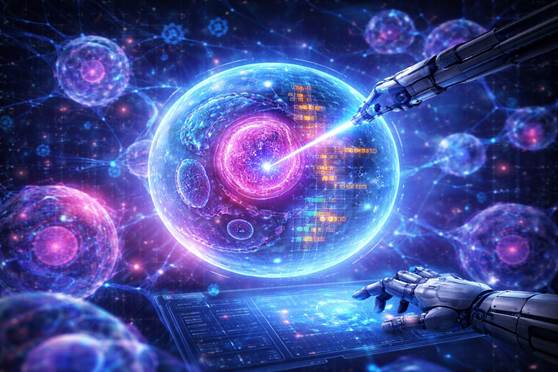
In biotech today, AI is no longer new.
Predicting molecular structures, finding drug candidates, filtering toxicity
early—these innovations are often summarized in one sentence: AI makes drug
development faster. Efficiency, cost, speed. All true.
But the bigger change is happening somewhere else.
AI is not only changing the pace of drug discovery—it is changing the
way we think about disease.
The core question is shifting:
“Which target should we block?” to
“Which cellular state should we restore?”
This shift moves biotech’s language from targets to states—and more boldly, from parts to programs.
Diseases Rarely Heal Just Because One Part Was Fixed
For decades, drug discovery has followed a highly “engineering-like” logic: identify the key target that drives disease, then design a drug to inhibit or activate it. This approach built modern biotech, and it produced countless successes. But it also runs into repeated failure—especially in cancer and chronic diseases.
· Cancer learns how to escape drugs.
· Autoimmune diseases flare up again and again.
· Neurodegeneration is a slow progression, not a single event.
· Fibrosis eventually moves into a point-of-no-return trajectory.
These diseases are not best explained as single-target malfunctions. They are better understood as changes in system state—shifts in how cell populations behave and evolve.
At that point, disease starts to look less like a machine with a broken component and more like a software system running in the wrong mode.
Disease Is a Problem of “Runtime State”
For a long time, biology looked at averages. Bulk tissue assays measure gene expression, but what they report is the mean signal of millions of cells.
Then came single-cell omics and spatial omics, revealing disease not as an average, but as a living, heterogeneous system.
Within the same tissue:
· some cells respond to therapy,
· others escape into resistance,
· and many occupy intermediate states often arranged in highly structured spatial patterns.<
This is similar to what happens in computer science when you troubleshoot a system by reading its logs and stack traces. Disease is unfolding on a map of cellular states not in a single average number.
Once We Build a “Disease State
Machine,” the Goal of Therapy Changes In computer engineering, there’s the concept of a state machine—a
model that describes how a system transitions between states based on certain
conditions. Disease behaves the same way: ·
Healthy → early inflammation ·
Early inflammation → chronic inflammation ·
Response → resistance ·
Injury → fibrosis
The critical question is not only what state the system is in, but which
direction it is moving. Even for the same patient and the same diagnosis, biological states shift
over time. Therapy reshapes these trajectories—it can accelerate, delay,
stabilize, or redirect them. Treatment, therefore, is no longer simply “pressing down a target.” It
becomes a way to alter the trajectory of cellular state transitions. And this is where AI’s role becomes truly transformative. AI doesn’t just search for “a drug that binds well.” It can learn the
state space, predict transitions, and ultimately help design interventions that
push cells toward the desired state. Future Therapies Won’t Be Switches—They Will Be “Patches” Traditional drugs act like switches: they turn down pathways that are
turned on too strongly. But in a state-based framework, therapy isn’t a switch.
It’s a patch. A patch does not simply turn something off. It modifies
faulty logic and restores the system to stable execution. In biology, this idea aligns with cell-state reprogramming: ·
shifting hyperactivated immune cells into a regulatory mode, ·
steering resistant tumor cells back toward differentiation or
cell death, ·
pulling tissues away from fibrotic progression toward
regeneration. And here’s the key insight: a patch doesn’t always need to be a brand-new
molecule. It can also be: ·
drug combinations, ·
dosing sequences, ·
treatment timing, ·
rhythmic intervention schedules. These are all tools of state-transition control. In other words, tomorrow’s biotech products may not be defined by a
compound alone, but by an entire intervention scenario as a programmable
strategy. Debugging Starts Not With Observation, But With Perturbation Software debugging cannot be solved by “just looking.” You have to
intervene, test, and trace cause-and-effect. Biology is no different. This is
why perturbation models are becoming central: ·
perturb genes with CRISPR, ·
observe how cellular states shift at single-cell resolution, ·
perturb with drugs or cytokines, ·
learn how interventions reshape trajectories. Perturbation datasets provide something observation alone cannot:a pathway
toward causality. And here, AI evolves from a prediction
engine into a true debugging tool: ·
What is the root error driving this disease state? ·
Which intervention restores healthy state most efficiently? ·
In which cell subtypes does a target actually matter? ·
What early warning signals appear before resistance emerges?
Rather than producing a list of candidate compounds, AI starts generating
something deeper: a bug report for the disease program. Biotech Advantage Will Shift From “Targets” to “Transition
Control” This shift will reshape the industry. 1)
Pipelines will be re-centered Old
pipeline: target → compound → indication New pipeline: disease state →
transition rules → reset strategy (patch) 2)
Data value will be redefined The most valuable assets won’t
be the largest omics datasets, but: ·
perturbation datasets,
and ·
longitudinal
time-resolved data (pre/post/relapse) Those are the ingredients that
allow state machines to be built. 3)
Competition will move from molecules to strategies Even the same drug can produce
different outcomes depending on: ·
which patient, ·
which cellular state, ·
which sequence, ·
and which combination. These are optimization problems and
AI is built for optimization. Final Thought: Once We Treat Disease as a Program, Therapy Becomes
an Update AI is accelerating drug discovery. But the most profound
change is not “finding drugs faster.” It’s the transformation of how we define
disease and therefore how we define therapy. Disease is not simply a
protein-level defect. It is a cellular system that has entered the wrong
runtime state. The future of therapy is not suppression it is reset. And
future drugs may be less like molecules and more like algorithms that design
state transitions. Biotech must now change its fundamental question: Not “What should we block?” And the technology best positioned to answer that
question is: AI that debugs the program of disease. About Unexakorea Unexakorea conducts innovative research to make advanced
biotechnology accessible to everyone in everyday life. unexakorea is also evolving into a total life-care platform.
Grounded in research, science, and technology, the company designs everything
from small daily routines to an individual’s entire life cycle with precision preparing
for an era in which people can live healthily up to 123 years. To achieve this,
unexakorea is establishing a structural health infrastructure that does not
rely solely on individual effort, developing long-term generational strategies
based on science, and creating a sustainable wellness model in which benefits
are shared across society. As an R&D-driven company specializing in
healthcare and nutraceuticals, unexakorea pursues sustainable innovation backed
by the financial stability and technological capabilities of its parent
company. Moving beyond the nutraceutical market’s traditional focus on “rapid
absorption,” unexakorea is advancing sustained-release formulation
manufacturing technology designed to deliver stable efficacy in the body for
more than 10 hours. Furthermore, the company is shaping a new paradigm for
sustainable biotechnology through research in microbiome
but “Which state should we restore?”
By operating a variety of connectivity-based services that reduce information
gaps and eliminate daily inconveniences, the company is building a
people-centered platform ecosystem.