Ainnocence’s foundation model trained from scratch, requiring no structure, no multiple sequence alignment, no fine-tuning, training in hours rather than weeks.
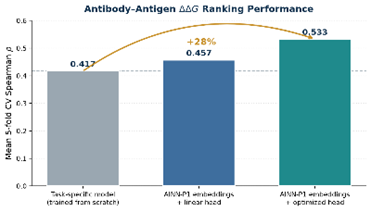
Ainnocence Inc., an AI-driven pharmaceutical & material IP-generating platform company, today released research showing that representations learned by its AINN-P1 protein foundation model substantially improve a core task in antibody engineering: ranking candidate antibody-antigen pairs by binding affinity. Using AINN-P1 as a frozen encoder, the company improved the mean Spearman rank correlation for predicted change in binding free energy (ΔΔG) from 0.42 to 0.53, a relative gain of approximately 28% over a task-specific model trained from scratch on the same data and evaluated under an identical five-fold cross-validation protocol.
The findings are described in a new preprint, “AINN-P1: A Compact Sequence-Only Protein Language Model Achieves Competitive Fitness Prediction on ProteinGym,” by Roger Wang, Kevin Jin, and Lurong Pan.
Key findings
● 28% relative improvement in ΔΔG ranking quality (Spearman ρ: 0.417 → 0.533) under identical five-fold cross-validation.
● A simple linear model on frozen AINN-P1 embeddings (ρ = 0.457) already beats a task-specific network trained end-to-end from scratch (ρ = 0.417) direct evidence that the gain comes from representation quality, not from added model capacity.
● Sequence-only. No co-crystal structure, docked model, or multiple sequence alignment is required at any stage.
● Orders-of-magnitude lower training cost: seconds per fold rather than hours, with the foundation model held frozen.
Why it matters
Antibody affinity maturation requires ranking large panels of candidate variants under tight experimental-label budgets. Building a bespoke predictor for each new target is data-hungry, slow and hard to reproduce across campaigns.
Many of the strongest published affinity and fitness predictors depend on structural input, an experimentally solved or computationally docked three-dimensional model of the complex or on deep multiple sequence alignments. For novel antibody-antigen pairs, which is precisely the regime that matters in discovery, co-crystal structures usually do not exist, and docked models introduce error at the exact interface the prediction depends on.
Ainnocence’s result is achieved without either. AINN-P1 encodes antibody and antigen sequences directly, and a lightweight supervised head ranks candidates from the resulting embeddings. Because the foundation model is never fine-tuned, the same embeddings can be reused across targets and objectives, and each downstream head trains in seconds enabling rapid, low-data iteration inside a live discovery campaign.
“The most informative result in this study is the one that looks least impressive on paper,” said Dr. Lurong Pan, Founder and CEO of Ainnocence. “A plain linear probe on our frozen embeddings outperforms a full network trained end-to-end on the same labels. That tells you the biology is already in the representation. We are not winning by building a bigger model on top, we are winning because AINN-P1 has learned something real about how proteins bind, from sequence alone.”
How it was measured
The team framed affinity maturation as a learning-to-rank problem: because downstream decisions depend on which candidates advance to the wet lab, the relative ordering of candidates matters more than absolute ΔΔG values. Spearman rank correlation served as the primary metric, with NDCG and AUC tracked as secondary measures.
Three configurations were evaluated on a curated antibody-antigen ΔΔG dataset. All shared identical inputs, labels, and cross-validation folds, and feature normalization were fit only on training folds to prevent information leakage isolating the effect of the representation itself.
Mean
five-fold cross-validated Spearman ρ for antibody-antigen ΔΔG ranking. All
configurations use identical data and folds. Source: Wang
et al., 2026 “Because
we keep the foundation model frozen, these numbers are a floor, not a ceiling,”
said Roger Wang, co-author of the study. “We have not yet spent a single
gradient step specializing AINN-P1 to antibody-antigen data. That is the next experiment,
and we expect the margin to widen.” What comes next Because the
foundation model is held frozen throughout, the reported accuracy represents a
conservative lower bound. Ainnocence plans a task-adaptive fine-tuning stage
that specializes AINN-P1 to antibody-antigen affinity data, alongside
higher-capacity model variants, multi-objective heads that optimize affinity
jointly with developability and specificity and closed-loop integration of
experimental feedback. Prospective wet-lab validation and broader benchmarking
across additional targets are underway. The
capability is being integrated into SentinusAI®, Ainnocence’s biologics and
antibody design platform. Representative
outcomes from recent antibody discovery campaigns run on SentinusAI® are
summarized in Table 1, spanning cytokines, receptors, immune checkpoints, and
bispecific formats. Representative
High-Yield Antibody Discovery Campaigns on SentinusAI® Target Hits/Tested Hit Rate (%) Best KD TSLP 13/9 69.2 1pM IL36R 20/11 55 1pM GD2 X CD3 44 / 85 51.8 129 pM IL15 34 / 74 45.9 392 pM CD19 50 / 124 40.3 28 pM Activin A X GDF8 46 / 116 39.7 18 pM TSHR 41 / 121 33.9 N/A FcRn 33 / 98 33.7 49 pM C1q 26 / 84 31 540 pM
Availability The preprint
is available at AINN-P1:
A Compact Sequence-Only Protein Language Model Achieves Competitive Fitness
Prediction on ProteinGym.
The AINN-P1 model and the curated antibody-antigen ΔΔG dataset are proprietary
to Ainnocence Inc. aggregate results are reported in full in the preprint.
Inquiries regarding data or model access may be directed to the corresponding
author.
About
Ainnocence, Inc. Founded in
2021 and headquartered in California, Ainnocence is a next-generation
biotechnology company transforming drug discovery and synthetic biology through
AI-based, sequence-first engineering. The company’s self-evolving platform
evaluates up to 10 billion molecules spanning proteins, antibodies, small
molecules, nucleic acids, and chemical formulations within hours to weeks,
enabling rapid, multi-objective design across therapeutic, biological, and
chemical systems. By reducing R&D timelines and costs while increasing
success rates, Ainnocence empowers industry and academic partners to pursue
complex biological innovation with greater precision and control.
Media
Contact Dr. Lurong Pan,
PhD, Founder and CEO +1
205-249-7424 Visit
us on social media: LinkedIn | YouTube | X
Forward-looking
statements. This
release contains forward-looking statements regarding anticipated model
performance, planned research directions, and platform development. Results
described reflect retrospective computational evaluation on a curated internal
dataset and have not been prospectively validated in the laboratory. Actual
results may differ materially. This release does not constitute an offer to sell,
or a solicitation of an offer to buy any securities.