
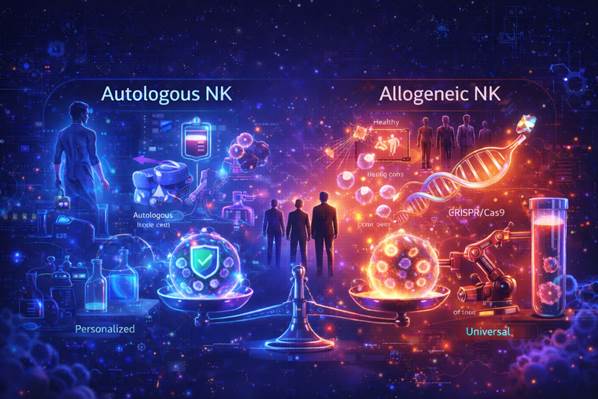
NK cells are the frontline warriors of the innate immune system. As the industry advances, the debate intensifies: will the "Autologous" or "Allogeneic" approach lead the market?
1. Strategic Comparison: Autologous vs. Allogeneic
Each method presents distinct advantages and trade-offs in terms of clinical efficacy and economic viability.
|
Feature |
Autologous NK |
Allogeneic NK |
|
Cell Source |
Patient's own blood |
Healthy donors, Cord blood, or iPSCs |
|
Immune Response |
Pros : No rejection; exceptionally safe |
Cons : Risk of GvHD or rejection without editing |
|
Immune Response |
Pros : No rejection; exceptionally safe |
Cons : Risk of GvHD or rejection without editing |
|
Timeliness |
Cons:Wait time required for culture (2-4 weeks) |
Pros : Immediate "Off-the-shelf" administration |
|
Cell Quality |
Cons : Potency varies based on patient health |
Pros : Consistently high potency from healthy donors |
|
Cost |
Cons : High cost due to bespoke production |
Pros : Lower cost through mass-production economies |
2.
Opportunities: Reliability vs. Accessibility ·
Autologous NK: Offers superior engraftment and long-term safety.
It is the ultimate personalized solution for elderly patients or those
requiring sustained, safe treatment. ·
Allogeneic NK: By utilizing CRISPR gene editing to remove
immune-rejection markers, it overcomes its primary weakness. Its ability to be
mass-produced and stored makes it a powerful candidate for universal medical
access. 3.
Leap and Progress: Technical Maturity ·
Solving Autologous Limits: Advanced expansion protocols now allow
for the production of trillions of high-purity NK cells from minimal blood
volumes.< ·
Solving Allogeneic Limits: iPSC-derived NK technology enables the
mass-production of "Super NK cells" with uniform quality,
establishing a robust industrial foundation for the next generation of cancer
care. Conclusion:
Completing the Era of Immuno-oncology Ultimately, autologous and allogeneic NK cells will coexist as
tailored options based on clinical needs. While allogeneic cells provide
immediate intervention for acute cases, autologous cells offer precise,
long-term care for relapse prevention. As these therapies cross the threshold of commercialization,
humanity has gained an anticancer solution that is both potent and safe. We are
moving beyond simply treating symptoms into an era of managing the fundamentals
of health through cellular engineering, ensuring a healthier and more
prosperous future for all.
About Unexakorea Unexakorea conducts
innovative research to make advanced biotechnology accessible to everyone in
everyday life. unexakorea is also evolving
into a total life-care platform. Grounded in research, science, and technology,
the company designs everything from small daily routines to an individual’s entire
life cycle with precision preparing for an era in which people can live
healthily up to 123 years. To achieve this, unexakorea is establishing a
structural health infrastructure that does not rely solely on individual
effort, developing long-term generational strategies based on science, and
creating a sustainable wellness model in which benefits are shared across
society. As an R&D-driven company specializing in
healthcare and nutraceuticals, unexakorea pursues sustainable innovation backed
by the financial stability and technological capabilities of its parent
company. Moving beyond the nutraceutical market’s traditional focus on “rapid
absorption,” unexakorea is advancing sustained-release formulation
manufacturing technology designed to deliver stable efficacy in the body for
more than 10 hours. Furthermore, the company is shaping a new paradigm for
sustainable biotechnology through research in microbiome.
By operating a variety of connectivity-based services that reduce information
gaps and eliminate daily inconveniences, the company is building a
people-centered platform ecosystem.