
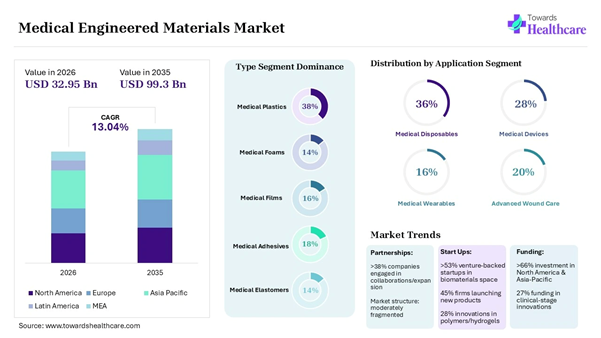
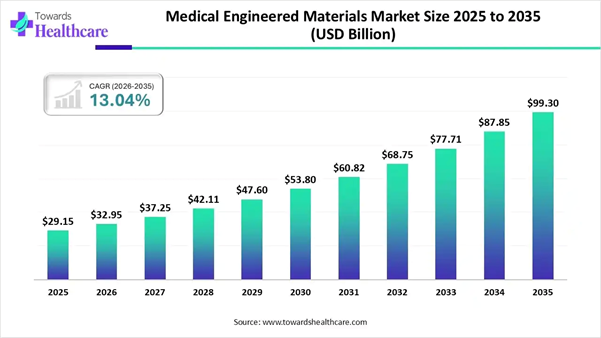
The global medical engineered materials market size was estimated at USD 29.15 billion in 2025 and is predicted to increase from USD 32.95 billion in 2026 to approximately USD 99.30 billion by 2035, expanding at a CAGR of 13.04% from 2026 to 2035.
The high-performance polymers and other engineered materials are required for the production of medical equipment and consumables. The engineered polymers are important in medical and hygiene applications because they offer durability, versatility, and biocompatibility. Apart from this, the engineered biomaterials are used in cancer therapy to integrate them in implants, devices, and tissue-engineering applications. The biomaterials are present in natural, synthetic, or hybrid forms to interact with biological systems for medical purposes.
Download the Free Sample Pages of this Report @ https://www.towardshealthcare.com/download-sample/6608
Medical Engineered Materials Market: Highlights
➔ Medical engineered materials market to cross USD 32.95 billion by 2026.
➔ Market projected at USD 99.3 billion by 2035.
➔ CAGR of 13.04% expected in between 2026 to 2035.
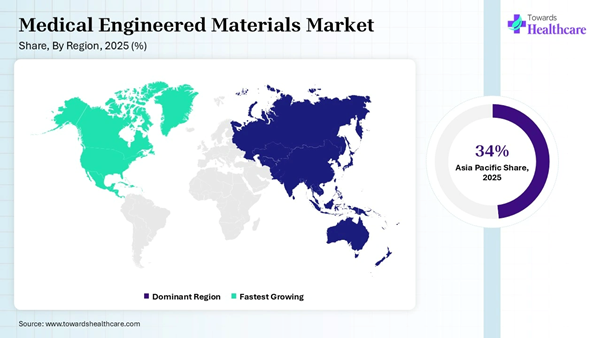
➔ Asia Pacific dominated the market share by 34% in 2025.
➔ North America is expected to grow at the fastest CAGR in the market during the forecast period.
➔ By type, the medical plastics segment dominated the market by 38% share in 2025.
➔ By type, the medical adhesives segment is expected to grow at the fastest CAGR in the market during the forecast period.
➔ By application, the medical disposable segment led the market share by 36% in 2025.
➔ By application, the medical devices segment is expected to grow at the fastest CAGR in the market during the forecast period.
Market Overview: Biomaterials Deciding the Success of Medical Devices
The medical engineered materials market is accelerated by the biomaterials, including synthetic materials such as polymers, metals, and composites, that have enhanced the success of medical devices. The novel biomaterial fabrication techniques have driven the boom of biomaterials in the global market. 3D bioprinting has enhanced biomaterials for protein delivery. The new methods allow the creation of structures that support tissue regeneration and enable precise control over scaffold size and shape.
Glimpse at the Potential Challenges and Future Outlook
The biomaterials have transformed the medicine industry by advancing tissue regeneration, targeted therapies, and implantable devices. On the other hand, certain limitations revolve around scaling production and biocompatibility. Moreover, the current advances in fabrication technologies include nanocomposites and smart materials that will continue to expand in the medical engineered materials market. There are wide applications of biomaterial innovations in healthcare. The biomaterials, like nanostructured carriers, chitosan nanoparticles, hydrogels, bio-piezoelectric scaffolds, bioactive peptides, chitosan and alginate polymers, scaffolds composed of biocompatible polymers, and other biomolecules, have revolutionized the medicine sector.
Novel Biomaterial Fabrication Techniques:
Electrospinning is one of the fabrication techniques that creates ultrafine polymer fibers, producing non-woven mats. This technique is ideal for protein encapsulation and controlled release. It introduces scalability and precision to tissue scaffolding, which makes intricate designs clinically viable.
Access our comprehensive healthcare dashboard for detailed market insights, segment breakdowns, regional performance, and company profiles: https://www.towardshealthcare.com/access-dashboard
Medical Engineered Materials Market: Segmental Analysis
Type Insights
|
Segment |
Market Share (%) |
|
Medical Plastics |
38% |
|
Medical Foams |
14% |
|
Medical Films |
16% |
|
Medical Adhesives |
18% |
|
Medical Elastomers |
14% |
Explanation:
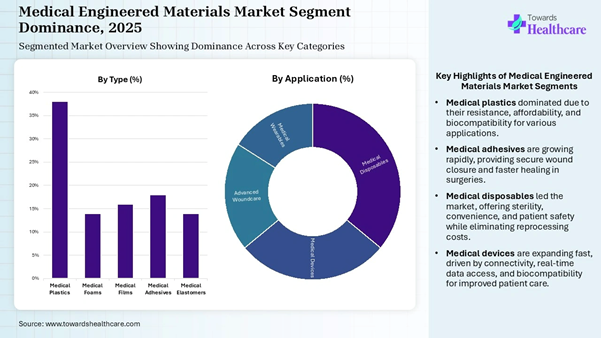
• Medical Plastics dominates the market by 38% due to its widespread use in a variety of medical devices, packaging, and equipment, owing to its durability, flexibility, and cost-effectiveness.
• Medical Foams holds a 14% share, valued for its lightweight, cushioning properties used in wound care, orthopedic applications, and surgical drapes.
• Medical Films represents 16% of the market, widely used in medical packaging, especially for sterilization and moisture barrier properties.
• Medical Adhesives accounts for 18%, essential in device assembly, wound closure, and surgical applications, driven by the demand for non-invasive and secure bonding methods.
• Medical Elastomers holds 14%, prized for their flexibility, resilience, and biocompatibility in a wide range of medical devices and pharmaceutical applications.
The medical plastics segment dominated the market by 38% in 2025, owing to the development of medical devices by the development of medical plastics. It has revolutionized the foundation materials with better materials, such as polyvinyl chloride (PVC) for silicone tubing, IV bags, and tubing for balloons and catheters. It has also enhanced fluoropolymers for IV catheters and polyolefins for trays and bottles.
The medical adhesives segment is expected to grow at the fastest rate in the medical engineered materials market due to the rise of key players such as Medtronic, 3M Company, and Nitto Denko to meet the rising demand for enhanced patient comfort, extended wear, and improved medical devices. Medical-grade adhesives have wide applications in the manufacture of medical fixation materials. Biological adhesives are used in surgical procedures, like wound suturing and skin grafting.
Application Insights
|
Segment |
Market Share (%) |
|
Medical Disposables |
36% |
|
Medical Devices |
28% |
|
Medical Wearables |
16% |
|
Advanced Wound Care |
20% |
Explanation:
• Medical Disposables leads the market with a 36% share, driven by the high demand for single-use products like syringes, gloves, and diagnostic kits, ensuring safety and reducing the risk of cross-contamination.
• Medical Devices holds a 28% share, growing with the increasing reliance on advanced diagnostic, therapeutic, and monitoring equipment in healthcare settings.
• Medical Wearables accounts for 16%, gaining momentum due to the rise in health-conscious consumers and the growing demand for continuous health monitoring and management technologies.
• Advanced Wound Care represents 20% of the market, driven by the need for innovative wound management solutions, particularly in chronic and complex wound treatment, improving patient outcomes and recovery times.
The medical disposable segment dominated the market by 36% in 2025, owing to the essential role of disposable medical supplies in healthcare. The disposable medical devices include hypodermic needles, bandages, gloves, exam gowns, and face masks. They serve to prevent cross-contamination between patients in medical settings.
The medical devices segment is expected to grow at the fastest rate in the medical engineered materials market due to the safety, improved clinical performance, and assembly of medical products and medical devices. The growing demand for advanced medical technologies for chronic disease management fuels the growth of medical devices. Furthermore, 3D printing, additive manufacturing, bioreabsorbable materials, smart materials, and nanotechnology are gaining traction in the medical devices industry.
Get the latest insights on healthcare industry segmentation with our Annual Membership: https://www.towardshealthcare.com/get-an-annual-membership
Medical Engineered Materials Market: Regional Analysis
|
Region |
Market Share (%) |
|
Asia Pacific |
34% |
|
North America |
27% |
|
Europe |
22% |
|
Latin America |
9% |
|
MEA |
8% |
Explanation:
• Asia Pacific dominates the market with a 34% share, driven by the rapid growth in healthcare infrastructure, increasing demand for medical devices, and a large manufacturing base in countries like China and India.
• North America holds a 27% share, supported by the high demand for advanced medical technologies and a strong healthcare system in the U.S. and Canada.
• Europe accounts for 22%, with a strong focus on medical research, innovation, and advanced healthcare systems in countries like Germany, the UK, and France.
• Latin America represents 9% of the market, growing steadily as healthcare access and investment in medical technology expand across the region.
• MEA holds 8% of the market, driven by improving healthcare infrastructure and increasing healthcare investments in the Middle East and Africa, though it remains a smaller segment compared to other regions.
Asia Pacific Leads the Medical Technology Market in 2025
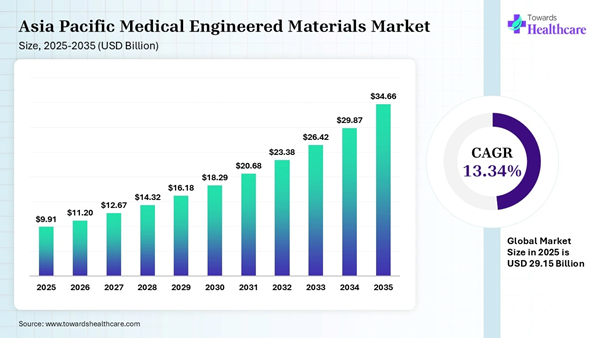
Asia Pacific dominated the market by 34% share in 2025, owing to the expanding healthcare infrastructure, the rising demand for minimally invasive surgery, the growing trend of 3D printing, and the growth in medical disposables. The Asia Pacific Medical Technology Association (APACMed) introduces manufacturers and suppliers of medical equipment, in vitro diagnostics, and related medical devices. It has set a goal to improve the standards of care for patients through strategic partnerships among stakeholders to shape the future of healthcare in the Asia Pacific region. The APACMed also represents industry associations and other major stakeholders associated with the medical technology industry in this region.
For instance,
• In September 2024, the Information Technology and Innovation Foundation (ITIF) reported that China is rapidly becoming the leading innovator in advanced industries, including biopharmaceuticals, robotics, AI, and chemicals. The Chinese Communist Party makes dedicated efforts to dominate global markets.
India Market Analysis
The medical engineered materials market in India is witnessing the growing need for advanced surgical materials, the growing trend of medical tourism, and affordable medical procedures. India is emerging as the global leader in advanced health technologies, which is dedicated to meeting diverse healthcare needs.
• In September 2025, Shri Jagat Prakash Nadda, the Union Minister for Health and Family Welfare and Chemicals and Fertilizers, proclaimed that the MedTech sector plays a pivotal role in the healthcare transformation in India. He reported the central role of this sector in delivering advanced devices, diagnostics, digital health, and AI-driven solutions. These solutions contribute to more efficient, affordable, and accessible healthcare and innovation for every citizen.
North America's Growth in Medical Technology: Driven by Innovation and Government Support
North America is expected to grow at the fastest rate in the market due to the rapid adoption of medical wearables, digital health, biosensors, and regulatory support that streamlines the approval process for novel engineered materials. The North American government programs were committed to advancing domestic manufacturing for essential medical materials and medical devices. In January 2025, the Biden-Harris Administration awarded the Semiconductor Research Corporation Manufacturing Consortium Corporation with the investment of $285 million for the new chips manufacturing USA institute for digital twins. The virtual models, like digital twins, are used by researchers and engineers to design, develop, and test processes.
For instance,
• In October 2024, the National Institute of Standards and Technology (NIST) awarded two organizations up to $1.5 million to support the development of regenerative medicine. It aims to train the current and future regenerative medicine workforce, dedicated to cell therapy, gene therapy, and therapeutic tissue engineering.
U.S. Market Trends
The medical engineered materials market in the U.S. is advancing due to the rising demand for specialized materials that support minimally invasive surgical tools, which reduce hospital stays and recovery times. In December 2025, Amgen announced that it had taken action with the U.S. government to lower prices of medicines for American patients, which shows Amgen’s commitment to innovation. The U.S. leads globally in biopharmaceutical innovation, and Amgen aims to continue this innovation with the U.S. government globally.
For instance,
• In September 2025, the U.S. Commerce Department reported the inauguration of the national security investigations into the import of medical items, personal protective equipment, robotics, and industrial machinery. This initiative applies to even higher tariffs on a wide range of medical and industrial goods, such as syringes, imported face masks, and infusion pumps.
Elevate your healthcare strategy with Towards Healthcare. Enhance efficiency and drive better outcomes schedule a call today: https://www.towardshealthcare.com/schedule-meeting
Medical Engineered Materials Market Companies
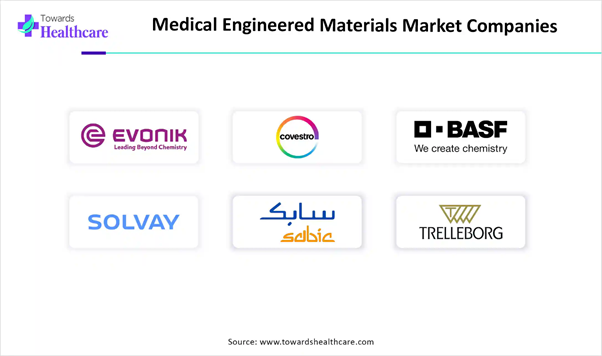
➢ Solvay
➢ SABIC
➢ Evonik Industries AG
➢ Covestro AG
➢ BASF SE
➢ Trelleborg AB
➢ Celanese Corporation
➢ 3M Company
➢ DSM Biomedical
Segments Covered in the Report
By Type
• Medical Plastics
• Medical Foams
• Medical Films
• Medical Adhesives
• Medical Elastomer
By Application
• Medical Devices
○ Diagnostic Equipment
○ Surgical Equipment
○ Dental Tools
○ Others
• Medical Disposables
○ Surgical Instrument & Supplies
○ Diagnostic & Laboratory Disposables
○ Medical & Laboratory Gloves
○ Others
• Medical Wearables
○ Smart Watch
○ Activity Monitor
○ Patches
○ Others
• Advanced Woundcare
○ Dressings
○ Devices & Accessories
○ Graft & Matrices
○ Others
By Region
• North America
○ U.S.
○ Canada
○ Mexico
○ Rest of North America
• South America
○ Brazil
○ Argentina
○ Rest of South America
• Europe
○ Western Europe
■ Germany
■ Italy
■ France
■ Netherlands
■ Spain
■ Portugal
■ Belgium
■ Ireland
■ UK
■ Iceland
■ Switzerland
■ Poland
■ Rest of Western Europe
○ Eastern Europe
■ Austria
■ Russia & Belarus
■ Türkiye
■ Albania
■ Rest of Eastern Europe
• Asia Pacific
○ China
○ Taiwan
○ India
○ Japan
○ Australia and New Zealand
○ ASEAN Countries (Singapore, Malaysia)
○ South Korea
○ Rest of APAC
• MEA
○ GCC Countries
■ Saudi Arabia
■ United Arab Emirates (UAE)
■ Qatar
■ Kuwait
■ Oman
■ Bahrain
○ South Africa
○ Egypt
○ Rest of MEA
Immediate Delivery Available | Buy This Premium Research @ https://www.towardshealthcare.com/checkout/6608
About Us
Towards Healthcare is a leading global provider of technological solutions, clinical research services, and advanced analytics, with a strong emphasis on life science research. Dedicated to advancing innovation in the life sciences sector, we build strategic partnerships that generate actionable insights and transformative breakthroughs. As a global strategy consulting firm, we empower life science leaders to gain a competitive edge, drive research excellence, and accelerate sustainable growth.
You can place an order or ask any questions, please feel free to contact us at sales@towardshealthcare.com
Europe Region: +44 778 256 0738
North America Region: +1 8044 4193 44
APAC Region: +91 9356 9282 04
Web: https://www.towardshealthcare.com
Precedence Research | Towards Packaging | Towards Food and Beverages | Towards Chemical and Materials | Towards Dental | Towards EV Solutions | Healthcare Webwire
Find us on social platforms: LinkedIn | Twitter | Instagram | Medium | Pinterest
Browse More Insights of Towards Healthcare:
The global market for engineered materials science solutions in healthcare was valued at USD 23 billion in 2025. This market is expected to grow from USD 25.99 billion in 2026 to approximately USD 78.08 billion by 2035, at a compound annual growth rate (CAGR) of 13% between 2026 and 2035.
The global medical device engineering market was valued at USD 9.96 billion in 2025. It is projected to grow from USD 10.97 billion in 2026 to around USD 26.16 billion by 2035, expanding at a CAGR of 10.14% from 2026 to 2035.
The global protein engineering market was valued at USD 3.08 billion in 2024, growing to USD 3.58 billion in 2025, and is expected to reach approximately USD 13.84 billion by 2034. This market is growing at a CAGR of 16.27% between 2025 and 2034.
The global synthetic tissue engineering market was valued at USD 1.72 billion in 2025. It is expected to grow to USD 1.97 billion in 2026 and is projected to reach about USD 6.47 billion by 2035, expanding at a CAGR of 14.14% between 2026 and 2035.
The market for medical device gaskets and seals was valued at USD 0.92 billion in 2023. This market is projected to grow to USD 1.57 billion by 2034, increasing at a CAGR of 5% from 2024 to 2034.
The biomedical refrigerator market was valued at USD 2.02 billion in 2023. It is projected to grow to USD 3.64 billion by 2034, rising at a CAGR of 5.5% from 2024 to 2034.
The global cell therapy raw materials market was valued at USD 6.76 billion in 2025, growing to USD 8.42 billion in 2026, and is projected to reach approximately USD 60.49 billion by 2035. This market is expanding at a CAGR of 24.5% from 2026 to 2035.
The mRNA vaccine raw materials market is experiencing significant growth, with projections indicating a substantial revenue increase by the end of the forecast period, from 2026 to 2035.
The global cell therapy human raw materials market was valued at USD 2.91 billion in 2023 and is expected to grow to USD 22.75 billion by 2034, increasing at a CAGR of 22.38% from 2023 to 2034.
The global lipid nanoparticle raw materials market is projected to reach USD 522.01 million by 2035, up from USD 300.72 million in 2025, growing at an annual rate of 5.67% during the forecast period from 2025 to 2035.

