
“As approvals accelerate, manufacturing scales and safety scrutiny intensifies simultaneously, market intelligence has stopped being a convenience for the CGT ecosystem and become a condition of doing business”- Payal Rabde, Research & Data Analytics
Towards Healthcare Research & Consulting, a global healthcare market intelligence and strategic advisory firm, today announced the availability of its Cell & Gene Therapy Intelligence Dashboard, a decision-support platform built to give pharmaceutical companies, biotechnology developers, CDMOs, investors, and regulatory affairs teams a continuously updated view of an industry that is now moving too fast, and carrying too much capital and clinical risk, to be tracked through quarterly reports and scattered press coverage alone.
An Industry That No Longer Moves on an Annual Clock
I have spent more than two decades advising life sciences organizations on market entry, competitive positioning, and portfolio strategy, and I have not seen a therapeutic category compress this much consequence into this short a timeframe. Cell and gene therapy is simultaneously in its adolescence and its reckoning.
The regulatory pathway that began with Kymriah's 2017 approval has now produced roughly 49 approved cell and gene therapies in the United States, according to industry tracking cited by Contract Pharma, with the field expected to add another 10 to 20 approvals a year going forward. At the same time, 2025 delivered one of the sector's sharpest reminders that commercialization and safety are not separate workstreams they are the same workstream, and organizations that fail to monitor both in real time expose themselves to reputational, regulatory, and balance-sheet risk within a matter of weeks.
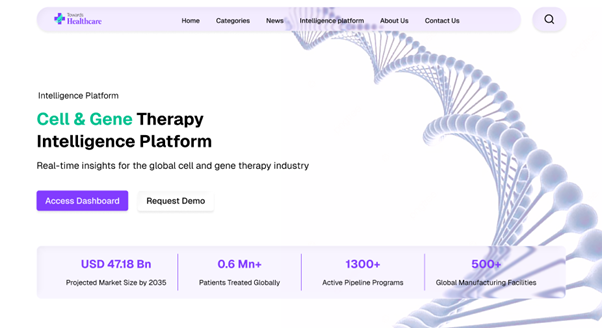
This is the operating environment the Towards Healthcare Cell & Gene Therapy Intelligence Dashboard was built for. Not a static report that ages the moment it is published, but a living instrument that tracks pipeline movement, regulatory designation changes, manufacturing capacity, and capital flows as they happen.
“Insight drives every successful commercialization strategy but only if it arrives before the decision, not after it.”
Connect with me to explore customized market intelligence and the Cell & Gene Therapy Intelligence Dashboard: https://www.towardshealthcare.com/schedule-meeting
The Science Has Diversified Faster Than Most Commercial Teams Have Adapted
Cell and gene therapy is no longer a single modality with a single business model. It is a family of distinct scientific platforms, each with its own manufacturing economics, regulatory posture, and competitive dynamics:
Cell therapy, spanning hematopoietic and mesenchymal stem cell approaches, CAR-T, TCR-T, tumor-infiltrating lymphocyte (TIL) therapy, NK cell therapy, and emerging macrophage and dendritic cell platforms, held approximately 64.78% of global cell and gene therapy market revenue in 2025, according to Towards Healthcare's market sizing (Report Code: 5052).
Gene therapy, delivered through in-vivo or ex-vivo approaches, accounted for the remaining 35.22% and is forecast to grow at the faster rate of the two segments through 2035.
Viral vector delivery principally AAV, lentivirus, retrovirus, and adenovirus platforms remains dominant, commanding 72.20% of the market by vector type in 2025, while non-viral delivery, including lipid nanoparticles and electroporation-based systems, held 27.80% and is scaling quickly on the strength of improved safety profiles and manufacturing economics.
Gene editing has itself fragmented into competing technical schools of thought: CRISPR-Cas9 nuclease editing, base editing, and prime editing each carry different precision, off-target, and regulatory risk profiles, a distinction that is no longer academic now that clinical-stage safety signals have started to differentiate them in the eyes of regulators and investors alike.
Where innovation accelerates, intelligence becomes indispensable. A commercial strategy team benchmarking a CAR-T asset against TCR-T and NK-cell competitors is not making one comparison it is making a dozen, across efficacy, manufacturing turnaround time, cost of goods, and reimbursement posture, often before a single peer-reviewed data set is public. The Towards Healthcare dashboard consolidates these comparative data points into a single competitive view rather than requiring analysts to reconstruct them from conference abstracts and earnings call transcripts.
Every approval changes the competitive landscape the question is whether your organization sees it change in real time or reads about it a quarter later.
Manufacturing Has Become the Industry's Central Strategic Battleground
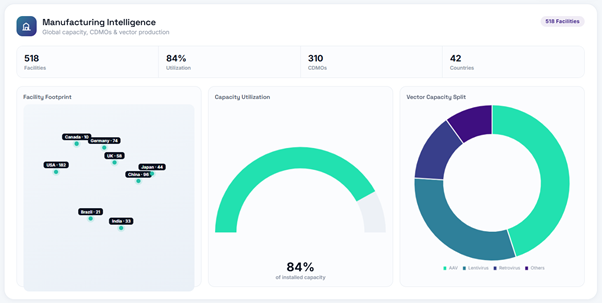
If clinical development defined the first decade of cell and gene therapy, manufacturing capacity is defining this one. The CDMO segment of the cell and gene therapy market alone was valued at approximately USD 3.14 billion in the United States in 2025 and is projected to reach USD 37.5 billion by 2035 at a CAGR of 28.15%, according to Towards Healthcare's CDMO-specific market sizing a growth rate that outpaces the broader therapeutic market because so much of the sector's near-term bottleneck sits in vector production, cleanroom capacity, and closed-system automation rather than in science itself.
The past eighteen months have produced a wave of capacity commitments that illustrate how seriously the industry is treating this constraint. Fujifilm Diosynth committed roughly USD 2 billion to a new gene therapy manufacturing facility in North Carolina, a move widely read as positioning against BIOSECURE Act-driven supply chain shifts away from Chinese manufacturing partners. Lonza expanded viral vector capacity by approximately 50% across its Houston and Visp, Switzerland facilities between 2024 and 2025 to meet accelerating demand.
In August 2025, Lonza also partnered with Excellos and Akadeum Life Sciences specifically to improve upstream cell therapy starting-material quality a sign that manufacturing competition has moved beyond raw capacity into process consistency and yield optimization. Catalent, now under Novo Holdings ownership following the largest CDMO transaction in the sector's history, has continued expanding its OneBio manufacturing platform across biologics, cell and gene therapy, and mRNA production. Meanwhile, India is emerging as a genuine alternative manufacturing hub, with hubs in Hyderabad, Bengaluru, and Pune scaling GMP-grade capacity at a reported 27% growth rate the fastest of any national market.
Get in Touch with Us: Have questions or need tailored healthcare market intelligence? Contact our team today. https://www.towardshealthcare.com/contact-us
From pipeline to commercialization, every milestone matters and increasingly, so does every square foot of cleanroom capacity behind it. Organizations evaluating CDMO partnerships, assessing regional manufacturing exposure, or benchmarking cost-of-goods trajectories need continuously updated visibility into facility additions, technology transfer announcements, and capacity utilization precisely the kind of fragmented, fast-moving information the Towards Healthcare CDMO Landscape module was designed to consolidate.
The Capital Environment Has Turned More Selective, Not Less Serious
Any credible market intelligence function has to resist the temptation to tell only the growth story. Venture funding into cell and gene therapy has contracted meaningfully since its 2021 peak. According to figures reported in the trade press, venture capital deal volume across biotech broadly fell around 61% between 2021 and 2025, while the number of CGT-specific deals dropped by roughly 66% over the same period, with average CGT venture round sizes down to approximately USD 60 million in 2025. Some organizations have pulled back from the space entirely: Galapagos wound down its cell therapy division in late 2025 after failing to find a buyer, and Takeda has redirected its own research emphasis away from cell therapy toward small molecules, biologics, and antibody-drug conjugates.
Turn industry complexity into strategic clarity because the funding contraction is not uniform, and treating it as a single narrative would mislead as much as it informs. Roughly half of remaining CGT venture activity is concentrated in Series B rounds, the inflection point where companies move from platform validation into clinical proof-of-concept, suggesting investors are still willing to fund derisked, later-stage science even as they avoid platform-stage speculation. Notable late-2025 and 2026 financings include Orca Bio's USD 250 million round, Dispatch Bio's USD 216 million raise, and Allogene Therapeutics' USD 200.4 million financing, alongside Souffle Therapeutics' USD 200 million Series A for targeted siRNA delivery. Strategic M&A has, if anything, intensified even as venture funding cooled: AbbVie's acquisition of Capstan Therapeutics, which develops in-vivo CAR-T and RNA delivery platforms, closed in August 2025 with up to USD 2.1 billion in upfront consideration, while Eli Lilly's acquisition of Adverum Biotechnologies in October 2025 extended large pharma's continued appetite for gene therapy delivery assets even as smaller developers struggle to raise.
The right data transforms decisions into opportunities. For investors and corporate development teams, distinguishing between a sector in retreat and a sector in disciplined consolidation is exactly the kind of judgment call that benefits from continuously updated funding, M&A, and licensing data rather than a single backward-looking annual report.
Regulatory Momentum Continues, But So Does Regulatory Scrutiny
The FDA's approval cadence for cell and gene therapies remains historically strong. The agency approved nine new cellular and gene therapy products in 2024 alone, spanning oncology, hematology and immunotherapy, neurology, genetic disorders, and cardiovascular disease.
Casgevy, the first CRISPR-based therapy approved for sickle cell disease, cleared the FDA in December 2023 alongside Vertex and CRISPR Therapeutics' broader hemoglobinopathy program, while bluebird bio's lovo-cel received approval the same month giving clinicians and payers two curative, mechanistically distinct gene therapies for the same disease within a single approval cycle.
In April 2026, Regeneron's lunsotogene parvec became the first FDA-approved gene therapy for OTOF-related hearing loss, notable both as a genuine first-in-category approval and for the company's decision to supply the therapy free of charge in the U.S. at launch an unusual commercial posture for a one-time gene therapy that market access teams across the industry are watching closely.
But 2025 also delivered the sector's most consequential safety episode in years. Sarepta Therapeutics disclosed three patient deaths associated with Elevidys, its AAV-based Duchenne muscular dystrophy gene therapy, and a related death in a limb-girdle muscular dystrophy trial using the same AAVrh74 vector platform all attributed to acute liver failure. The FDA requested a voluntary shipment suspension in July 2025, placed Sarepta's LGMD gene therapy trials on clinical hold, revoked the AAVrh74 platform's expedited-review designation, and ultimately required a black-box warning and a postmarketing observational study of roughly 200 patients.
Separately, Intellia Therapeutics' in-vivo CRISPR candidate nex-z was placed on clinical hold in October 2025 following a liver toxicity-related death, with the FDA lifting the hold on one Phase 3 trial in January 2026 even as management has publicly acknowledged it cannot yet rule out that the toxicity signal reflects a broader in-vivo CRISPR platform risk rather than a target-specific one.
Real-time intelligence creates competitive advantage nowhere more literally than here. A single safety signal in one AAV-based program can, and did, affect regulatory posture toward an entire vector class, reshaping how competitors, payers, and clinicians evaluate unrelated assets built on the same delivery platform. Organizations that were monitoring RMAT designations, black-box warning proceedings, and clinical hold announcements as they were issued had a materially different strategic picture than those relying on quarterly competitive updates. This is precisely the kind of cross-program regulatory contagion that the Towards Healthcare dashboard's Regulatory Updates and FDA/EMA Approvals modules are built to surface as it develops, not after the fact.
Commercial Execution Is Now the Differentiator, Not Just Approval
Approval is no longer the finish line it once was; commercial execution against manufacturing capacity, treatment center activation, and earlier-line adoption now determines which therapies actually reach patients at scale. Legend Biotech's Carvykti, a BCMA-directed CAR-T therapy for multiple myeloma developed with Johnson & Johnson, generated approximately USD 1.9 billion in net trade sales across full-year 2025, with fourth-quarter sales of USD 555 million reflecting 66% year-over-year growth.
The therapy has now treated more than 10,000 patients across 294 treatment sites globally, supported by manufacturing expansion across facilities in Raritan, New Jersey; Ghent, Belgium; and a Novartis-operated site under a three-way manufacturing agreement with international markets growing 335% year-over-year in 2025 as Carvykti launched across 14 global markets. By contrast, Novartis' Kymriah, the CAR-T therapy that opened this category in 2017, posted a 17% year-over-year sales decline in the most recent reporting period, illustrating how quickly commercial leadership can shift even within an approved, reimbursed modality once competitive and manufacturing dynamics change.
Monitor today's breakthroughs before they reshape tomorrow's market. Commercial strategy and market access teams evaluating where to position a CAR-T or gene therapy launch increasingly need line-of-sight not just into competitor approvals, but into competitor treatment center counts, manufacturing turnaround times, and line-of-therapy penetration data that historically lived across disconnected earnings transcripts, conference presentations, and payer bulletins
Introducing the Towards Healthcare Cell & Gene Therapy Intelligence Dashboard
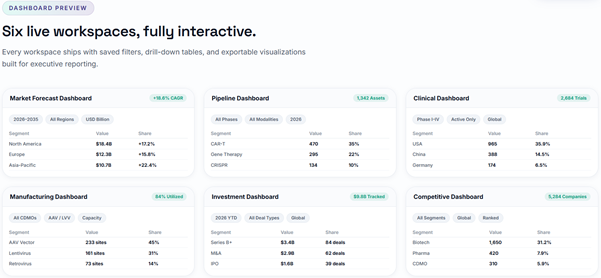
The Towards Healthcare Cell & Gene Therapy Intelligence Dashboard was built to answer a question I hear from clients in nearly every strategy conversation: where do I go to see all of this in one place, updated continuously, rather than piecing it together from a dozen sources every quarter?
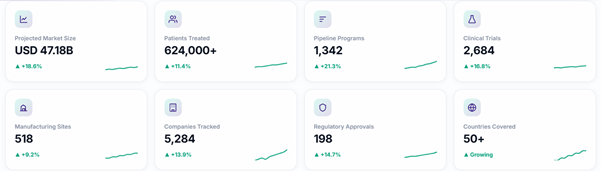
The dashboard consolidates the following intelligence domains into a single decision-support environment:
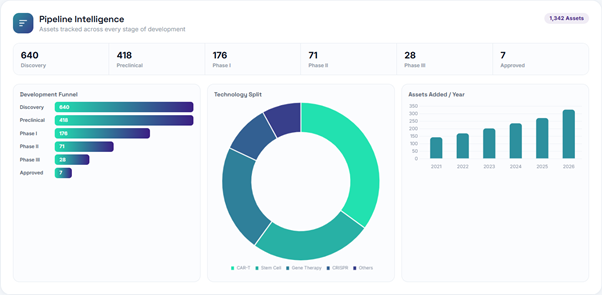
➔ Pipeline Intelligence candidate-level tracking across cell therapy, gene therapy, and gene-editing modalities, from preclinical through pre-registration.
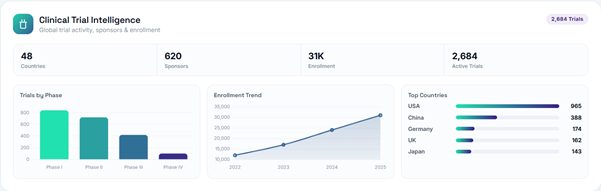
➔ Clinical Trial Intelligence trial status, enrollment, and outcome tracking across CAR-T, TCR-T, NK-cell, stem cell, and in-vivo/ex-vivo gene therapy programs.
➔ FDA and EMA Approval Tracking including RMAT, Fast Track, PRIME, and orphan drug designation activity, so regulatory affairs teams see designation changes as they are issued rather than in a subsequent bulletin.
➔ Company Profiles and Competitive Benchmarking standardized comparative views across developers, from large pharma to emerging biotech, updated as clinical, regulatory, and commercial milestones occur.
➔ Manufacturing Facilities and CDMO Landscape capacity additions, technology transfer announcements, and regional manufacturing footprint shifts, including the CDMO-versus-in-house-versus-hybrid dynamics reshaping sourcing strategy.
➔ Funding and Investment Trends venture financing, private equity activity, and public market movement across the CGT capital stack.
➔ Strategic Partnerships, Licensing Deals, and M&A deal terms, structure, and strategic rationale as transactions close.
➔ Technology Platform Tracking CRISPR, base editing, prime editing, viral and non-viral vector platforms, tracked by clinical maturity and safety profile.
➔ Regional Market Intelligence segment-level data across North America, Europe, Asia Pacific, Latin America, and the Middle East and Africa.
➔ Pricing, Reimbursement, and Commercialization Tracking payer decisions, outcome-based contracting models, and market access developments as they emerge.
➔ Market Sizing and Forecasting continuously updated revenue, patient population, and therapeutic-class forecasts built on Towards Healthcare's proprietary modeling.
Every one-time treatment carries a lifetime of commercial and regulatory consequence the intelligence supporting it should be built to match.
What Executives Are Telling Us
Conversations with clients across biopharma, CDMOs, and institutional investors over the past year point to a consistent set of priorities: manufacturing scale-up risk, regulatory designation volatility following high-profile safety events, the shift of capital toward later-stage and derisked assets, and growing pressure to demonstrate real-world commercial execution rather than approval alone. These are not abstract concerns they are the direct, practical consequence of an industry where approval velocity, capital selectivity, and safety scrutiny are now moving on the same timeline rather than in sequence.
Turn industry complexity into strategic clarity, and turn strategic clarity into competitive position. That is, in one sentence, the value proposition behind continuous market intelligence in this category.
A New Commercial Era, Built on a Foundation That Still Needs Watching Closely
Cell and gene therapy has moved past the question of whether curative, one-time treatments are scientifically achievable. Casgevy, Carvykti, and the therapies that follow them have already answered that question. What remains open and what will determine which organizations lead this category over the next decade is whether companies can manufacture at scale, price and reimburse sustainably, and manage safety signals with the transparency and speed that regulators, clinicians, and patients now expect.
That is why continuous, centralized intelligence has stopped being optional. A market growing at 18.1% annually, with regulatory designations that can be revoked within weeks of a safety signal, and a capital environment that rewards precision over enthusiasm, is not a market that can be navigated on a quarterly cadence. It requires the kind of always-on visibility the Towards Healthcare Cell & Gene Therapy Intelligence Dashboard was purpose-built to provide.
The right intelligence does not predict the future of cell and gene therapy it simply makes sure you are never the last to see it arrive.
Access the Full Market Analysis and Dashboard
Organizations seeking a deeper, continuously updated view of the global cell and gene therapy landscape can access the following resources:
Cell and Gene Intelligence Dashboard: https://www.towardshealthcare.com/cell-gene-intelligence-platform
Towards Healthcare Research and Consulting: https://www.towardshealthcare.com
Sales: sales@towardshealthcare.com
Media Contact
Sanskruti Sathe: sanskruti.s@towardshealthcare.com
General contact: https://www.towardshealthcare.com/contact-us