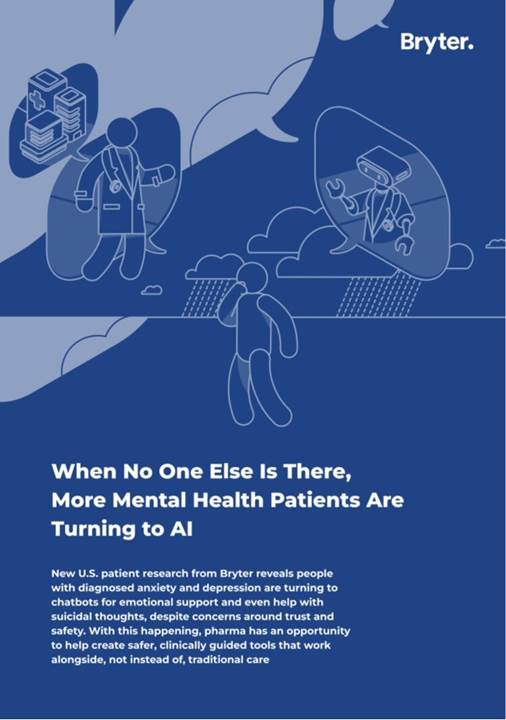
A new report by Bryter released today reveals where pharma can lead as patients turn to (and question) AI tools for mental health.
NEW YORK, February 4, 2020. The research from Bryter, based on surveying
nearly 1000 diagnosed patients with Generalized Anxiety Disorder (GAD) and/or Major
Depressive Disorder (MDD) highlights a clear opening for pharma to lead in AI
chatbot mental health support by building on high trust in traditional
treatments, the report outlines where pharma can win complementing care,
engaging AI users, and addressing safety gaps.
AI
as a complement to established treatment Patients
see AI as an add-on, not a substitute.
Pharma
can use this foundation to develop AI tools that improve adherence and
day-to-day management.
Converting
AI users to be pharma advocates Experience
with AI increases confidence in pharma’s role.
Targeted,
useful AI-driven digital tools can shift skepticism and build trust.
Filling
the accuracy and safety gap Current
AI tools like ChatGPT fall short on credibility and emotional intelligence.
With
86% still relying on general tools like ChatGPT, the market is ready for
clinically vetted alternatives.
Ben Gibbons, Founder & Director of Bryter, said, “Patients
aren’t looking for AI to replace therapy or medication – they want support
that’s available, trustworthy, and human. Our research shows pharma is uniquely
positioned to lead by pairing clinically proven treatments with safe,
transparent AI that genuinely complements care.”
Further insights are available from Bryter's report ‘Is AI helping
or harming Gen Z Americans with mental health conditions?’ at https://www.bryter-global.com/ai-mental-health.
About the survey: The
Bryter AI in Mental Health Survey is an online survey conducted in the US with adults
aged 18+ with a diagnosis of Generalized Anxiety Disorder (GAD) and/or Major
Depressive Disorder (MDD). Bryter survey N=957 patients in December 2025. The
survey was designed, executed and funded by Bryter Inc., New York. Data on
file.
About Bryter: Bryter is a US- and UK-based market research and insight
consultancy specializing in healthcare research. We're committed to delivering
actionable insights for growth and innovation in healthcare and
pharmaceuticals. We go beyond stated importance, helping clients understand
patients' lives and prescriber behavior.
Contact: Ben Gibbons, MD, Bryter,
ben.gibbons@bryter-global.com Company: Bryter Website:
https://www.bryter-global.com/